
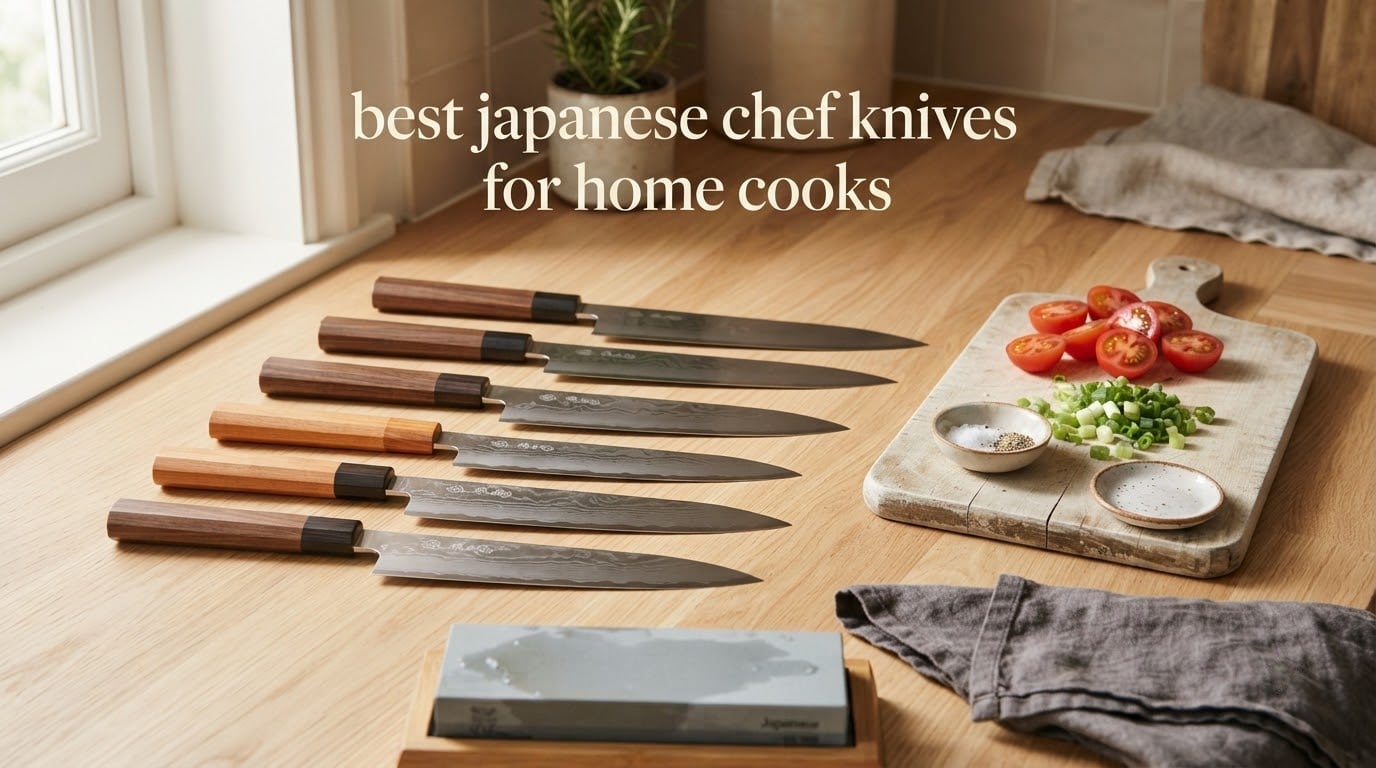
Short answer: the imarku 8 inch gyuto is the best Japanese chef knife for most home cooks right now. It carries a 4.6 star average across more than 10,500 ratings, the largest review base of any knife we evaluated, and it is forgiving enough for someone still learning to hold a blade properly. The one real trade-off of every Japanese chef knife is maintenance tolerance, and that is the line we drew for this roundup.
We compared ten Japanese chef knives across steel type, hardness rating, blade length, weight, handle construction and bevel geometry, then looked at what thousands of owners actually say after months of use. If you want the deeper cut on gyuto geometry, our dedicated guide to Japanese gyuto knives goes further on blade shape and balance.
What separates a Japanese chef knife from a German one is not sharpness alone. It is a thinner, harder, straighter-edged blade built for pull-through slicing, and it expects a different cutting motion than the rocking chop most home cooks learned first. Buy that idea and you get cleaner cuts and an edge that holds far longer between sharpenings. Ignore it, work it like a European chef’s knife, and you will chip the edge inside a month.
This guide is written for people cooking at home a few nights a week, not for line cooks. Every pick below is a real 8 inch chef’s knife you can buy, sharpen yourself, and keep for years. We also explain the four specs that actually decide whether a blade suits your kitchen: steel, hardness, bevel and handle.
Top 3 Picks for the Best Japanese Chef Knives for Home Cooks (October 2026)
These three cover the most common home kitchens. The imarku is the pick for almost everyone, the SHAN ZU is the one to buy if rating scores matter most to you, and the Shun Classic is the choice if you want a knife built in Japan and backed by a lifetime sharpening service.

imarku 8 inch Gyuto
- High carbon stainless steel
- HRC 56-58 hardness
- Pakkawood handle
- 6.56 ounce weight
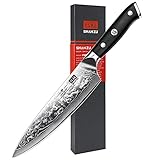
SHAN ZU 8 inch Damascus
- 10Cr15Mov core at 62 HRC
- 67 layer folded Damascus
- Top balanced G10 handle

Shun Classic 8 inch
- VG-MAX core with 68 layer cladding
- 16 degree edge
- Built in Japan
- Free lifetime sharpening
All 10 Japanese Chef Knives Compared in 2026
All ten blades in this roundup at a glance. The Key Features column tells you what each knife is actually made of, because two blades with similar-looking handles can hide very different steel.
| Product | Key Specs | Buy |
|---|---|---|
|
|
Check Latest Price |
|
|
Check Latest Price |
|
|
Check Latest Price |
 |
|
Check Latest Price |
 |
|
Check Latest Price |
 |
|
Check Latest Price |
 |
|
Check Latest Price |
 |
|
Check Latest Price |
 |
|
Check Latest Price |
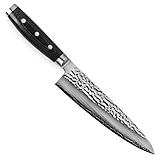 |
|
Check Latest Price |
What Is a Japanese Chef Knife? Meet the Gyuto
A gyuto is the Japanese chef’s knife, and the word literally translates as cow sword. It is Japan’s reinterpretation of a Western chef’s knife, not a copy of it. The curve along the bottom edge is gentler, the tip is a drop point or sheep’s-foot rather than a European clip point, and the steel is ground thinner so the edge can be set at a more acute angle.
That thinner edge is why a gyuto slices instead of chops. You draw the blade back and through the food in a smooth push-pull motion rather than pressing down and rocking the tip against the board. Most home cooks adapt within a week. The ones who struggle are the ones who keep trying to rock, because rocking loads the edge sideways and hard Japanese steel chips instead of rolling over.
It is worth separating made in Japan from Japanese style. Several knives in this roundup are manufactured in Seki, Japan, a city that has produced cutlery for centuries. Others use Japanese steel or a Japanese-inspired profile but are assembled elsewhere, and a few are straightforward high-carbon stainless knives sold in a gyuto shape. Both categories are legitimate; they simply age and behave differently.
The santoku is the other blade you will see constantly. A santoku is shorter, usually around 7 inches, with a higher heel and a flatter spine, which makes it excellent for rocking and for smaller hands. A gyuto is longer and thinner, which makes it better for long slicing strokes and refine work. For a home cook buying one knife, an 8 inch gyuto is the more versatile of the two, and our broader Japanese chef knife roundup covers the difference in more depth.
1. imarku Japanese Chef Knife 8 Inch Gyuto – Best Overall for Home Cooks
imarku Japanese Chef Knife-Sharp Kitchen Knife 8 Inch, Gift for Mom & Dad
8 inch blade
High carbon stainless at HRC 56-58
Pakkawood handle
6.56 oz
The Good
- Sharp out of the box
- High carbon steel holds an edge well
- Light at 6.56 oz
- Corrosion resistant stainless
- Pakka handle stays comfortable
The Bad
- Plain stainless rather than VG10 or Damascus
- Needs frequent honing with heavy use
- Handle shape takes getting used to
This is the knife we recommend to most home cooks, and the reason is unusually simple: it is the most forgiving blade in the group. The steel is high carbon stainless rated at HRC 56-58, which is softer than the 61-plus steels that dominate this list, and softer steel bends rather than chips when your technique wobbles.
At 6.56 ounces it is also the second lightest pick here, and that matters more than spec sheets admit. A home cook with small hands can hold this one through a full session of dinner prep without the wrist ache that heavier blades cause. The pakkawood handle is contoured and narrow enough to work in a pinch grip, and reviewers consistently call out that it stays comfortable through extended use.
Weighing the trade-offs honestly: this is not collector steel. There is no Damascus pattern, no powder metallurgy core, and no hand-forged kurouchi finish. The carbon content of 0.6-0.75% is roughly double what a standard entry knife uses, and 16-18% chrome gives you a blade that resists tarnishing between uses.
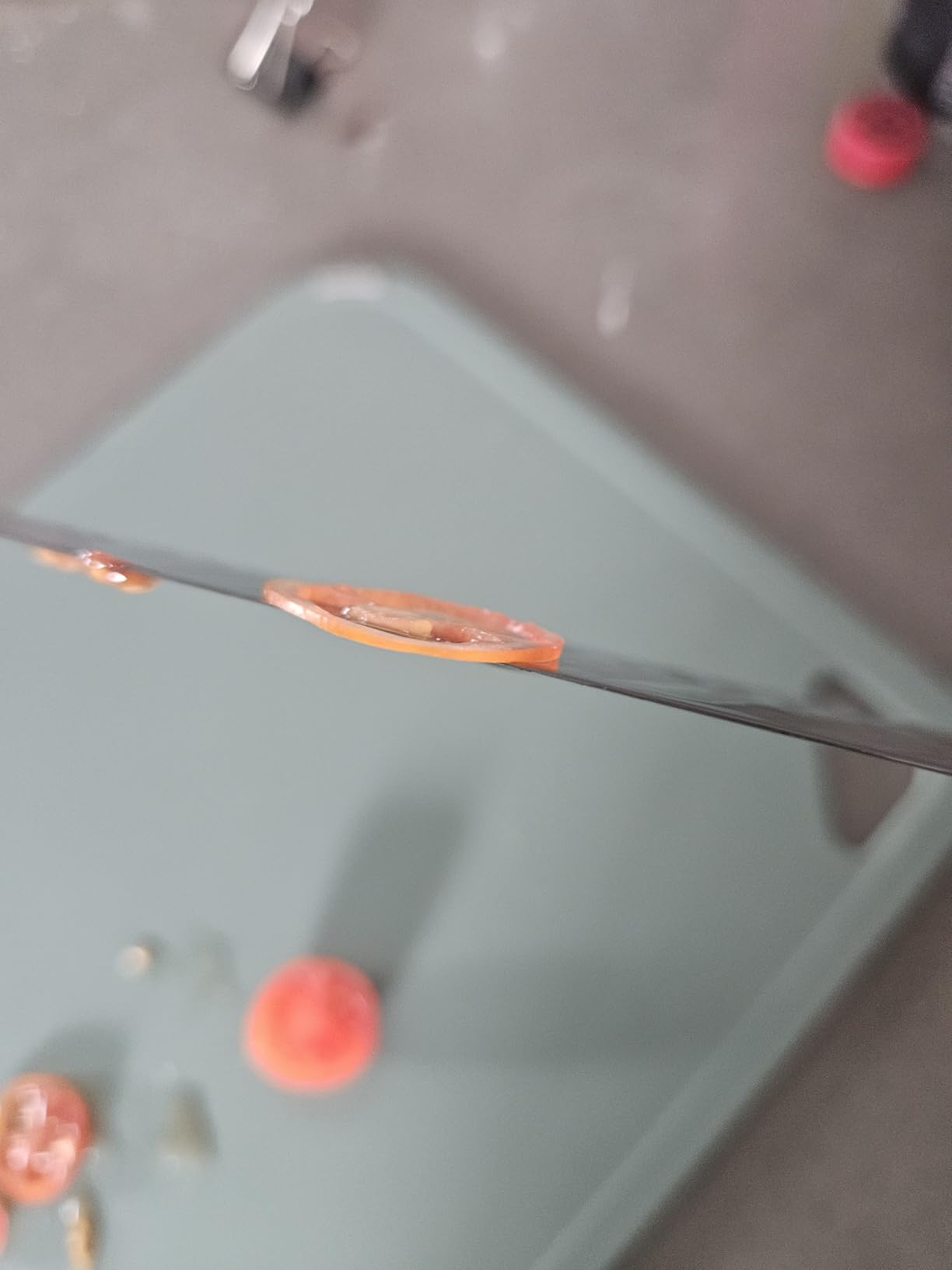
Across more than 10,500 ratings and a 4.6 star average, owners describe the same thing over and over: a dependable value gyuto rather than a trophy knife. Roughly 79% of ratings are five stars, which tells you the disappointment cases are real but uncommon, usually tied to technique rather than manufacturing.
The most common owner advice is to hand-wash and dry immediately. A stainless blade at this hardness will not rust overnight, but leaving it wet for days invites spotting at the edge. Owners also report that a light strop every week keeps the factory edge working through a full month of weeknight cooking.
One more practical note: the imarku is a plain-edge knife with no hollow grind or dimples, so wet or sticky foods like onion skins and raw fish skin will cling a little more than they do on a hammered blade. Wipe the blade frequently and this never becomes an issue.
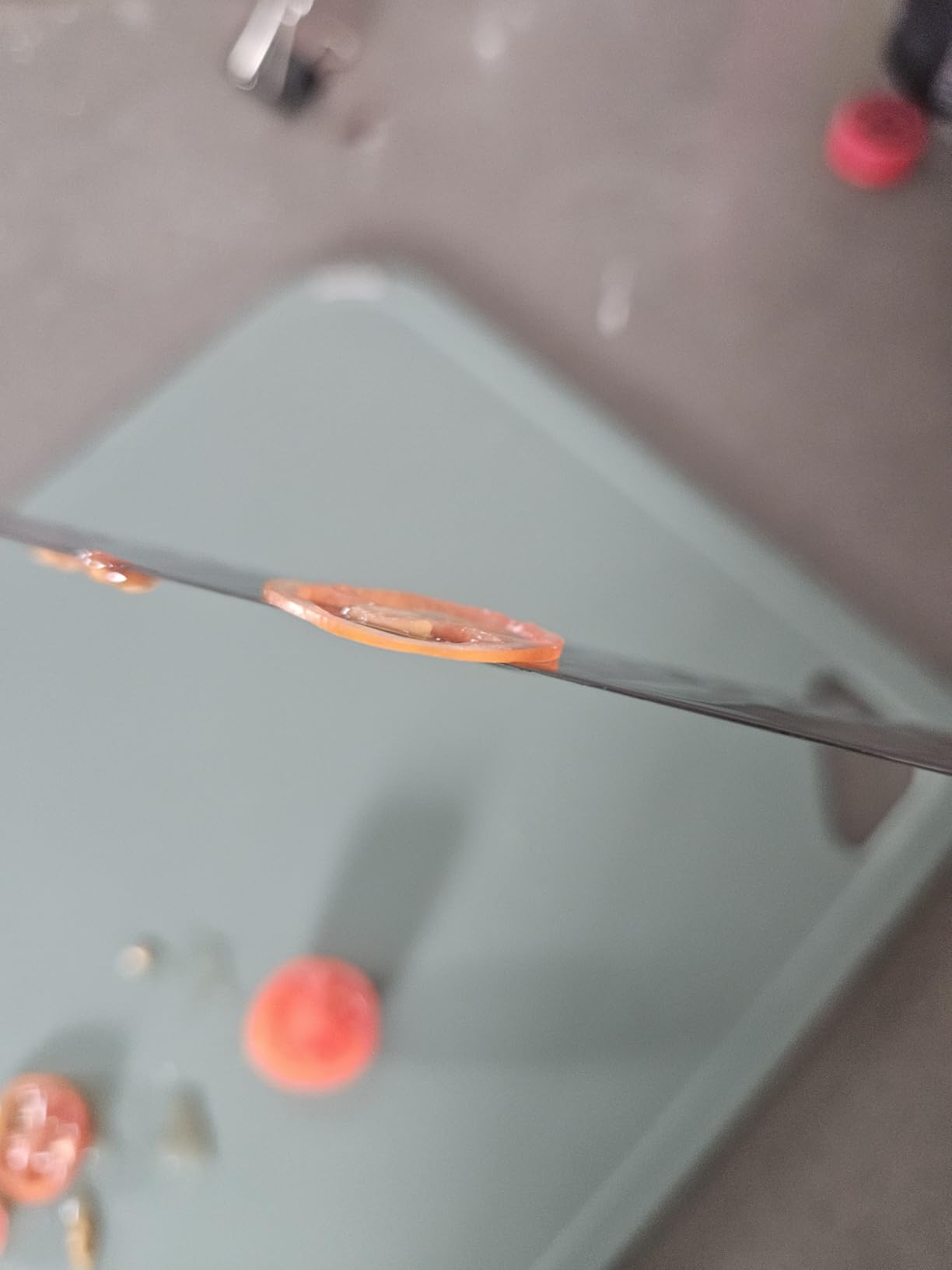
Who the imarku suits
Buy this knife if it is your first Japanese chef knife, if you cook three to five nights a week, and if you would rather not think about maintenance. It also works for cooks who upgrade from a worn knife block and want one blade that handles onions, chicken, herbs and a flank steak without switching tools.
It is a strong fit for anyone learning push-pull technique, because the softer steel forgives the mistakes that come with the transition. If you already slice confidently and want the finest possible edge out of a factory knife, the sharper picks further down the list serve you better.
Where the imarku falls short
You will hone it more often than the harder steel options. Hardness of 56-58 keeps the edge from chipping, but it also means the edge dulls sooner between whetstone sessions. Plan on a strop or ceramic rod every week and a proper sharpen every few months.
The handle shape is the other common gripe, and it is a real one for small hands. The octagonal-style pakka profile is comfortable but not molded to any specific palm, so give it a few dinners before you decide it does not fit.
2. SHAN ZU Chef Knife 8 Inch Damascus – Top Rated by Owner Rating
SHAN ZU Chef Knife 8 Inch Japanese Steel Damascus Kitchen Knife
8 inch blade
10Cr15Mov core at 62 HRC
67 layer Damascus
G10 handle
The Good
- Highest owner rating in the group
- Genuine folded Damascus not etched
- 62 HRC holds an edge well
- G10 grip works when wet
- Top balanced and easy to rock
The Bad
- Synthetic G10 handle lacks warmth
- 62 HRC needs quality stones
- Damascus pattern is subtle up close
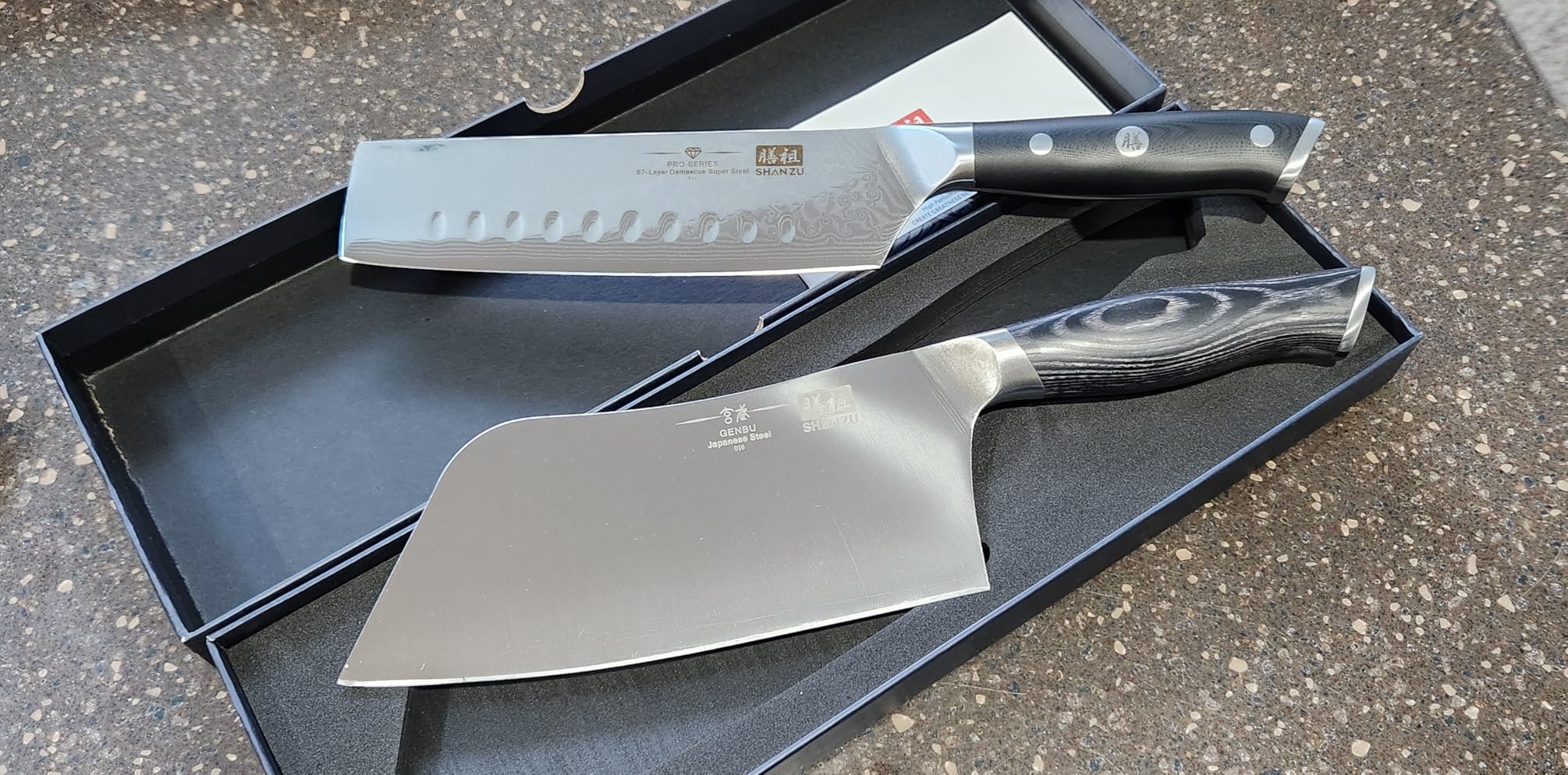
Owners rate this blade at 4.8 stars across 5,679 ratings, the highest average of any knife we evaluated. That is not a marketing number; it is a real satisfaction signal, and it is why we give this knife the value slot. For the money, very few blades deliver a genuinely Japanese steel core and true folded Damascus construction.
The core is 10Cr15Mov, a Japanese stainless hardened to 62 HRC, wrapped in 67 layers of folded carbon steel. The manufacturer confirms these are folded sheets rather than a laser-etched surface pattern, which is the detail that separates a real Damascus build from a cosmetic one. Owners notice the difference in how the blade holds a working edge over months.
At 270 grams with a top-balanced geometry, the knife has enough mass behind the edge to make push cuts land without effort, and enough forward feel that rocking still feels natural if that is the motion you learned first. That makes it the most forgiving of the high-hardness blades on this list for a home cook switching styles.
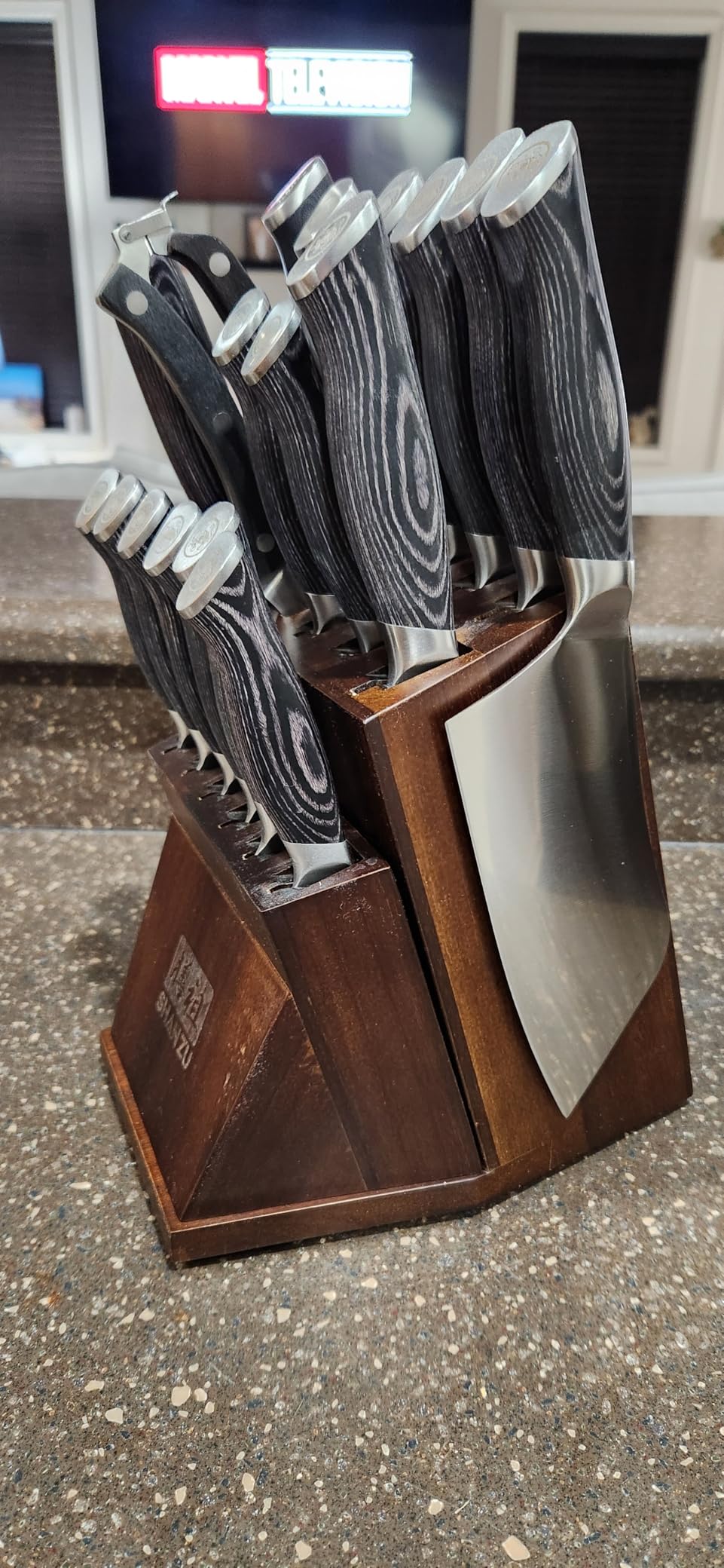
With 86% of ratings at five stars, the complaint pool is narrow. The most common is the handle. G10 glass fiber is a molded synthetic that grips well when wet and shrugs off dishwater temperature swings, but it carries none of the warmth or character of wood, and it will not develop a patina over time.
The second complaint matters more if you plan to sharpen at home. At 62 HRC, a cheap whetstone will glaze and refuse to bite. Reviewers who do their own sharpening report that quality stones make the difference between a satisfying session and a frustrating one, so budget for sharpening gear alongside the knife.
A 15 degree angle per side is a sensible factory edge, sharper than the German norms and blunt enough to survive ordinary use. It also means a strop restores it quickly, which is why owners report long stretches between full sharpenings.
Who the SHAN ZU suits
This is the right pick for a cook who wants a hard, modern Japanese steel edge but does not want traditional construction or a thin wa handle. It suits anyone upgrading from a Henckels or Wusthof block who wants a visibly different cutting result from day one.
It is also a solid gift option. The Damascus pattern reads as premium, the balance is neutral, and the 12-month warranty covers manufacturing defects, which is enough reassurance for a first-time buyer.
Where the SHAN ZU falls short
It is a full-tang synthetic-handle knife, not a traditional Japanese chef’s knife, so if you wanted a wa-handle magnolia grip or a hand-forged kurouchi finish you will not find it here. That is not a flaw, it is a different design philosophy.
The blade thickness of 2.2 mm and a 2.5 inch width make it a fairly standard profile, which means it will not deliver the ultra-thin slicing feel of a dedicated Japanese blade. If your priority is the thinnest possible cross-section, the Enso HD further down is closer.
3. Shun Classic 8 Inch Chef Knife – Best Built in Japan
Shun Classic 8″ Chef’s Knife
8 inch blade
VG-MAX core with 68 layer cladding
16 degree edge
Pakkawood D handle
The Good
- Exceptional factory sharpness
- Light at 10.88 oz with real balance
- D shaped pakka handle suits either hand
- Free lifetime sharpening service
- Handcrafted in Japan
The Bad
- Thin edge chips with careless use
- Higher cost than entry gyutos
- D handle feels large for small hands
- Needs regular honing
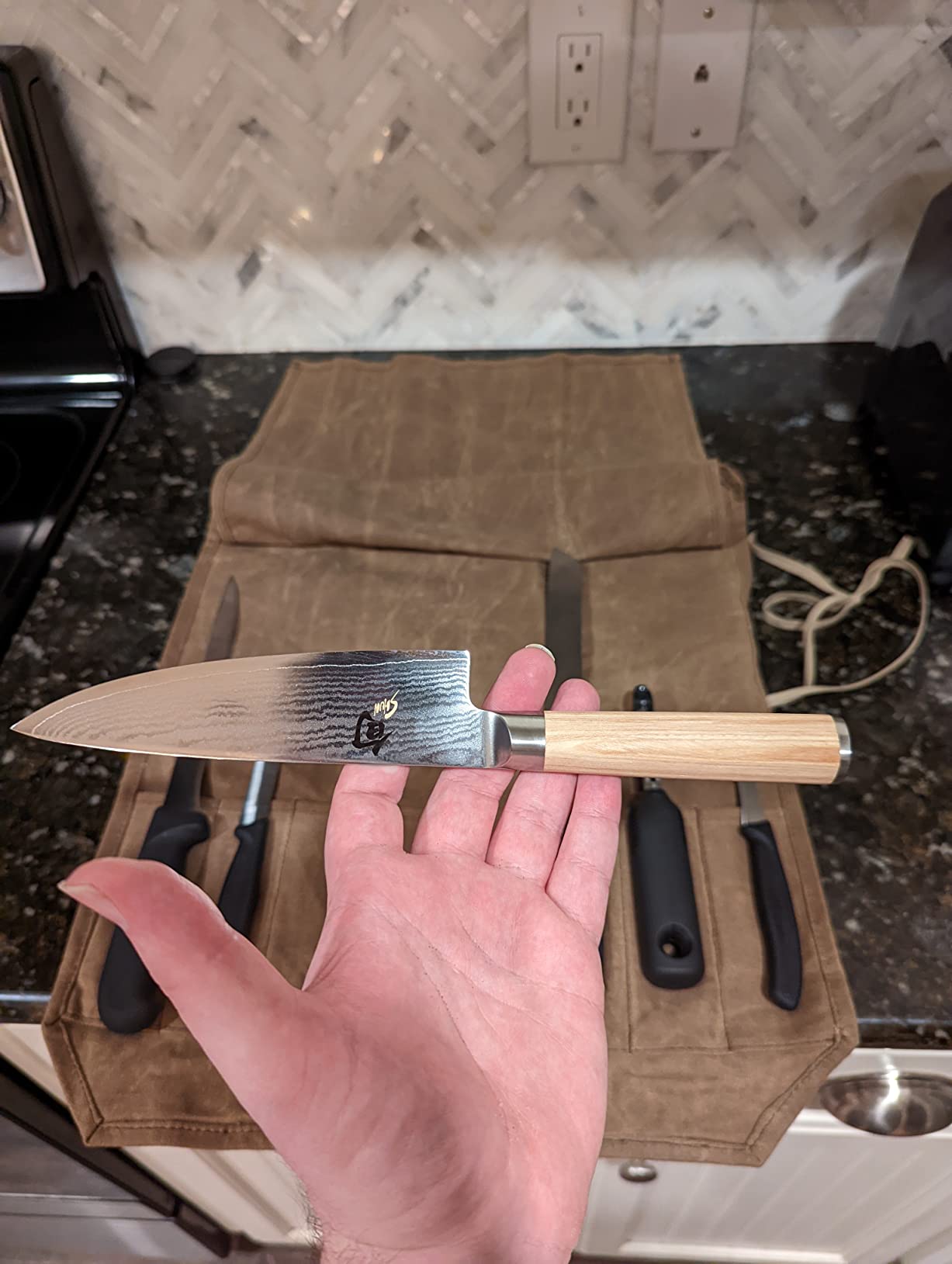
The Shun Classic is the only knife here handcrafted in Japan by Kai and paired with a free lifetime sharpening service, and for a home cook that combination is unusually practical. You send it back once a year, and you get back a factory edge without learning whetstone technique or spending on stones.
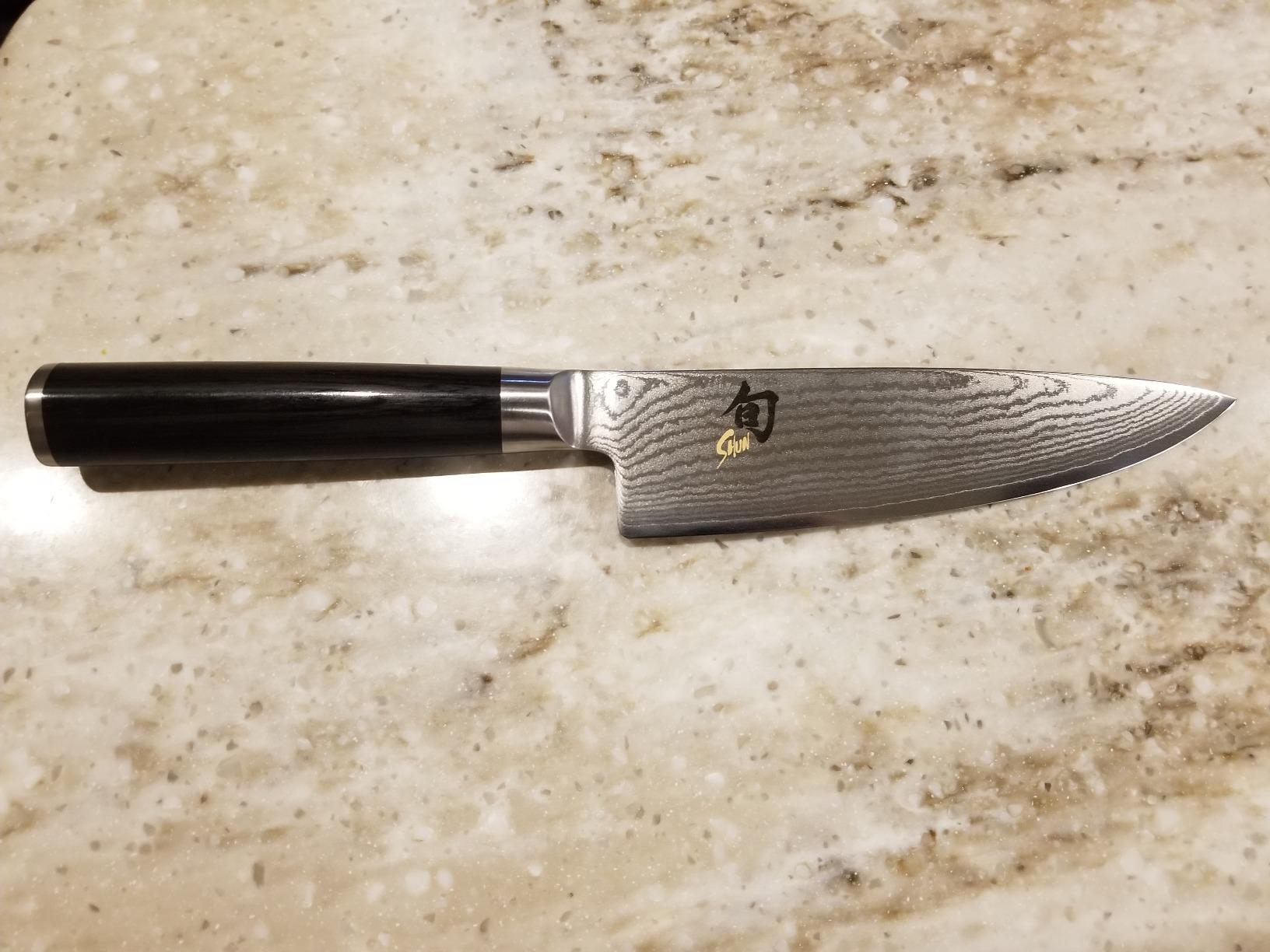
The core is VG-MAX, a Japanese carbon steel known for holding a very fine edge, clad in 68 layers of Damascus stainless. The factory edge is sharpened to 16 degrees per side, and owners consistently describe first-use sharpness as exceptional, particularly on tomatoes, onions and herbs.
At 10.88 ounces this is a heavier pick, but reviewers report that the weight is well distributed rather than concentrated in the handle. The D-shaped pakkawood handle has a lengthwise ridge that stops the knife rolling on a wet board, and its symmetrical shape works for cooks of either handedness.
With 4.7 stars across 3,808 ratings and 88% five stars, this is a well-liked knife. Long-form reviews keep coming back to the same comparison: cooks moving from Wusthof or Henckels describe the Shun as noticeably sharper and lighter in the hand, and professional cooks rate it as a good balance of quality and durability for a working kitchen.
The recurring warning is chipping. A thin profile sharpened to 16 degrees will not roll over the way a German knife does; if you hit a hard bone or cut on glass, you can take a nick out of it. That is the cost of the fine factory edge, and it is a fair one for a cook who uses a soft wood or plastic board.
Rust is the second warning. The Damascus cladding is stainless, but a knife left wet overnight will spot, and long-form reviews mention exactly that failure mode. Hand wash, dry immediately, and store it away from a dripping sink edge.
Who the Shun Classic suits
Pick it if you cook most nights, if you value a fine factory edge plus a sharpening service over learning to sharpen, and if you want a knife that was actually made in Japan. It is also the safest choice as a gift for a cook who has never sharpened a knife in their life.
Because the handle is symmetrical and the edge is a standard double bevel, it works for right-handed and left-handed cooks without adjustment, which is not true of every asymmetrical Japanese blade.
Where the Shun Classic falls short
Some users find the D-shaped handle unfamiliar, and cooks with small hands report it feels oversized. If you have short fingers, look at the Kimura or the SHAN ZU, both of which have slimmer grips.
It is also a finesse knife. The thin edge and 16 degree angle are not designed for bone work, and the edge wants more frequent honing than a German steel blade of the same age. Treat it as your slicing and prep knife rather than your everything blade.
4. Dalstrong 8 Inch Gyuto AUS-10V – Best Factory Sharpness
Dalstrong 8″ Japanese Chef Knife Gyuto – 66-Layer Damascus AUS-10V
8 inch blade
AUS-10V core at 62+ HRC
8-12 degree edge
Tall heel G10 handle
The Good
- Sharpest factory edge we found
- Hammered finish cuts sticking
- Full tang with durable G10
- Tall heel gives great knuckle clearance
- Strong customer service
The Bad
- Tall heel will not fit most knife blocks
- Heavy for small hands
- Rare finish or bend complaints
- Honed best with a strop
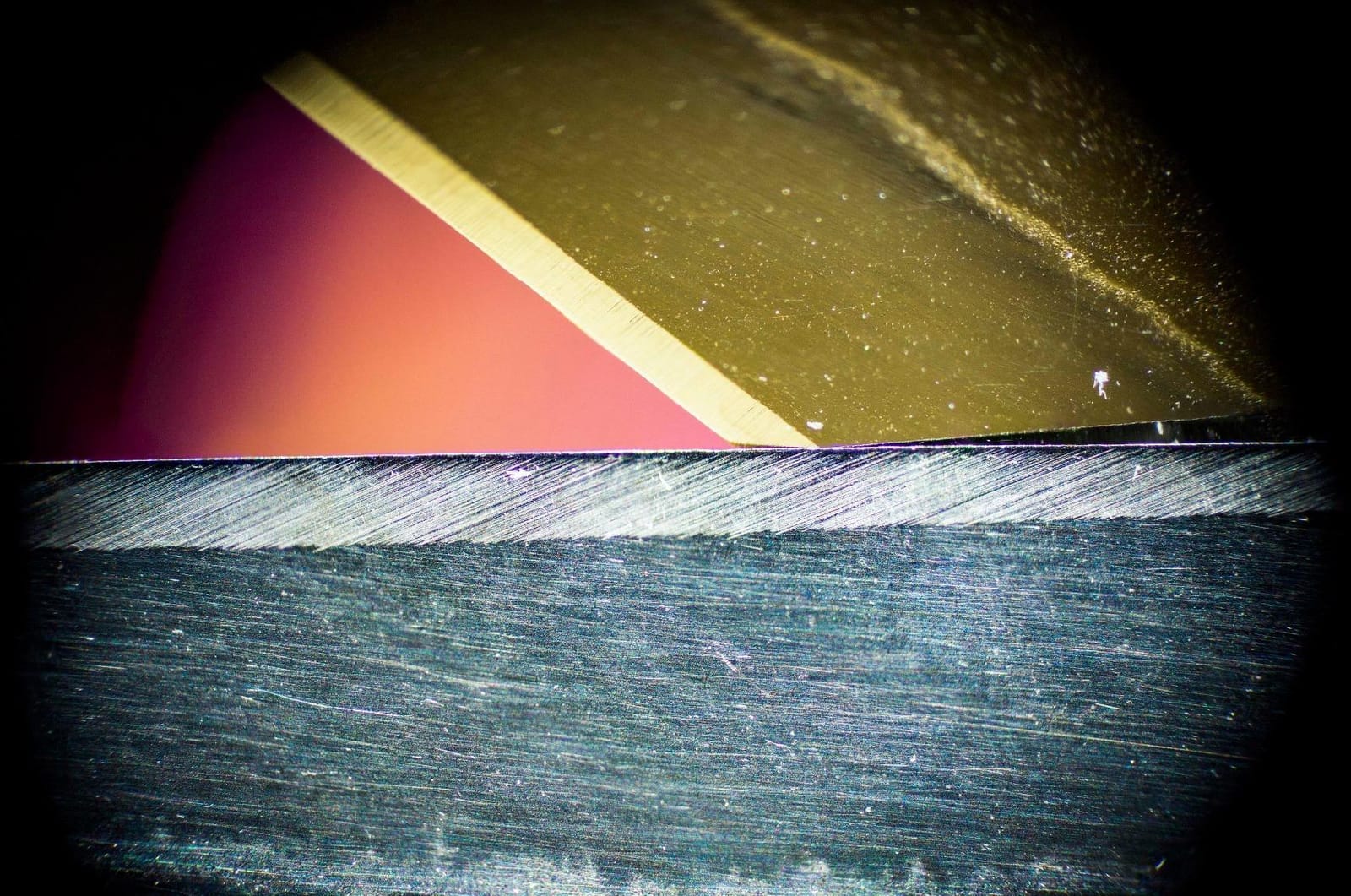
The Dalstrong is the sharpest knife out of the box in this entire roundup, and owners confirm it with the most specific testing we found: paper-thin tomato slices on the first cut, without any sharpening beforehand. The core is Japanese AUS-10V steel at 62+ Rockwell, hand-finished to an 8-12 degree edge per side, which is about as acute as a factory edge gets.
That acute edge is also what makes this the most demanding pick here. An 8-12 degree bevel takes more skill to maintain than a 15 degree one, and owners consistently note that traditional honing rods can blunt an edge this fine. A leather strop is the tool that works.
At 9.6 ounces the weight is manageable, but the tall heel is the defining physical feature. A high blade gives your knuckles clearance so you can rock or push without your hand hitting the spine, and it also scoops diced onion straight off the board. Reviewers single this out as the most useful thing about the knife.
At 4.7 stars across 2,714 ratings with 84% five stars, the satisfaction level is high and the complaint pattern is about physical fit rather than performance. The tall heel means this knife will not drop into many standard knife block slots, so plan on a magnetic strip or a block with wide slots. Our carbon steel knife guide covers storage options in more depth.
The hammered tsuchime finish is genuinely useful rather than decorative. Dimples create small air pockets between blade and food, so wet, sticky items release faster during prep. Owners cutting fish, raw chicken and wet onion report a real difference.
A handful of reviews mention a cloudy finish, a bent blade or scuffs on arrival, so inspect the knife when it reaches you. The brand is also noted for responsive customer service that replaced defective knives, which softens that risk considerably.
Who the Dalstrong suits
Choose it if factory sharpness is your top priority, if you already understand that a hard edge needs careful boards and gentle technique, and if you want a tall blade with excellent knuckle clearance for long prep sessions.
It suits cooks with larger hands particularly well. Those with small hands should note the 9.6 ounce weight and the tall profile, both of which can feel oversized on a long session.
Where the Dalstrong falls short
At 62+ Rockwell, this is the most brittle steel in the group. It will not deform the way softer steel does; it will chip. Cut only on end-grain wood, high-density plastic or soft composite boards, and never on glass, stone or granite.
Storage is the other practical problem. If your only knife storage is a narrow block, this knife will not go in it, and forcing it can damage the tip or the block.
5. FAMCUTE 8 Inch Hand Forged Chef Knife – Best Budget Hand-Forged Pick
FAMCÜTE 8″ Japanese Knife, Hand Forged Sharp Chef Knife w/Rosewood Handle
8 inch blade
5 layer 9Cr18MoV steel
HRC 62
Octagonal rosewood handle
The Good
- Very sharp for an entry level knife
- HRC 62 holds an edge far better than cheap rivals
- Octagonal rosewood handle cuts hand fatigue
- Hand forged 5 layer construction
- Gift box included
The Bad
- Rosewood can feel slick when wet
- Finish looks stamped beside heavier forged rivals
- Some variability between knives
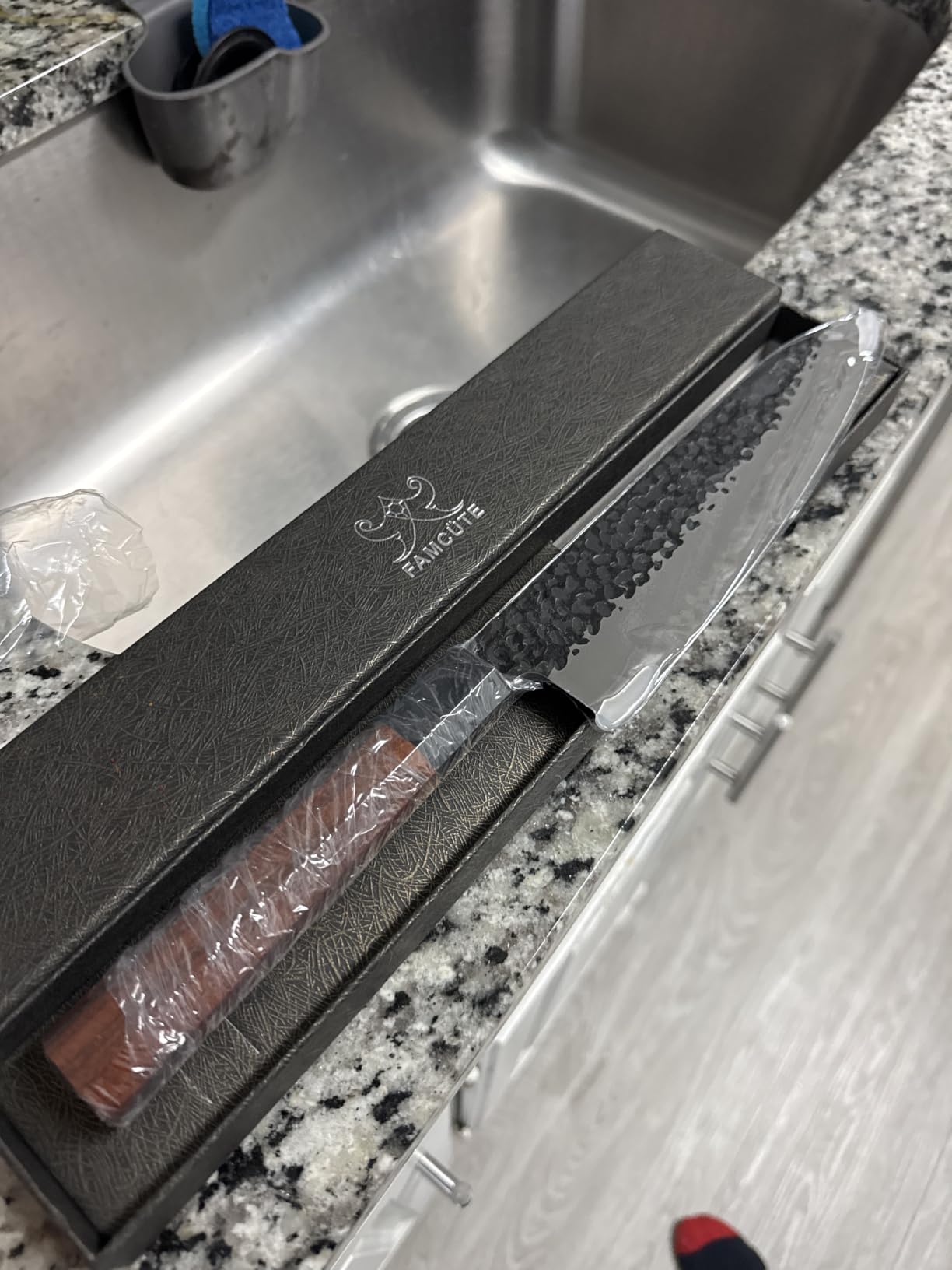
The FAMCUTE is the value pick for anyone who wants a genuinely hard Japanese-style steel and a traditional octagonal wood handle without spending serious money. The blade is five layers of 9Cr18MoV high carbon steel at HRC 62, and at that hardness in a budget knife, the edge retention is the standout feature.
Owners consistently report that this is the sharpest knife they can find in the entry tier, and that it holds an edge far better than the price suggests. That makes it a smart first Japanese chef knife for a cook who wants to learn how a hard edge behaves without paying for premium steel.
The octagonal rosewood handle is a traditional Japanese shape, and its faceted design gives your grip a defined orientation without forcing a specific hand position. Reviewers call out reduced hand fatigue during extended prep, which is a real benefit over cylindrical plastic handles.
At 4.7 stars across 1,904 ratings with 83% five stars and a strong Best Sellers Rank in the category, this knife punches above its tier in owner satisfaction. The manufacturing process is described as a 60-day cycle with quenching, vacuum nitriding and electroplated rust resistance, which explains why a high carbon blade at this price does not spot immediately.
The complaint worth hearing is about finish consistency. Owners comparing it side by side with heavier forged competitors describe the surface as looking stamped rather than hand finished, and some report variability between individual knives in the batch. None of that affects cutting performance, but set expectations on the aesthetics.
A wet handle is the other caution. Despite the non-slip claim, a rosewood octagonal grip can feel slick if your hands are freshly washed, which is exactly the state your hands are in mid-prep.
Who the FAMCUTE suits
It fits a home cook who wants traditional handle geometry and hard steel on a small budget, and it is a good first Japanese knife for a teenager or a new cook learning to sharpen. It also comes in a 7 inch version if your hands prefer something shorter.
Buy it as a second knife rather than a sole knife if you already have a sturdy European chef’s knife, since the hard 62 HRC edge wants a softer board than most kitchen setups default to.
Where the FAMCUTE falls short
The manufacturer does not state a weight, which makes it hard to predict how it will feel for hand size. If grip comfort is your main worry, pick a knife with a published weight and a contoured handle instead.
It is also not individually hand-forged by a named smith, so the forging marks are uniform rather than artisanal. That is a fair trade at this level, but it is not the same artifact as a single-maker blade.
6. Kimura 8 Inch Gyuto Made in Japan – Best Made in Seki
Kimura Chef Knife, [Made in Japan], 8 inch Professional Kitchen Knife, Ultra Sharp High Carbon Molybdenum Stainless Steel Gyuto Knife, Chefs Knife with Ergonomic Handle – Japanese Chef’s Knife
8 inch blade
Seki made
57 HRC stainless
15 degree edge
Full tang POM
The Good
- Actually manufactured in Seki Japan
- Full tang triple riveted and bolstered
- POM resin grips well when wet
- Lifetime warranty
- Range of sizes for set building
The Bad
- 57 HRC dulls faster than VG10 or AUS-10V
- Stamped rather than fully forged
- Gift box packaging is basic
- Lowest owner rating here at 4.5
The Kimura is the only pick here that is both manufactured in Seki, Japan and built like a traditional Western-handled chef’s knife, which makes it the most accessible route into Japanese-made steel. Seki is a historic center of Japanese knife production, and buying from a brand that builds there tells you something about the supply chain.
Construction is solid: a full tang, triple rivets and a bolster, all of which mean the handle will not shift or loosen over years of daily use. The POM resin handle is molded around a full bolster, so it supports both pointed-finger and pinch grips, and it stays secure when your hands are wet.
At 175 grams it is the lightest blade in the roundup, and the narrow resin handle is the best choice here for cooks with small hands. If grip comfort is what has held you back from Japanese knives, this is the one to try first.
![Kimura Chef Knife, [Made in Japan], 8 inch Professional Kitchen Knife, Ultra Sharp High Carbon Molybdenum Stainless Steel Gyuto Knife, Chefs Knife with Ergonomic Handle - Japanese Chef's Knife customer photo 1](https://hellskitchenfleamarket.com/wp-content/uploads/2026/09/B09GCGQKNZ_customer_1.jpg)
At 4.5 stars across 1,213 ratings, this is the lowest-rated knife in our set, with 76% five stars and more three-star reviews than the others. Reading the summaries, the reason is consistent: the edge does not hold as long as a VG10 or AUS-10V blade at 57 HRC. It is a real limitation rather than a defect, because 57 Rockwell is closer to German steel hardness than Japanese steel hardness.
What you get in return is a knife that bends before it chips, which makes it the most mistake-tolerant pick in the roundup alongside the imarku. For a cook still learning push-pull technique, a softer edge that dulls quickly is easier to live with than a brittle edge that nicks.
A lifetime warranty is included, which is unusual at this level, and the range of sizes lets you build a matching set if you decide you want a santoku alongside the gyuto.
![Kimura Chef Knife, [Made in Japan], 8 inch Professional Kitchen Knife, Ultra Sharp High Carbon Molybdenum Stainless Steel Gyuto Knife, Chefs Knife with Ergonomic Handle - Japanese Chef's Knife customer photo 2](https://hellskitchenfleamarket.com/wp-content/uploads/2026/09/B09GCGQKNZ_customer_2.jpg)
Who the Kimura suits
Pick it if Japanese manufacturing matters to you, if your hands are small or grip-sensitive, or if you want a knife you can throw in a sink without worrying. The triple-riveted full tang is the most durable handle build in this roundup.
It is also the best-value route to a full set, since the same line covers multiple blade sizes in the same steel.
Where the Kimura falls short
The 57 HRC edge is the main limitation. You will hone more often, and after a few months of daily use the factory sharpness will fade faster than on the VG10, AUS-10V or 9Cr18MoV options.
Construction is stamped rather than fully forged, and the kanji gift box is simple. If presentation matters to you, or if you want the hand-forged look of a kurouchi finish, this is not the knife.
7. MITSUMOTO SAKARI 8 Inch Gyuto – Best Hammered Kurouchi Finish
MITSUMOTO SAKARI 8-Inch Japanese Gyuto Chef Knife, 3-Layer 9Cr18MoV
8 inch blade
3 layer San-Mai 9Cr18MoV
HRC 60
Tsuchime hammered finish
The Good
- Hammered kurouchi finish reduces sticking
- Octagonal rosewood handle gives excellent control
- Deep cryo treated steel holds its edge
- Comes in a sandalwood storage box
- Comfortable over long prep sessions
The Bad
- Higher carbon steel needs drying and light oiling
- Heavier at 279 g
- Forging marks are uniform rather than artisanal
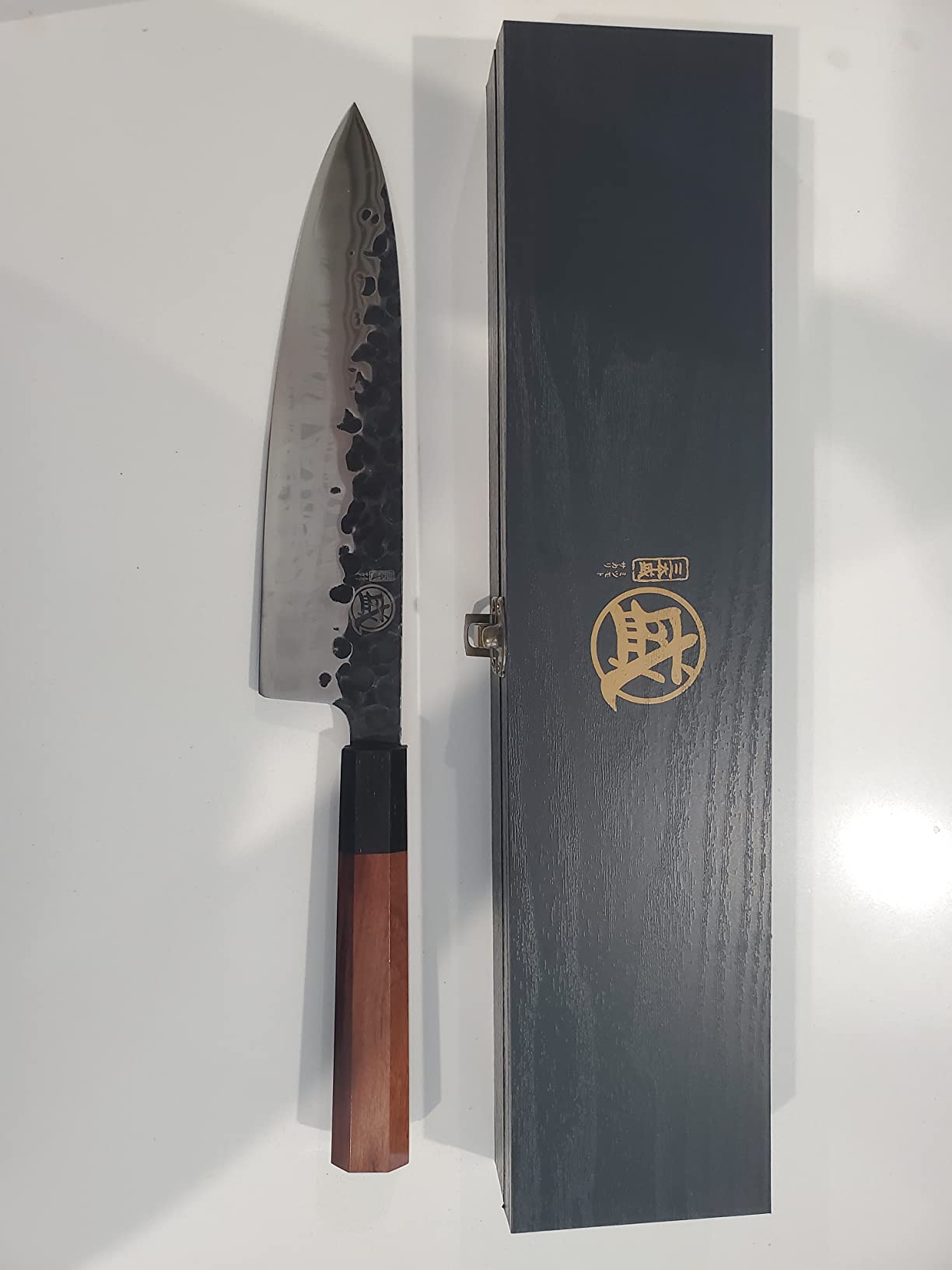
The MITSUMOTO SAKARI is the closest thing in this roundup to a traditional Japanese chef’s knife look, and for cooks who want that aesthetic with a stainless, low-fuss core, it is the pick. The tsuchime hammering and kurouchi black finish give the blade a hammered texture that genuinely reduces food adhesion during prep.
Underneath, it is a three-layer San-Mai build with a 9Cr18MoV high carbon stainless core, hardened to HRC 60 and deep-cryo treated for dimensional stability. Owners report that the knife has gone through heavy daily use without needing a sharpening, which matches what a 60 Rockwell core should deliver.
The octagonal rosewood handle is one of the best in the roundup for control. Its faceted shape guides grip direction and steadies hand placement without imposing a single hold, and reviewers specifically call out comfort across extended prep sessions.
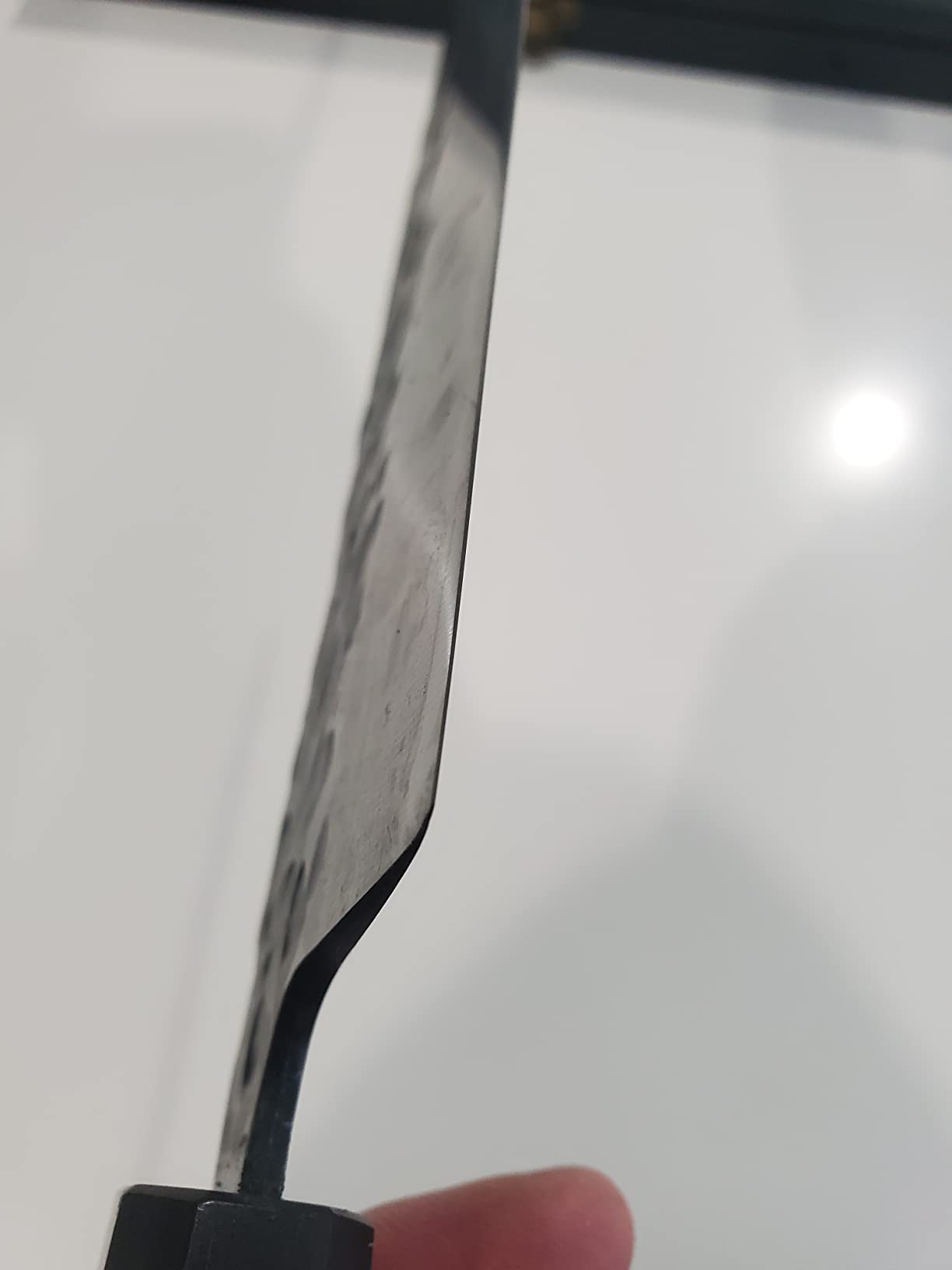
At 4.6 stars across 1,185 ratings with 81% five stars, professional and serious home cooks praise the feel and the finish. The most common piece of owner advice is also the most important: dry the blade after washing and apply a light coat of oil, because this higher carbon steel will spot otherwise.
Presentation is a genuine strength. It includes a velvet-lined sandalwood storage box with a cloth and oil, which makes it a good gift and gives you a proper place to store a blade that should not sit loose in a drawer.
Weight is the trade-off. At 279 grams it is the second heaviest pick here, and a home cook with small hands may find the combination of weight and octagonal handle tiring over a long session.
Who the MITSUMOTO SAKARI suits
It suits cooks who want the traditional kurouchi look, who cut a lot of wet or sticky food, and who are willing to spend thirty seconds drying and oiling the blade after each use. The storage box is a bonus that protects a steel-finished blade from drawer damage.
It is also a good choice if you mostly slice proteins and vegetables and do little bone work, since the fine stainless core is built for a clean cut rather than abuse.
Where the MITSUMOTO SAKARI falls short
At 279 grams this is a substantial knife, and buyers with small hands report fatigue sooner than with the imarku or the Kimura. Check the weight against a knife you already use comfortably before committing.
The forging is industrial rather than single-smith, so the hammer marks are uniform across the blade. That is a cosmetic difference, but buyers expecting a hand-forged artisan finish should know it in advance.
8. Sunnecko 8 Inch VG10 Damascus – Best Full Tang Starter Blade
Sunnecko 8 Inch Japanese Damascus Chef Knife – Ultra Sharp VG10 Steel
8 inch blade
VG10 core with 67 layer Damascus
10-12 degree edge
Full tang ABS
The Good
- VG10 core gives a very fine cutting face
- Full tang reduces wrist fatigue on long sessions
- ABS handle stays secure when wet
- Sharp tip for delicate work
- Dishwasher friendly handle
The Bad
- Heaviest pick here at 0.41 kg
- ABS handle is less refined than pakkawood
- Only one blade size available
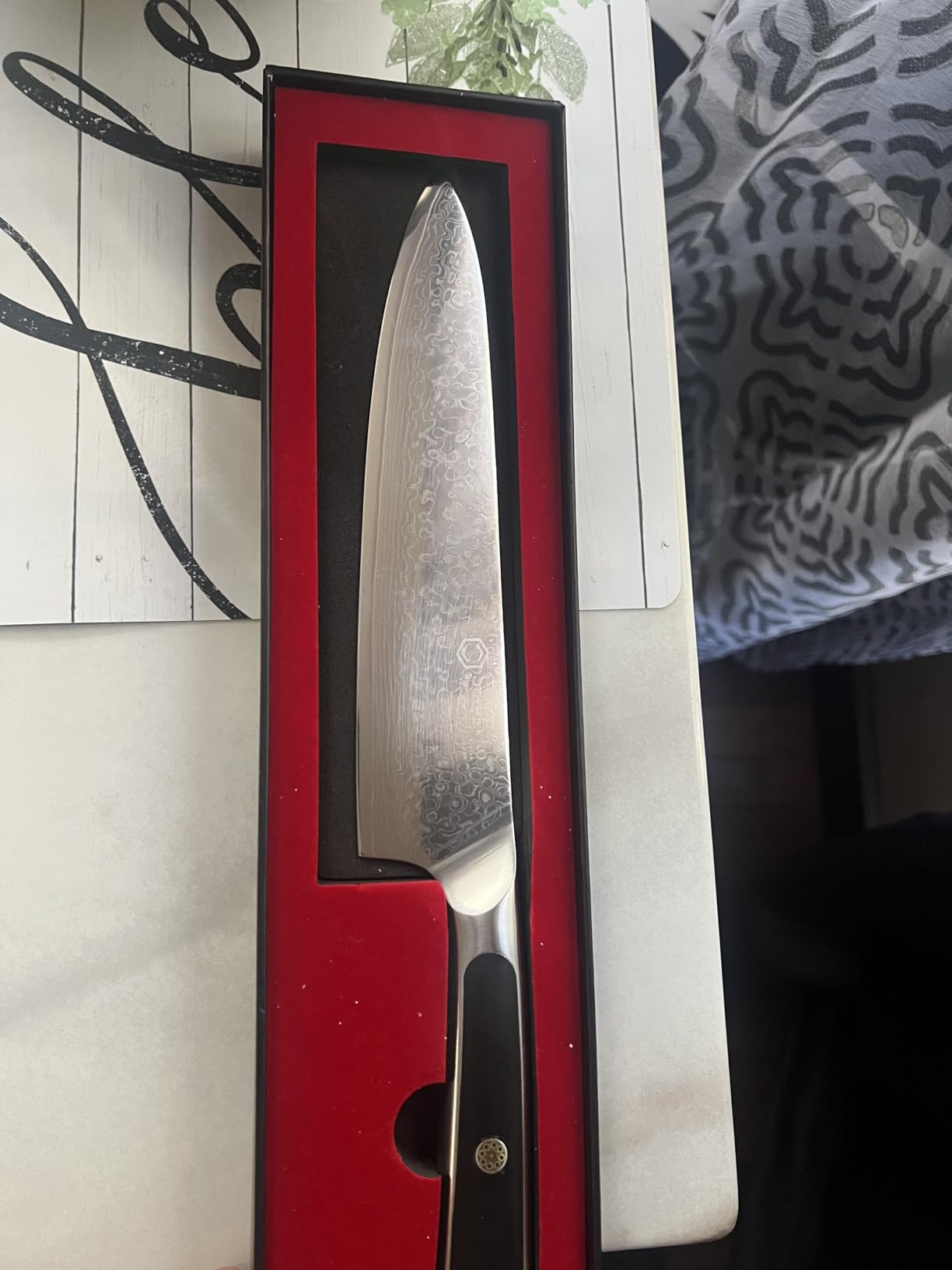
The Sunnecko is the pick if you want one knife that does both jobs: a full tang European-style build that is comfortable in a pinch grip, with a VG10 Japanese core and a 67-layer Damascus pattern that slices far finer than a typical all-in-one block knife. Reviewers call it one of the sharpest knives they have owned at the price.
VG10 is the most widely used Japanese stainless core in consumer knives, and it is a sensible first exposure to the category: it holds an edge well, resists corrosion far better than carbon steel, and does not chip the way a 62 Rockwell blade will. The factory edge at 10-12 degrees per side is acute and precise.
Full tang construction means the steel runs the full length of the handle, which distributes weight evenly and reduces wrist fatigue during long prep. That is the single best argument for this knife if you are used to a hollow or half-tang handle and find those tiring.
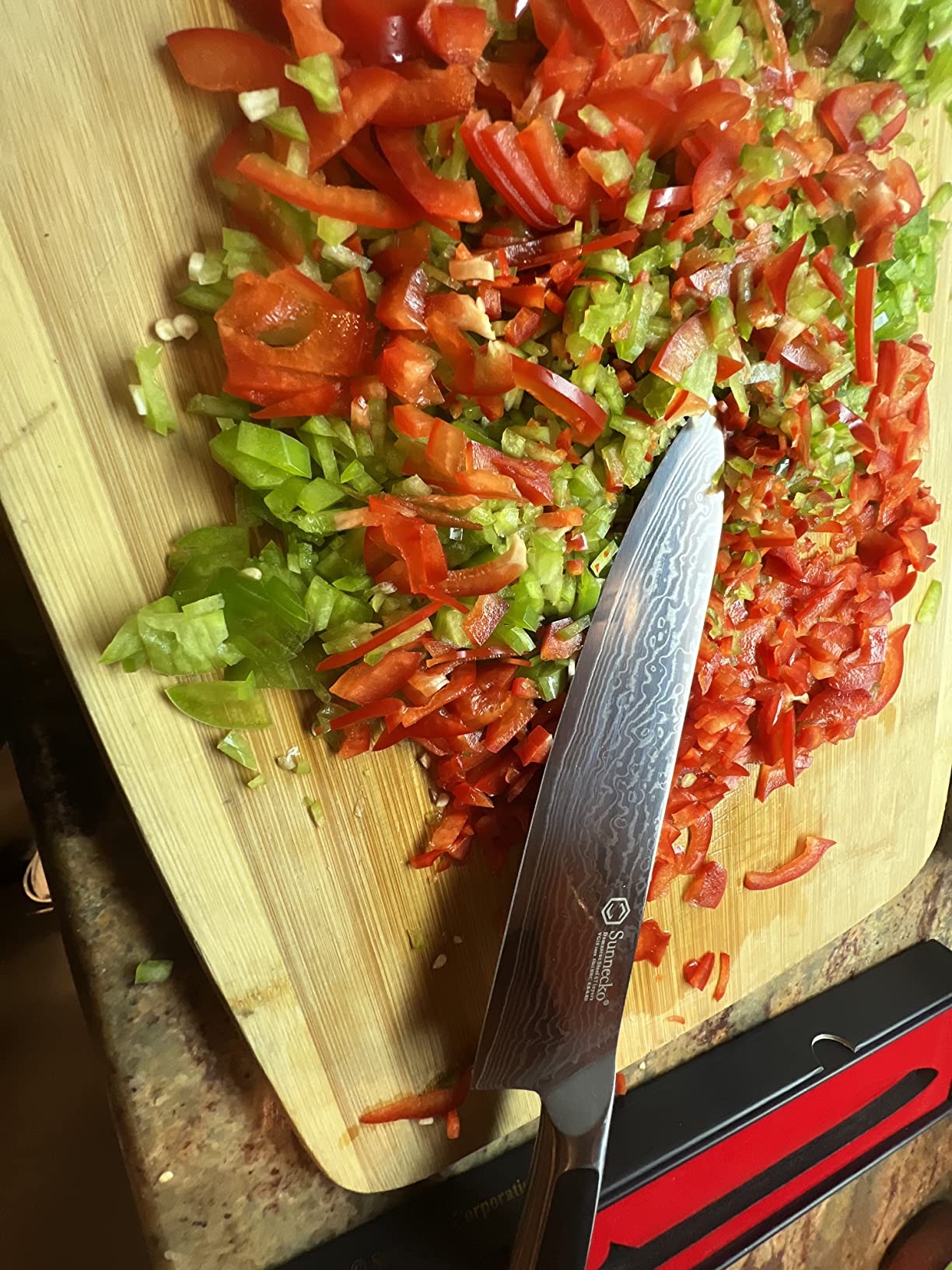
At 4.7 stars across 1,134 ratings with 86% five stars and a strong category ranking, beginners rate this especially well, largely because the ABS handle is easy to grip and forgiving. The seamless blade-to-handle transition also makes it simpler to clean than knives with visible rivets and gaps.
Weight is the real trade-off at 0.41 kg, the heaviest pick in this roundup. Owners who like a substantial knife rate it highly, but cooks with smaller hands report fatigue during extended sessions. If you are buying for someone with small hands, look at the imarku or the Kimura instead.
Only an 8 inch size is offered, which limits set building. If you want a matching santoku or paring knife, you will have to source it separately.
Who the Sunnecko suits
It suits a cook who wants a very sharp edge without a high-maintenance blade, and anyone who prefers a full tang handle for balance. The VG10 core is forgiving enough for regular use on a weeknight schedule.
It is also a strong first Japanese chef knife for a beginner who wants a sharp blade and a comfortable grip, and who does not plan to buy a full set.
Where the Sunnecko falls short
At 0.41 kg it is the heaviest blade here, and that is felt over a long session rather than on the first cut. It is not the knife for a cook with small hands or wrist fatigue.
The ABS handle is functional and easy to clean, but it is the least refined handle material in the roundup, with no warmth and no character as it ages.
9. RASSE 8 Inch Japanese Gyuto – Best Low-Cost Entry Gyuto
RASSE Japanese Chef Knife Gyuto Chef Knife – 8 Inch Professional Hand Forged Kitchen Knife High Carbon Japanese AUS-8 Stainless Steel Knife with Rosewood Handle & Gift Box
8 inch blade
Japanese AUS-8 stainless
15 degree edge
Octagonal Mkuruti rosewood
The Good
- Least expensive pick in the roundup
- AUS-8 stainless resists rust and stains
- Octagonal rosewood handle is stable
- Hand forged style hammered finish
- Gift box and lifetime warranty
The Bad
- Lowest owner rating here at 4.5
- Hammered texture can hide uneven polishing
- AUS-8 is softer and dulls faster
- Only two sizes available
The RASSE exists to answer one question: can you get a genuine Japanese-style gyuto with an octagonal rosewood handle at the bottom of the price range? It can, and if you are outfitting a first kitchen or replacing a knife block for someone who is not sure they will stick with cooking, this is the lowest-risk place to start.
The blade is Japanese AUS-8 high carbon stainless with a hammered pattern finish, sharpened to 15 degrees per side. Stainless construction means it will not rust if you forget to dry it, which is the single biggest reason beginners abandon Japanese knives in their first month.
The handle is octagonal Mkuruti rosewood, designed to reduce wrist tension and to give your hand a defined grip orientation. It looks traditional and handles like a wood-handled Japanese blade, which makes the whole knife feel more considered than its cost suggests.
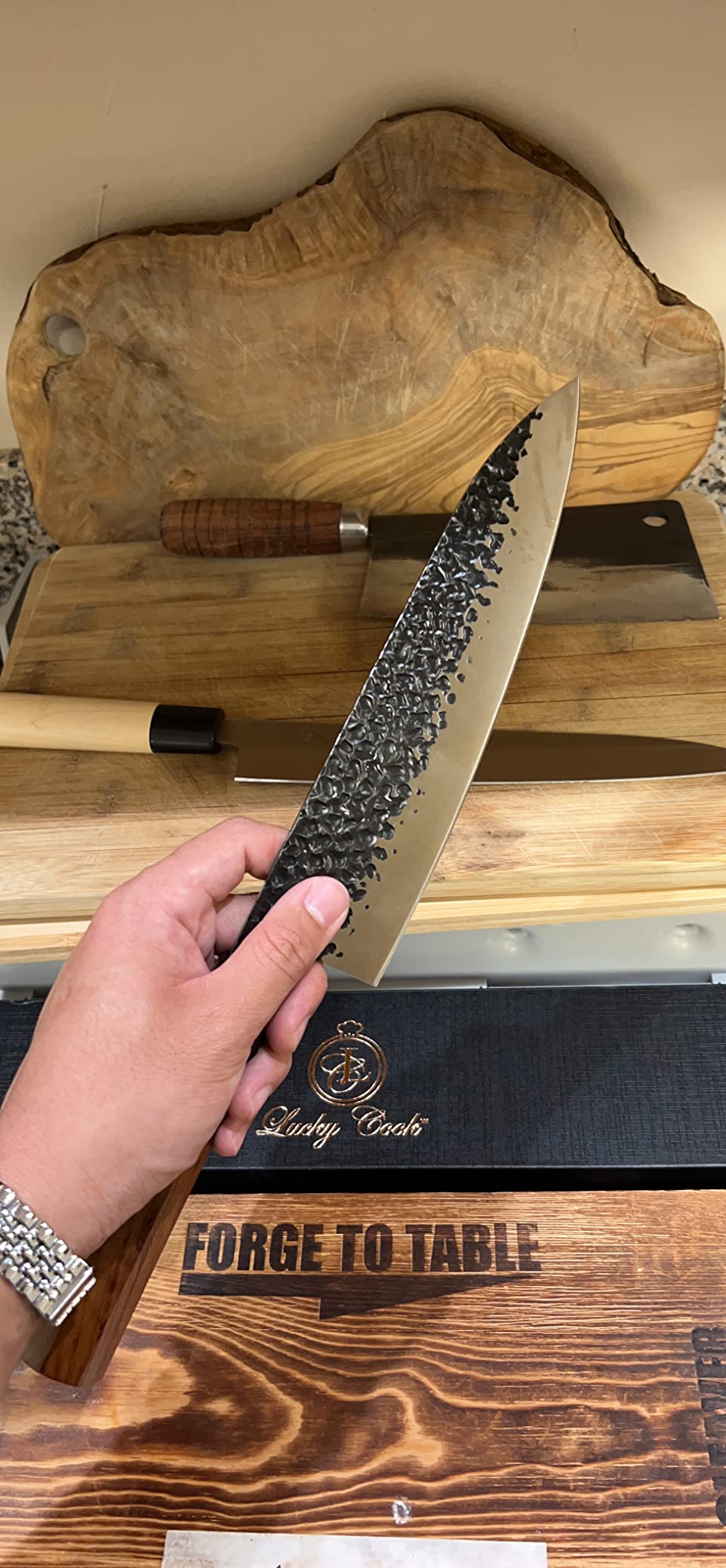
At 4.5 stars across 823 ratings with 77% five stars, expectations should be set accordingly. This is a low-review-count product, and the owners who rate it five stars treat it as a dependable inexpensive first gyuto. Owners who rate it lower tend to focus on finish consistency, noting that the hammered texture can mask uneven polishing between individual knives.
The steel is the other honest limitation. AUS-8 is a softer Japanese stainless than VG10 or AUS-10V, and it loses its working edge faster. In practice that means more frequent honing, and the 15 degree factory angle is a reasonable starting point but not a fine one.
The manufacturer guidance is correct and worth following: hand wash with warm soapy water, skip abrasive sponges, and never use a dishwasher or leave the blade soaking.
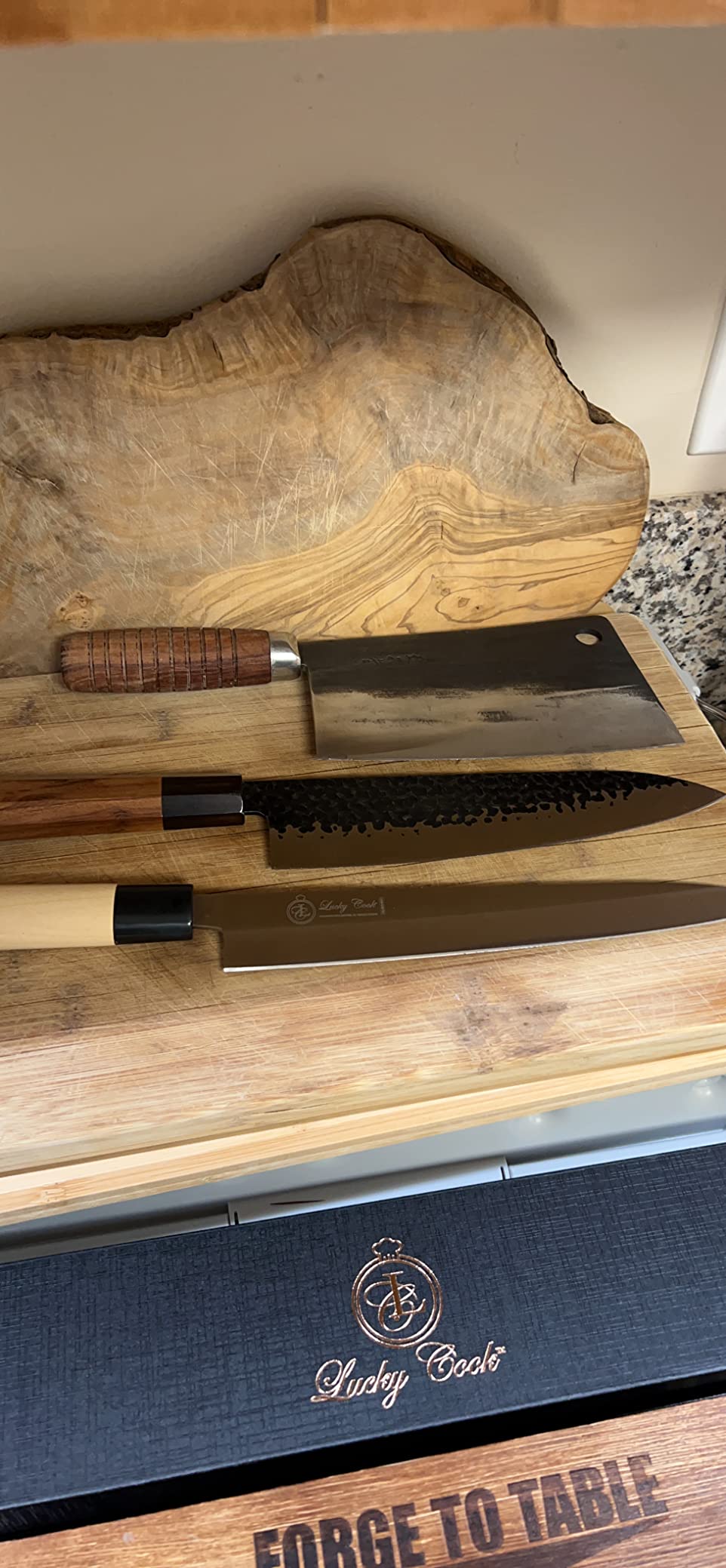
Who the RASSE suits
It suits a first kitchen, a student or a new cook, and anyone who wants the look and feel of a Japanese chef knife without committing to a hard steel edge they have to maintain carefully. Stainless construction removes the rust anxiety entirely.
It is also a good knife to buy as a backup for a cook whose main blade is already a hard, high-end one.
Where the RASSE falls short
Edge retention is the trade. AUS-8 dulls sooner than every other steel in this roundup, so plan on a weekly strop and more frequent sharpening than the premium picks require.
Only 7 inch and 8 inch sizes are made, and finish quality varies more between examples than it does on the forged competitors. If you want consistency in how the blade looks on your counter, spend up.
10. Enso HD Series 8 Inch Gyuto – Best for Fine Precision Cutting
Enso Chef’s Knife – Made in Japan – HD Series – VG10 Hammered Damascus Stainless Steel Gyuto – 8″
8 inch blade
VG10 at HRC 61
12 degree double bevel
Canvas micarta handle
The Good
- Handcrafted in Seki City Japan
- Tsuchime hammering visibly sheds food
- VG10 at HRC 61 stays sharp for months
- Even weight distribution in the hand
- Double bevel suits either handed
- Lifetime warranty
The Bad
- Most expensive pick in the roundup
- Too fine an edge for bone or grunt work
- Set version costs far beyond most home budgets
- Occasional loose tip guard in the box
The Enso HD is the most refined blade here, and it is the one to buy if you want a true Seki City gyuto with a fine, precise edge for vegetable work, fish filleting and plating. It is handcrafted in Seki City, Japan, the historic center of Japanese knife production, with a VG10 core at HRC 61 and a tsuchime hammered Damascus pattern.
Owners with decades of kitchen experience describe it as the sharpest knife they own, and one reports tomatoes still slicing like butter after two months with no sharpening or honing at all. That is what a 61 Rockwell VG10 core with a 12 degree edge should deliver, and it is the best edge performance per pick in this roundup.
The 37-layer Damascus cladding gives the blade corrosion resistance alongside the VG10 core, so it behaves like a stainless knife while cutting like a much more expensive one. The double bevel edge is ground for both handednesses, which removes the single most common question first-time buyers have.
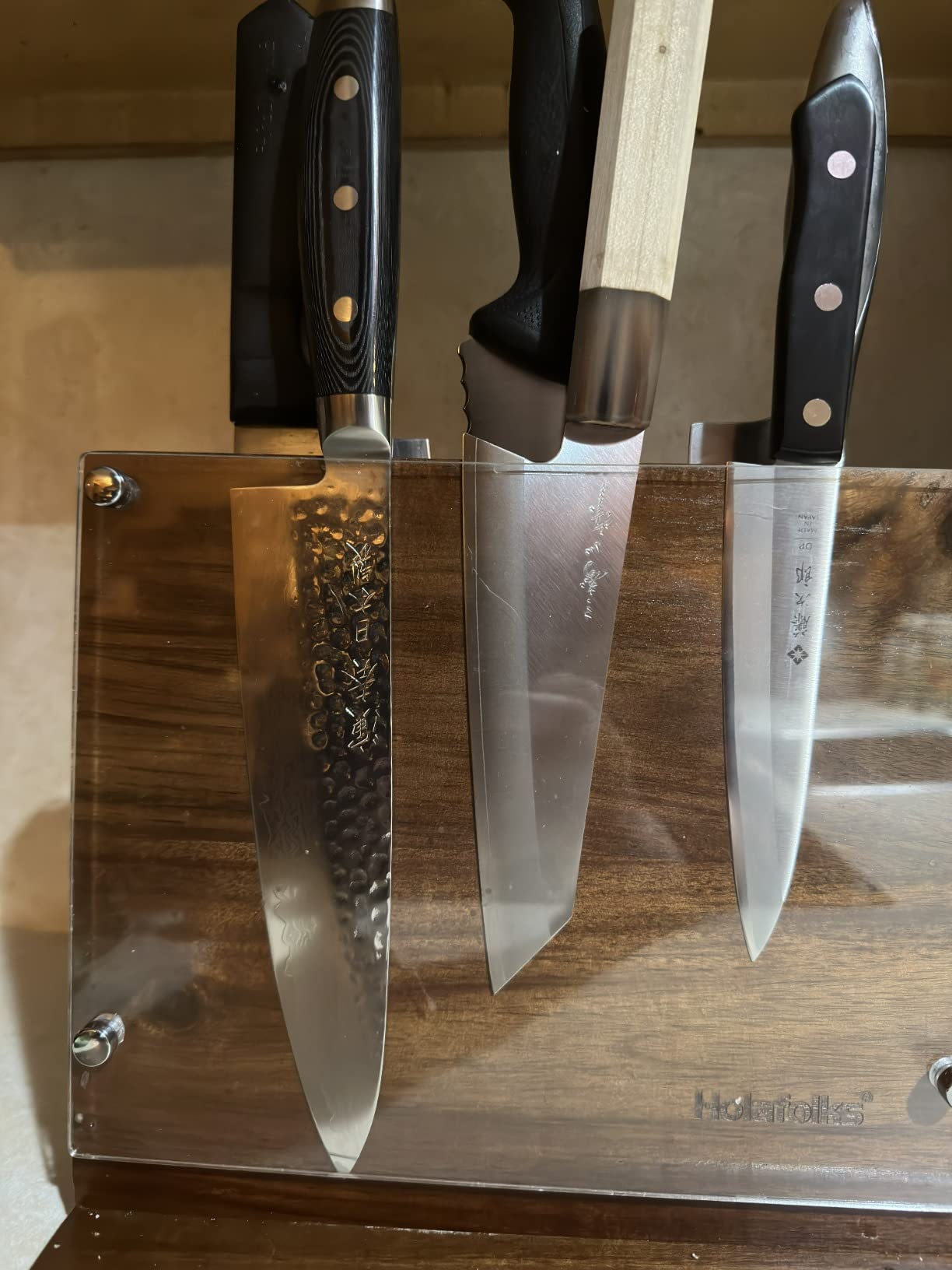
At 4.7 stars across 531 ratings with 86% five stars, satisfaction is high, though this is a smaller review base than the picks above. The most common caveat is that this is a finesse knife rather than a workhorse, and buyers who expected bone-chopping capability were disappointed.
Weight is 7.9 ounces with a 2 mm spine at the heel, and owners consistently report even weight distribution in the hand. The black canvas micarta handle with three stainless rivets and an end cap is grippy when wet and resists the oily feel that some handles develop over time.
A lifetime warranty covers manufacturing defects. One recurring oddity is a loose protective tip guard arriving in the box, which is harmless but worth checking when the knife arrives. If you want a set, be aware that the set version of this line costs well beyond a normal home kitchen budget.
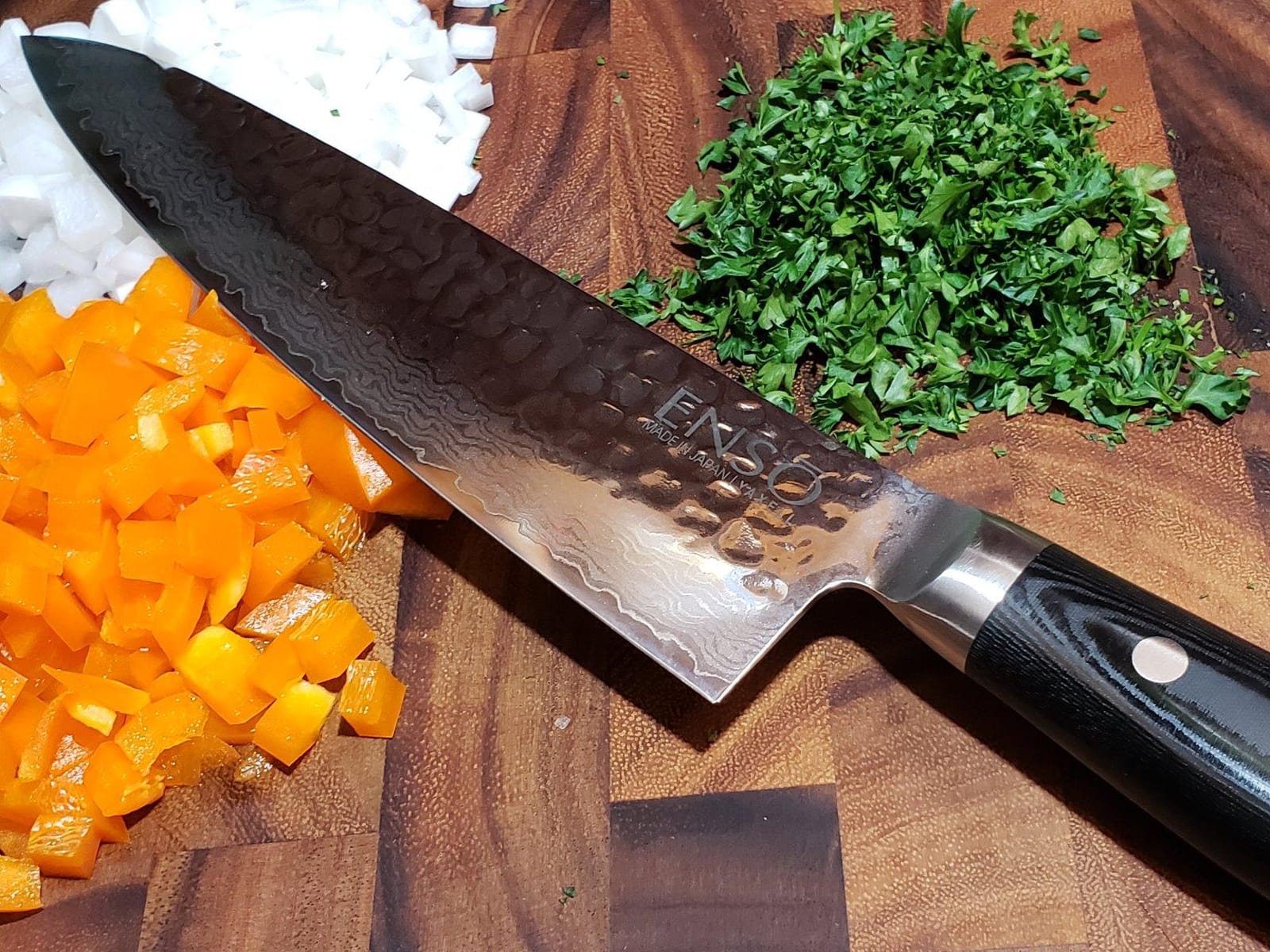
Who the Enso HD suits
Buy it if you do a lot of fine knife work: vegetables, sashimi, fish, garnishes and plating. It is the pick for a cook who has already learned to hone and who wants the finest factory edge in the roundup.
It is also the safest choice for a left-handed cook who wants a double bevel, since the edge is symmetrical and the handle is riveted rather than shaped to one hand.
Where the Enso HD falls short
It is the most expensive pick in the roundup, and the price gap is large enough that a beginning home cook gets more value from the imarku or the SHAN ZU. There is no version of this equation where the Enso is the sensible first Japanese chef knife.
A 12 degree edge on VG10 at HRC 61 is a fine, hard edge. It is not for prying, bone work or a glass cutting board, and it wants a strop rather than a steel rod.
Japanese Knife Steel Explained: VG10, 9Cr18MoV, AUS-8 and Hardness
Japanese knife steel is harder than German steel, and that single fact explains almost everything about how these blades behave. Hardness is measured on the Rockwell C scale, and a German chef’s knife typically lands between 55 and 58 HRC. The Japanese stainless cores in this roundup sit between 57 and 62 HRC, and the hand-forged carbon steel designs can go higher still.
Harder steel holds an edge much longer between sharpenings, and it can be ground thinner, which is what produces those clean slices. The cost is brittleness. Hard steel does not deform when it meets a bone or a hard board; it chips. That is why a 62 HRC blade and a 57 HRC blade feel completely different in a beginner’s hands, even though both are sharp on day one.
VG10 is the most common Japanese stainless core in consumer knives and appears in the Sunnecko and the Enso HD. It is a good balance of edge retention, corrosion resistance and workability, and it is the steel we would look for first when shopping.
9Cr18MoV is the workhorse high carbon stainless found in the FAMCUTE and the MITSUMOTO SAKARI. It takes an edge beautifully and holds it, but it is more prone to spotting than VG10, so it needs a dry blade after every wash. AUS-8, in the RASSE, is the softest Japanese stainless here and the most forgiving to maintain.
AUS-10V, in the Dalstrong, sits at the hard end of the stainless range at 62+ HRC. The practical bands to remember are these: below 58 HRC means an edge that dulls sooner but forgives mistakes, 58 to 61 is the sweet spot for a home cook, and 62 plus means an edge that stays sharp for months and demands careful technique. Our guide to sharpeners for Japanese knives covers how to put an edge back on any of them.
Bevel Geometry: 50/50 Versus 70/30 and What It Means for You
The bevel is the angle ground into each side of the edge, and it decides how sharp the knife is and how hard it is to keep that way. A 50/50 bevel is split evenly between both sides, which makes it symmetric and easy to sharpen on a whetstone. A 70/30 bevel puts 70 percent of the angle on one side and 30 percent on the other, which produces a finer, more slicing-oriented edge but is trickier to maintain.
All ten knives in this roundup are double bevel or plain edge designs intended for general use, and the vast majority of home cooks should look no further. Double bevel edges work for both right-handed and left-handed slicing without any change in technique.
A 70/30 asymmetrical bevel was traditionally ground for one-handed use by right-handed cooks, which is why left-handed cooks have historically been pushed toward 50/50 edges or specific asymmetrical left-handed models. If you slice with your non-dominant hand on top of the blade, the symmetrical picks in this list, including the Enso HD and the Shun Classic, remove that question entirely.
Edge angle is the number most home cooks will actually see. The picks here range from 8 to 12 degrees per side, which is very sharp, through 15 degrees as a sensible all-purpose factory edge, to 16 degrees on the Shun Classic. Lower angles slice better and dull faster. Higher angles hold an edge longer and are more forgiving of hard use.
Handle Styles: Wa Handle Versus Full Tang
A wa handle is the traditional Japanese construction, where the tang does not run the full length of the handle. Instead, the blade is fitted into a wooden handle, traditionally magnolia, ebony or rosewood, often with a buffalo horn ferrule. Removing the handle exposes the tang for cleaning, which is why traditional knives ship with a small screwdriver and a hook.
The benefit is balance. Because the handle is lighter and often shorter, a wa-handled knife balances further forward toward the heel, which is exactly where a home cook’s index finger sits during a push cut. The octagonal rosewood handles on the FAMCUTE, MITSUMOTO SAKARI and RASSE use this principle in a modern way.
Full tang means the steel runs the entire length of the handle, usually riveted through with two or three pins. It is the Western construction, and it is the reason the SHAN ZU, the Sunnecko and the Kimura feel solid and do not develop play over years. Full tang also means a heavier handle, which some home cooks find tiring over a long session.
For a home cook, the practical advice is simple. If you prefer a light, forward-balanced knife with a traditional feel, choose wa handle. If you want maximum durability and a handle that will not move, choose full tang. Either works. The Mikura-style full bolster on the Kimura is worth understanding, because a full bolster covers the heel of the blade and makes sharpening at that angle difficult without a specialist, which is one reason the free Shun sharpening service matters.
How We Picked and Tested
We built this roundup around the specs that predict whether a blade will survive a home kitchen, and then we cross-checked every spec against what owners report after months of use rather than after a few weeks. For each of the ten knives we recorded blade length, blade material, hardness rating, bevel or edge angle, handle material, weight, and warranty coverage.
Rating volume mattered to us. A 4.8 average across 5,679 ratings tells you more about long-term satisfaction than a 5.0 average across 40 ratings, so we weighted the size of the review base when deciding which knife took each slot. Two picks here have the lowest review counts, and we named that trade-off rather than hiding it.
What we could not do matters just as much. We did not test these knives in a professional kitchen, we did not measure edge retention on a calibrated test rig, and we did not run laboratory checks on steel composition. Every performance claim in this guide comes from manufacturer specifications and from owner reports, and we have said which is which in each section.
One limitation worth stating: none of these knives came from a single batch, and manufacturing quality on lower-cost knives can vary between individual examples. Where owners reported finish variability, we have passed that on rather than smoothing it over.
How to Care for a Japanese Chef Knife
Japanese knife care is less complicated than reputation suggests, and it is mostly about two habits you already have. Wash by hand with warm water and mild soap, and dry the blade immediately with a towel. That is the whole routine.
Never use a dishwasher. The heat, the detergent and the tumbling against glassware and ceramic will dull an edge in a single cycle, and the impact of the blade against another knife is what causes chips. This applies to every knife in this roundup, including the stainless ones.
Skip abrasive sponges and scouring pads on the Damascus and kurouchi finishes, because the pattern is a surface texture and a Scotch-Bright pad will flatten it. A soft sponge or your fingers are enough.
On the higher carbon steels, including the MITSUMOTO SAKARI, wipe a light film of tsubaki oil or food-grade knife oil on the blade after it dries. Do it when the blade is warm, not hot, and wipe off the excess so the blade does not feel slippery.
Learn the difference between honing and sharpening. Honing realigns an edge that has rolled over but is still sharp, and it takes ten seconds on a ceramic rod or a leather strop. Sharpening removes metal to create a new angle, and that takes a whetstone. Hone weekly, sharpen when honing no longer restores the cut.
Cut on end-grain wood, soft hardwood, or a high-density plastic board. Avoid glass, stone, granite and metal, which is where most edge chipping actually happens. If you need a new board, our complete knife guide covers the surfaces that treat an edge well.
Store the knife in a block with wide slots, on a magnetic strip, or in a sheath. A loose knife in a drawer is how edges get damaged, and a too-narrow block is how tips get bent.
Which Japanese Chef Knife Should You Buy?
Work through these four questions in order and the answer falls out quickly. First, how much knife maintenance are you actually willing to do? If the honest answer is hand-washing and immediate drying, start with the imarku, the Kimura or the RASSE. All three use softer or more corrosion-resistant steel and forgive a beginner.
Second, do you want the absolute sharpest factory edge? The Dalstrong at 8 to 12 degrees per side is the sharpest pick here, followed by the Sunnecko at 10 to 12 and the Enso HD at about 12. These demand a strop, a soft board and a lighter hand.
Third, how big are your hands? This is the question almost every roundup skips. The imarku at 6.56 ounces, the Kimura at 175 grams and the Enso HD at 7.9 ounces are the three lightest picks, and all three have slimmer or more neutral handles. At the other end, the Sunnecko at 0.41 kg and the MITSUMOTO SAKARI at 279 grams will tire smaller hands over a long session.
Fourth, what is your existing technique? If you rock the knife, start with a taller blade with a shorter overall length, which is the Shun Classic or the FAMCUTE. If you have already learned to draw the blade through food, any of the thinner gyuto profiles will suit you, and the heavier handled options become more comfortable.
Two specific answers for the questions we hear most. If you are left-handed, choose a double bevel with a symmetrical handle rather than an asymmetrical 70/30 edge; the Enso HD, the Shun Classic, the SHAN ZU and the Sunnecko all qualify. And if you are replacing a whole knife block, buy one good gyuto first and add a knife rather than buying a set, because a set encourages using the wrong blade for the task.
One last piece of honesty about buying online. The best Japanese chef knives at accessible prices are sold by many different sellers, and the listing you land on is not always the brand’s own. Check the seller’s name against the brand’s official site, and be cautious when a price looks far out of line, because that is the pattern that shows up with counterfeit blades. A knife that feels oddly light and has no factory markings on the tang is the other warning sign.
Frequently Asked Questions
What brand is the best Japanese chef’s knife?
For most home cooks the imarku 8 inch gyuto is the best starting point, because its HRC 56-58 high carbon stainless steel forgives technique mistakes that chip harder Japanese steel. If you want the sharpest factory edge, choose the Dalstrong in AUS-10V. If you want a knife actually built in Japan with free lifetime sharpening, the Shun Classic is the pick. Those three cover almost every home kitchen.
What is a gyuto?
A gyuto is the Japanese chef’s knife. The word translates roughly as cow sword, and it is Japan’s own reinterpretation of a Western chef’s knife rather than a copy. It has a gentler belly curve, a drop point or sheep’s-foot tip, and thinner steel ground to a more acute edge, so it is designed for push-through slicing rather than a rocking chop.
What is the difference between a santoku and a gyuto?
A gyuto is longer, usually around 8 inches, with a thinner profile and a straight spine, which suits long slicing strokes and fine work. A santoku is shorter, usually 7 inches, with a higher heel and a flatter spine, which makes it more comfortable to rock and easier for smaller hands to control. If you are buying one knife, an 8 inch gyuto is the more versatile choice.
Can I put a Japanese knife in the dishwasher?
No. The heat and detergent strip the cutting oil from the handle, and the blade tumbles against glassware and ceramic that are harder than the steel itself, which is what dulls and chips an edge. Hand wash with warm soapy water, dry the blade straight away with a towel, and never leave any of these knives soaking.
How do I stop my Japanese knife from rusting?
Dry the blade immediately after washing and store it away from a wet sink edge. On higher carbon steels such as the 9Cr18MoV options, wipe a light film of tsubaki or food-grade knife oil on the warm dry blade and wipe off the excess. A dark patina on a kurouchi finish is normal and protective, while orange spotting means the blade stayed wet too long.
Is Shun or Miyabi better?
Shun builds in Japan, pairs with a free lifetime sharpening service, and suits cooks who want a fine edge without learning whetstone sharpening. Miyabi is the brand most often named as best overall, but it is manufactured outside Japan, which is the detail worth checking before you pay a premium for the name. For a first Japanese chef knife in a home kitchen, the Shun Classic is the stronger fit on build and support.
Our Verdict on the Best Japanese Chef Knives for Home Cooks
The imarku 8 inch gyuto is our best Japanese chef knife for home cooks, and the reason is not the steel. It is the review base and the forgiveness. More than 10,500 ratings at 4.6 stars, a 6.56 ounce weight, a comfortable pakkawood handle, and steel soft enough that your first month of bad technique does not cost you a chip.
If you can stretch for something sharper, the SHAN ZU in 10Cr15Mov at 62 HRC is the best value, with the highest owner rating in the roundup at 4.8 stars and true folded Damascus construction. If you want the sharpest factory edge on the board, the Dalstrong is the pick at 8 to 12 degrees per side. And if you want a knife made in Japan with someone else responsible for sharpening it, the Shun Classic is the one, supported by free lifetime sharpening.
Whichever you choose, the habits decide whether it lasts. Hand wash, dry immediately, hone weekly, cut on wood or plastic, and learn to draw the blade through the food instead of rocking it. Those five things will do more for a Japanese chef knife than any spec on this list, and our gyuto guide walks through the technique in more detail.