

If you want one honest answer before you read any further: the VEVOR 2 Frame Manual Honey Extractor is the best overall pick in our roundup because it carries the largest pool of real owner feedback of anything we looked at and holds a 4.3 average across 882 reviews, and the VIVO BEE-V004E is the one to buy if you run six hives or more because it handles eight shallow or medium frames and four deep frames per load on a quiet 120V motor. For a middle ground, the VEVOR 2/4 Frame Electric removes the arm work without the big-machine footprint. We break down all six below, with the wobble, drain height and capacity traps that nobody mentions on the product page.
A honey extractor is a drum that spins uncapped frames so centrifugal force throws the honey out of the comb and into a bucket, while the wax comb survives intact inside the frame. That intact comb is the entire point. Bees eat roughly seven pounds of honey to rebuild one pound of wax, so a machine that returns the comb to the hive protects your yield and repays its cost within a season or two.
We spent weeks reading every owner review we could find on these six units, then weighed them on the criteria that decide whether a season goes smoothly or badly: how many frames actually fit, where the drain sits, how the machine behaves at speed, how easy it is to wash out, and whether parts and support exist when something fails. The two forums that dominate this category’s search results are full of the same two complaints, wobbling stands and honey crystallizing inside drums that were not rinsed the same day, so we treated both as buying criteria rather than footnotes.
One last thing before the list. Beekeepers with one or two hives should check whether a local bee club already owns a shared extractor before spending anything. A borrowed machine teaches you your frames, your honey and your own pace, and clubs are almost always happy to lend one to a member. Everything below assumes you have decided to buy.
Top 3 Honey Extractor Picks in 2026

VEVOR 2 Frame Manual
- Food-grade stainless steel drum
- Hand crank with enclosed metal gears
- Height adjustable stand 11.81-14.96 inch
- Transparent acrylic lid

VIVO BEE-V004E 8 Frame
- Quiet 120V AC motor
- 8 shallow/medium or 4 deep frames
- Gate elevated 17.2 inch for a 5-gallon bucket
- Clear lid and enclosed gears

VEVOR 2/4 Frame Electric
- 140W motor up to 1300 rpm
- 2 deep plus 2 medium or shallow frames
- Lid safety interlock stops the motor
- Stand 39.3-42.5 inch bolts to plywood
The VEVOR 2 Frame wins our overall slot on evidence rather than on spec sheet. Nothing else in this group has 882 owners behind it, and the pattern in those reviews is unusually consistent: fast assembly, easy rinsing, a lid that shows you the spin, and one repeated request, which is a sturdier base. The VIVO takes the larger-operation slot because four deep frames per load is real throughput, and its gate is raised high enough that a standard bucket fits underneath with no riser.
The VEVOR 2/4 Frame Electric is the value pick because it brings the two features hobbyists most want from a motor machine, adjustable speed and a lid interlock that kills power if the lid comes up mid-spin, into a package most beginners will find manageable. Its vibration under a full four-frame load is the trade you accept, and bolting it to a board fixes most of it.
Best Honey Extractors at a Glance in 2026
| Product | Key Specs | Buy |
|---|---|---|
|
|
Check Latest Price |
|
|
Check Latest Price |
|
|
Check Latest Price |
 |
|
Check Latest Price |
 |
|
Check Latest Price |
 |
|
Check Latest Price |
Read that table as a map rather than a ranking. Three of the six are hand-cranked, two are electric, and the frame counts are not interchangeable. A 2-frame manual and an 8-frame electric both spin two frames per pass in a different way, and knowing which frame depth you actually use matters more than any other number on the page.
1. VEVOR 2 Frame Manual Honey Extractor – Best Overall
VEVOR Honey Extractor, 2 Frame Manual Honey Extractor with Transparent Lid, Stainless Steel Honeycomb Drum Spinner with Height Adjustable Stand,Honeycomb Extraction Centrifuge Equipment for Beekeeping
Food-grade stainless steel
2-frame drum, shallow medium or deep
Height adjustable 11.81-14.96 inch
The Good
- Most owners report 5 to 20 minutes from box to spinning
- Transparent lid shows the extraction without opening the drum
- Enclosed metal gears keep honey out of the drivetrain
- Carry handle and adjustable stand make it portable
The Bad
- Legs flex and walk unless bolted to a board
- Plastic honey gate threads can pop off
- Sharp leg edges out of the box
Our first impression of the VEVOR 2 Frame was the box itself. It went from flat-packed to spinning in under twenty minutes with basic tools, and the assembly manual is straightforward enough that a first-year beekeeper will not need help. That speed of setup is the single most repeated theme across the 882 reviews, and it matters because the alternative on a first harvest is a trip to the shed hunting for tools while the frames sit there losing warmth.
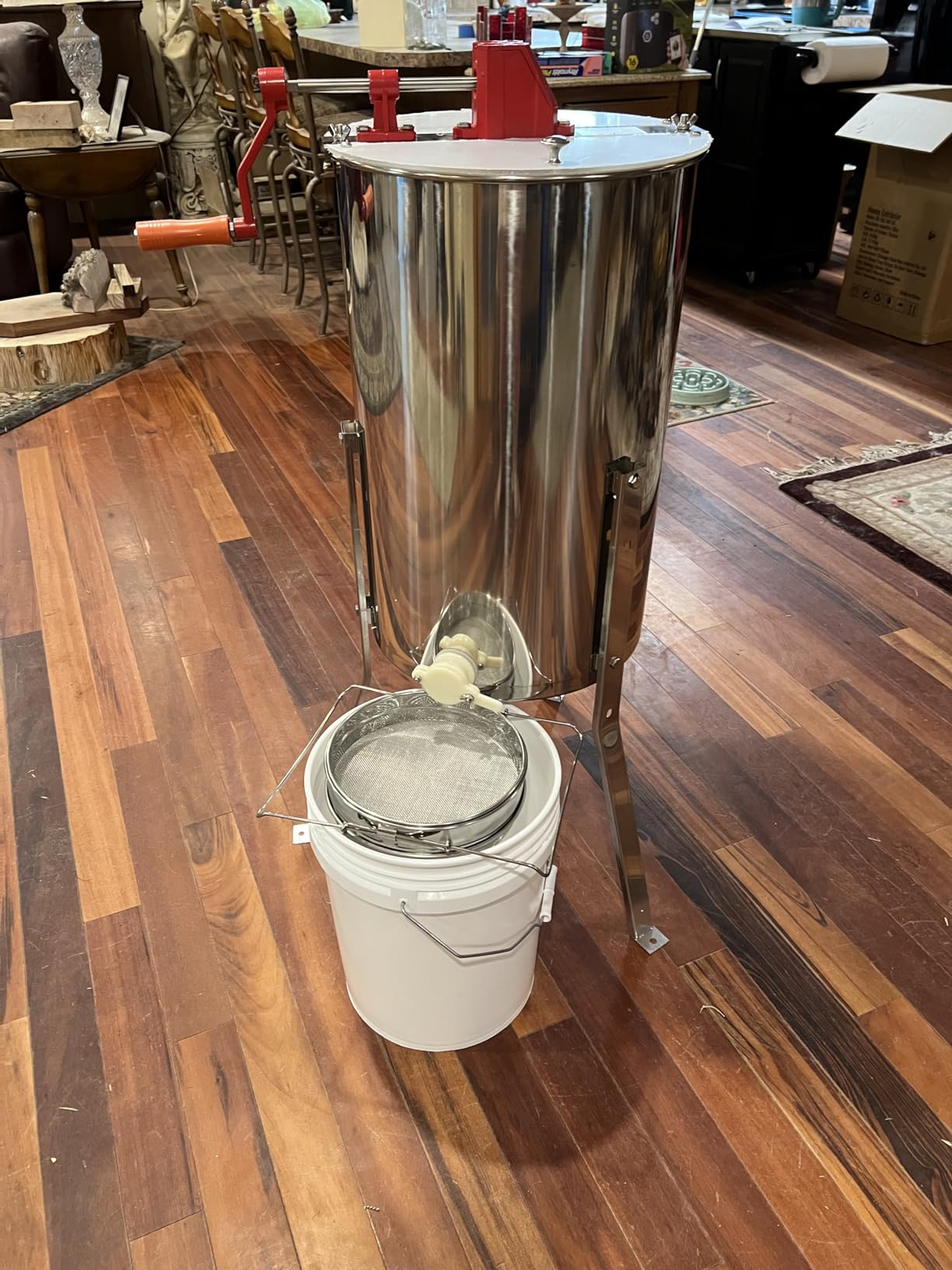
The drum is food-grade stainless steel with a seamless barrel, which is exactly what you want for something you will rinse with warm water and watch for corrosion season after season. The clear acrylic lid means you can watch honey coming off the comb without lifting anything, and because the gears are enclosed metal rather than exposed plastic, honey stays out of the drivetrain where it would otherwise turn to grit.
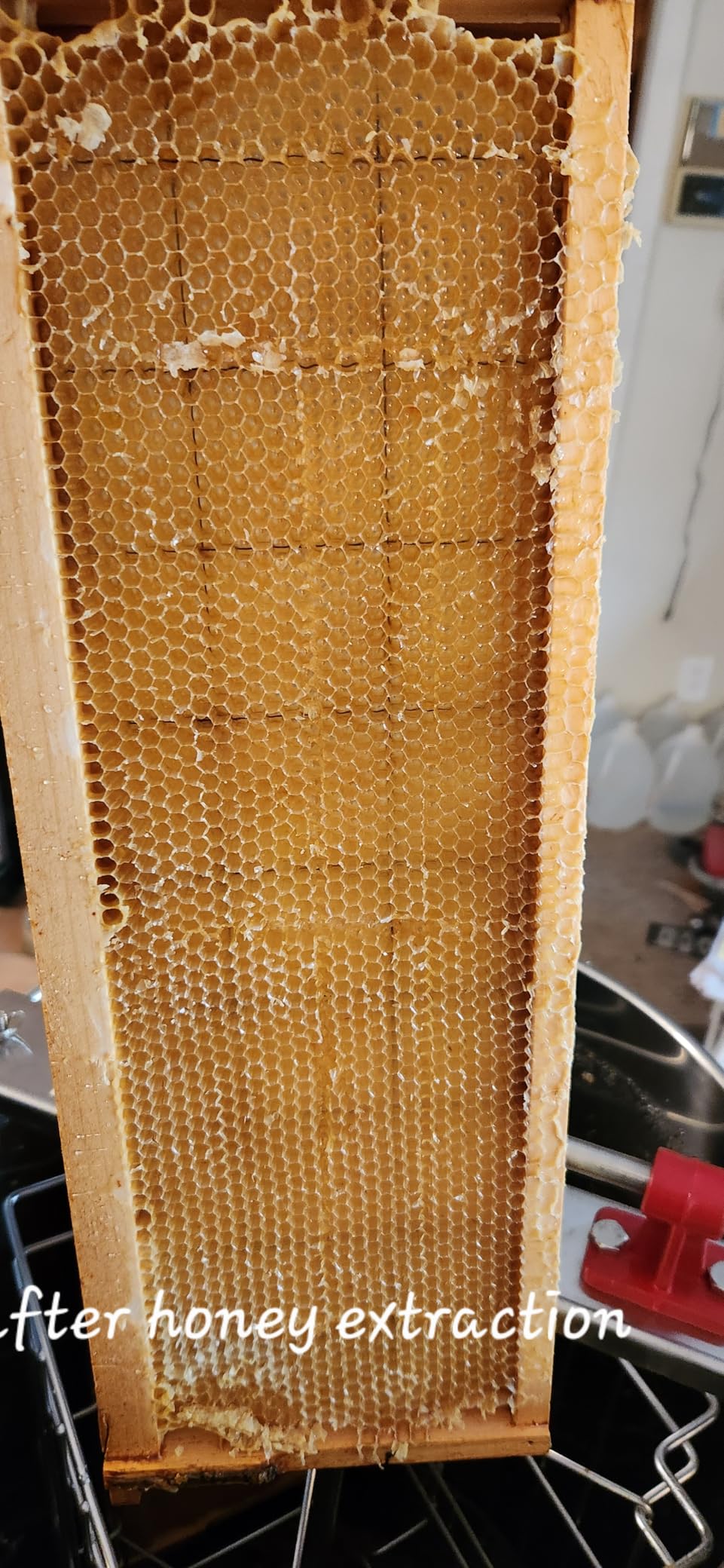
What it does not do is pretend to be a heavy machine. The triangular three-leg structure is genuinely useful for moving it, and the height adjusts between 11.81 and 14.96 inches so you can set a comfortable draining angle. But owners are blunt about the stand being on the light side, and the legs flex under a running load. Nearly every experienced voice in the beekeeping forums says the same fix: cut a square of plywood, bolt the leg plates to it, and run the machine on that. Once anchored, the wobble complaints largely disappear.
The 2-frame basket takes shallow, medium and deep frames, so it does not lock you into one box style as you scale up. It does mean batches of two, and by the time you have more than a handful of hives the cranking adds up. Owners with four to ten hives report that it replaces brush-and-strain work entirely and repays the purchase quickly, which is the honest reason this unit sits at number one rather than a larger machine.
Who this extractor suits
This is the right choice for a hobbyist running one to five hives who wants a reliable first machine with no motor, no electrical load and nothing to plug in at an off-grid yard. If your apiary has no power and no intention of getting any, hand-cranking is not a compromise, it is the only real option.
It also suits anyone who extracts on a schedule rather than in a rush. Two frames per batch is slower than an electric unit, and that slowness is a feature when you are processing honey after dark in a garage with one light bulb. Nothing overheats, nothing spins, and the whole job is quiet.
Where owners report trouble
The plastic honey gate at the bottom is the weak point. Owners report its threads popping when tightened, and a replacement gate is a simple afternoon fix if your honey is warm enough to flow. Check it before you need it rather than after.
Balance the frames. A top bar loaded alone opposite three bars produces a heavy uneven wobble that shakes the whole machine, and no extractor is built to correct an uneven load. Load opposite pairs, and if a frame is heavier, put the heavier one at the drum wall where it is counterweighted by the rest.
2. VIVO BEE-V004E Electric 8 Frame Rack – Best for 6 or More Hives
VIVO Electric Honey Extractor 8 Frame Rack, BEE-V004E
Quiet 120V AC motor
8 shallow/medium or 4 deep frames
Gate 17.2 inch up, fits a bucket
35.3 pounds
The Good
- Largest load capacity in this group
- Gate opening sits 0.5 inch above the barrel bottom so honey drains without tipping
- 1 year warranty and US-based company
- Quiet operation you can run indoors
The Bad
- Heaviest unit here at 35.3 pounds and needs a permanent spot
- Large stainless drum is a real step up in cost
- 49.5 inch tall footprint
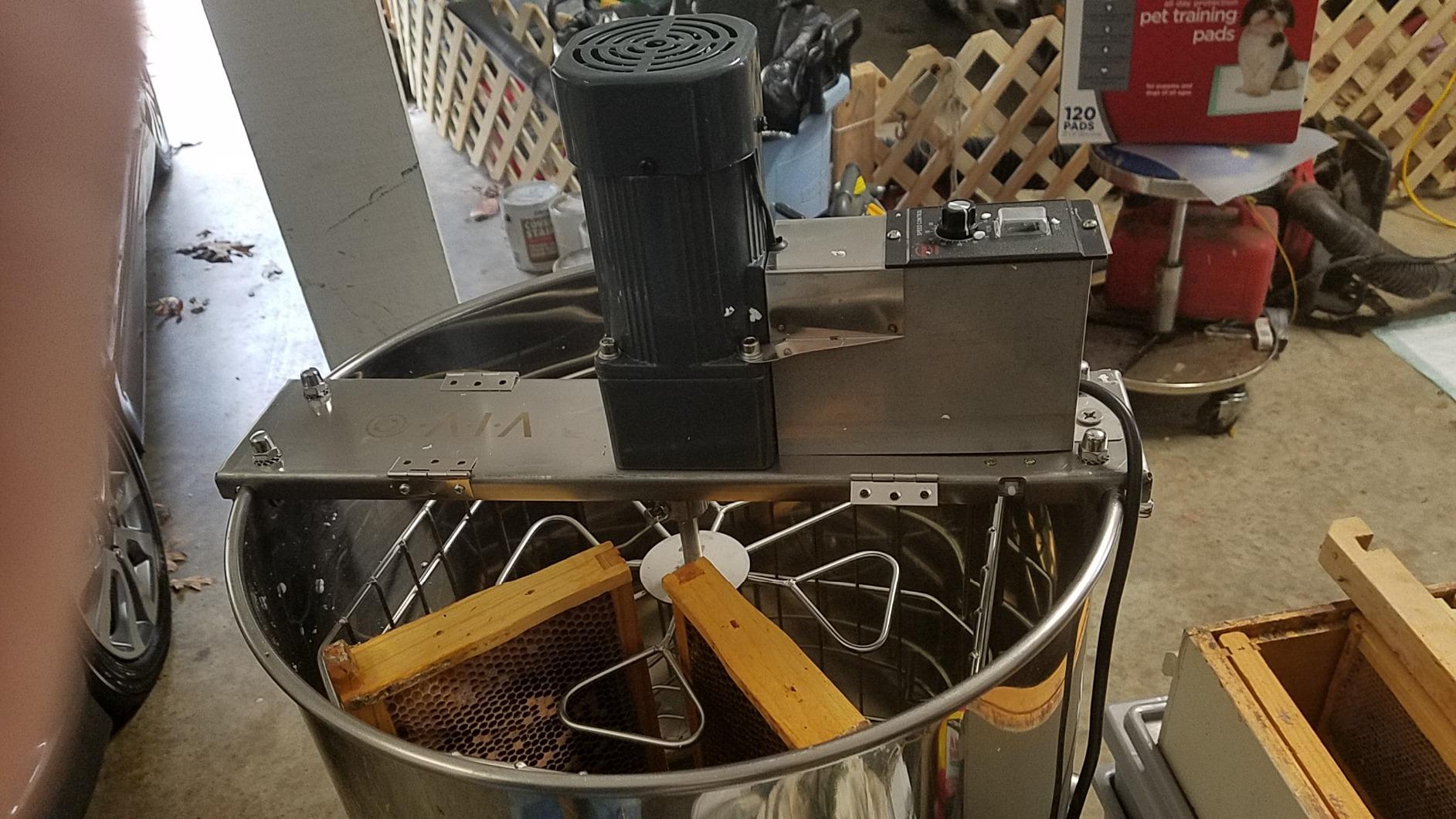
The VIVO BEE-V004E is the only machine in this group built around a real motor-driven rack rather than a small spinning drum, and you feel the difference the moment you load it. The stainless steel drum stands 25.5 inches tall and 18.5 inches across, and it takes up to eight small or medium frames or up to four deep frames in a single pass. That is the throughput that makes a ten-hive yard tractable.
Two design details matter far more than the marketing photos. First, the honey gate sits 17.2 inches off the floor, which leaves genuine clearance for a standard five-gallon bucket underneath. So many extractors force you to build a riser; this one does not. Second, the gate opening rests just half an inch above the bottom of the barrel, so nearly all of the honey drains out on its own instead of requiring you to tip the drum to catch the last few pounds.
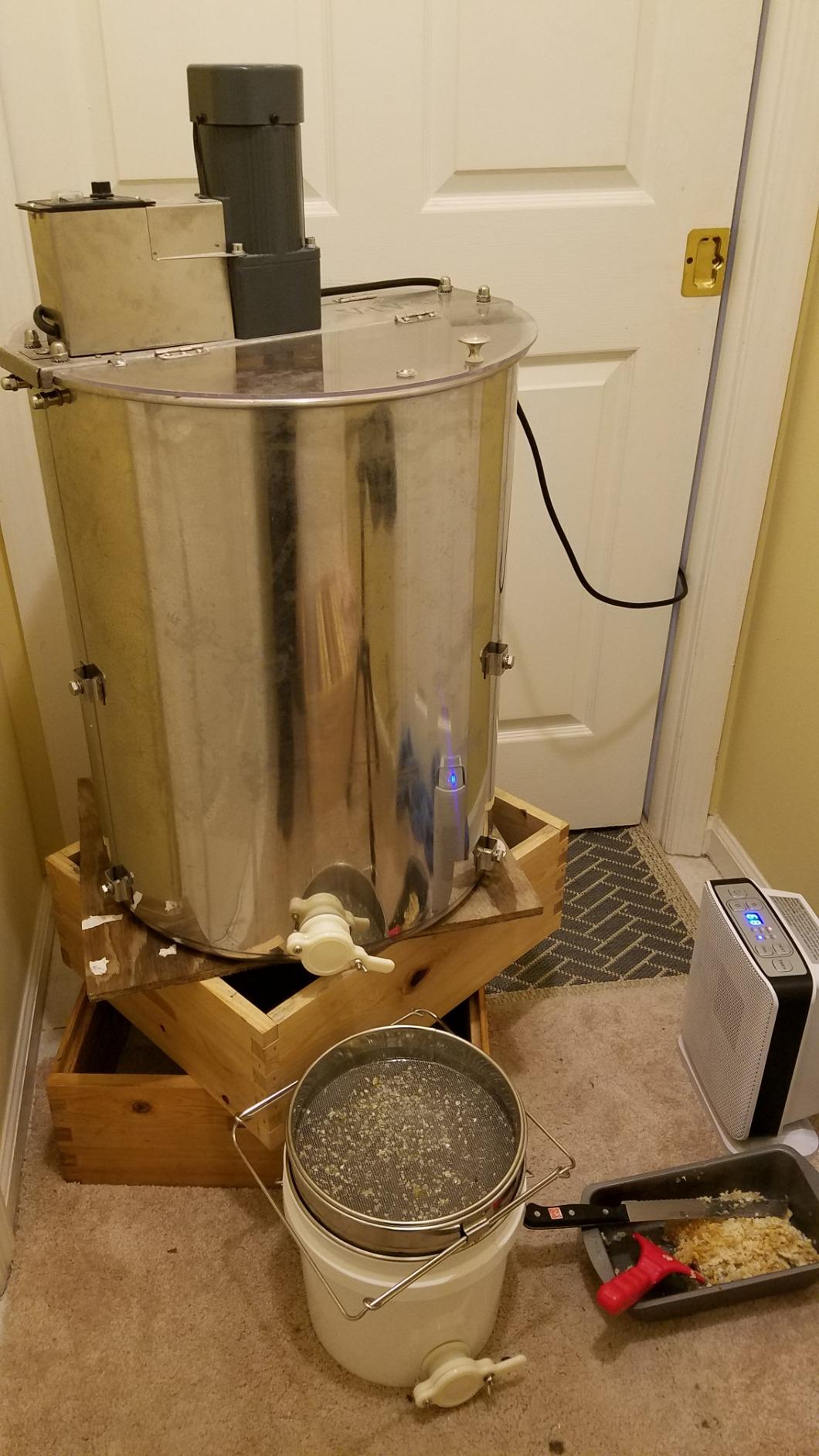
The motor is a quiet 120V AC unit rather than a loud gearmotor, which matters because extraction usually happens indoors. Enclosed metal gears keep honey out of the drivetrain, and the clear plastic lid lets you watch the spin. VIVO is a US-based company, and that shows up in practice: parts and replacement pieces are available, and support is responsive, which is the single most common complaint levied at import brands in beekeeping circles.
The honest drawback is weight and permanence. At 35.3 pounds and 49.5 inches tall, this is not a machine you carry out to a distant yard for a spontaneous harvest. It is a piece of equipment that gets a spot in your extraction room, with an outlet nearby, and stays there. Owners with a few hives often find that more machine than they need and start on something smaller.
Who this extractor suits
It suits beekeepers running six to fifteen hives who are done making two-frame batches by hand, and it suits anyone moving from hobby toward selling honey. Four deep frames per load means fewer passes, fewer flips and far less time standing over a crank.
It also suits a household with reliable mains power and a dry room. The motor runs cool enough for indoor use, the noise level is low enough to work beside, and the elevated gate means the whole operation fits a normal bucket rather than a custom stand.
Where owners report trouble
Capacity claims get read carefully here. Eight frames means eight shallow or medium frames, or four deep frames. Owners who assume they have bought an eight-deep machine arrive on extraction day disappointed, so count your actual box type before you commit.
Size and weight are the other fair criticism. This is a large stainless drum, and the step up in cost from a manual unit is real. The counterargument is the one-year warranty and the availability of parts, which is precisely what separates this machine from cheaper imports when a motor fails mid-season.
3. VEVOR 2/4 Frame Electric Honey Extractor – Best Value Electric
VEVOR 2/4 Frame Electric Honey Extractor with Adjustable Stand
140W motor to 1300 rpm
2 deep plus 2 medium or shallow
Clear lid with safety interlock
Stand 39.3-42.5 inch
The Good
- Adjustable speed lets you ramp up and back off
- Interlock stops the motor if the lid opens during a spin
- Polished rust-resistant stainless is easy to wash
- Quiet and simple to run
The Bad
- Wobbles noticeably with four frames loaded
- Some owners say it will not truly take four medium frames
- Drain is not the lowest point so the last honey needs tipping
The VEVOR 2/4 Frame Electric is the most polarised machine in our group, and that is worth saying plainly before recommending it. It holds a 4.1 average across 609 reviews, with a large share of five-star reports and the highest share of one-star reports in the lineup. In plain terms: most owners love it, and a small but vocal group has had motor trouble that turned into a warranty argument.
What earns the enthusiasm is the drivetrain. A 140W motor with adjustable speed up to 1300 rpm means you control the ramp rather than living with a single on-off spin, which is what protects delicate comb. The clear lid has a safety interlock that stops the motor if the lid opens mid-extraction, a feature you will find on very few machines at this level, and the polished rust-resistant stainless drum rinses clean without special treatment.
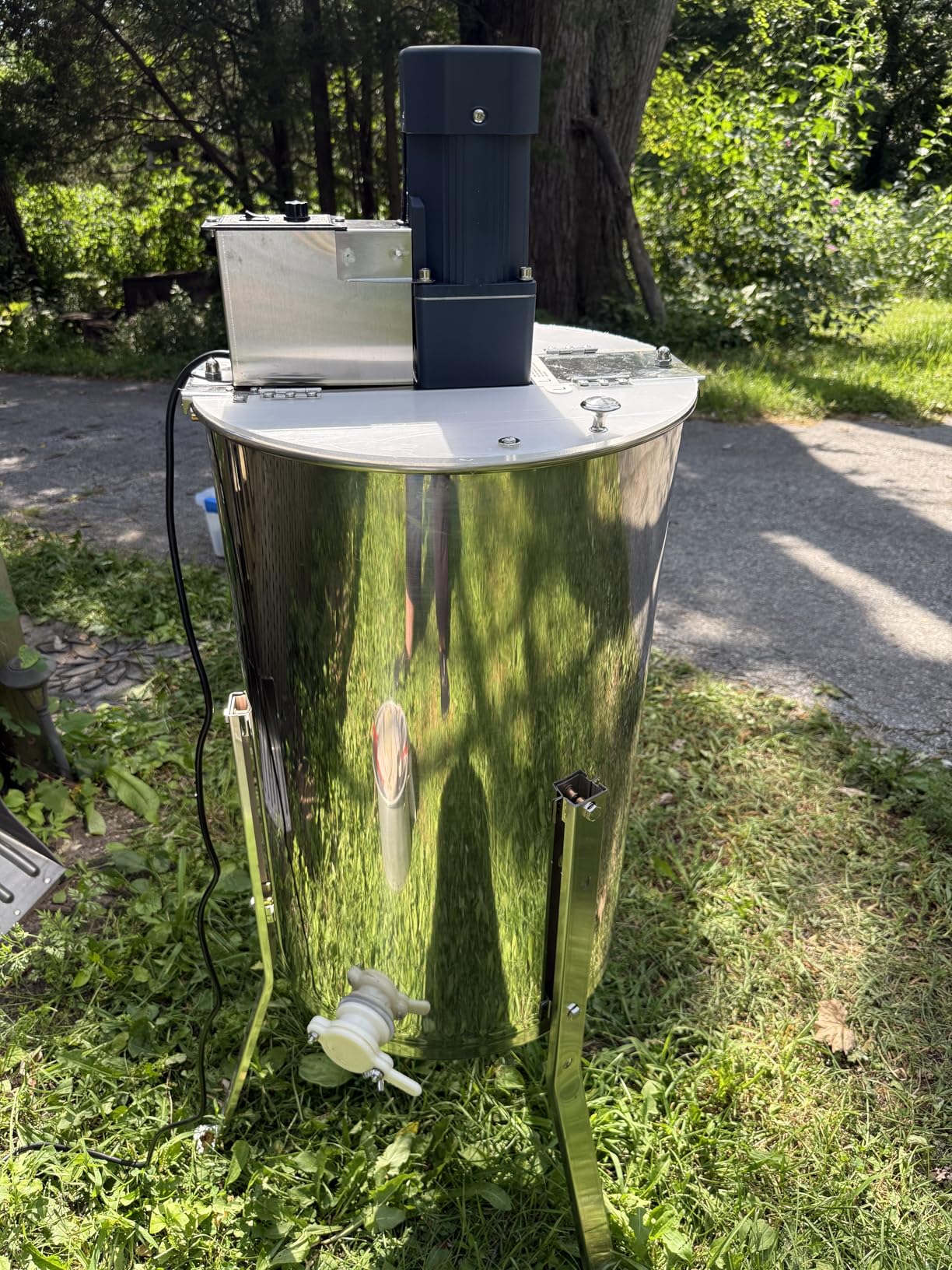
Frame capacity is two deep frames, or two medium or shallow frames, alongside them. The listed dimensions cover deep frames at 18.9 by 9 inches and medium at 18.9 by 6.3 inches. Here is the trap: some owners report that a full four medium frames will not seat as advertised, so if you run mostly medium supers, check the slot geometry against your actual frames before purchase.
The stand adjusts from 39.3 to 42.5 inches, which is tall enough to drain into a bucket on a low shelf but not quite enough for a bucket on the floor. Owners also report that the drain is not at the absolute lowest point of the drum, so the last of the honey needs the drum tipped forward. The internal basket is awkward to remove for a deep clean, which matters if you are the kind of person who lets honey sit. None of these are deal breakers, but all of them are predictable.
Who this extractor suits
It suits a beginner moving to three or five hives who wants a motor but not a large machine, and it suits anyone whose back or shoulders object to an hour of cranking. The adjustable speed and interlock are genuinely useful safety and control features at a price point where they are uncommon.
It also suits a beekeeper extracting outdoors where a low centre of gravity matters more than footprint. It is a compact, self-contained unit that assembles quickly and packs away between harvests.
Where owners report trouble
Vibration is the headline complaint, and it appears again and again in the reviews. With four frames loaded the unit moves noticeably, and the advice owners pass on is the same advice the forums give: bolt the legs to plywood and dampen the movement. The manufacturer even builds the leg plates with that in mind.
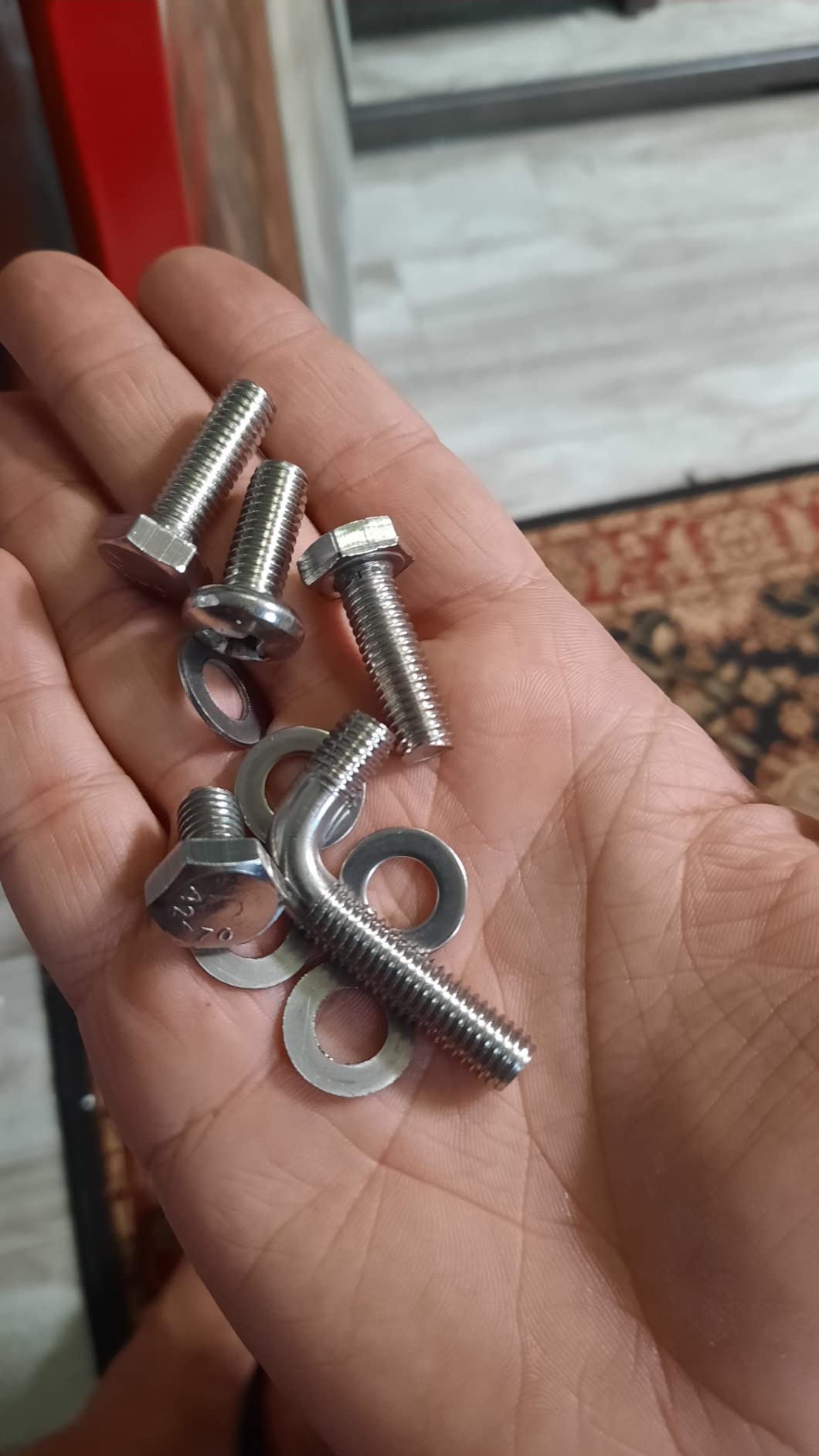
Small screws holding the top doors can shake loose during a run, and the internal basket resists removal when you want to wash it properly. Plan for a quick check with a screwdriver before every extraction rather than discovering a stripped fastener mid-spin.
4. Hardin Professional 2 Frame Manual Extractor – Best Stainless Build
GOODLAND BEE SUPPLY Hardin Professional 2 Frame Manual Honey Extractor, Metallic
16 gauge stainless steel tank
Steel gears with sealed bearings
Clear Plexiglas top
Stand included
The Good
- Heaviest gauge steel in the group resists warping
- Sealed bearings run clean and resist corrosion
- Long-running listing with a deep owner review pool
- Manual so no power needed anywhere
The Bad
- Two-frame capacity is the smallest drum here
- Hand cranking only with no powered drive option
- Middling spread of reviews with a high two-star share
The Hardin is the tank you notice first. Sixteen gauge stainless steel is heavier and more rigid than the lighter-gauge drums elsewhere in this roundup, and rigidity is the point, because a drum that flexes under load is a drum that vibrates and a drum that vibrates is a comb you can damage. The steel gear construction uses sealed bearings, which keeps water and honey out of the places that seize.
The clear Plexiglas top lets you watch the extraction, and the optional leg and stand raise the drum to a comfortable working height so you are not bent over it. Being a manual unit, it needs no electricity at all, which makes it equally at home in a shed, a field or a garage with a single extension lead for a light.
What you give up is capacity and convenience. This is a two-frame machine, and it is the smallest drum we tested alongside the VEVOR and the Little Giant, so a large harvest means many small batches. There is also no powered drive option, so every batch is cranked by hand no matter how many hives you run.
Its 4.0 average across 183 reviews tells you something worth hearing. The reviews are not clustered around one defect, the way a failing motor would be. They spread across the range, which usually means owners are satisfied with the build and divided on whether the size fits their operation. If you run two hives and appreciate heavy steel, that is a good trade. If you run eight, the batching will test your patience.
Who this extractor suits
It suits a small-scale beekeeper who values build quality over throughput and wants a machine that will still be running in ten seasons. The heavier steel and sealed bearings are the kind of things that do not show up in a first season and do show up in a fifth.
It also suits anyone who spins in an awkward space. The included stand means you can set the drum at the height that suits your back, which on a two-frame machine you will be doing many times a season.
Where owners report trouble
Two frames per load is the limit, and that is the honest reason this unit does not rank higher. Honey yield per batch is modest, and the work is entirely in your arms.
The spread of middling reviews also suggests some owners found the finish and fit less refined than the steel promised. Before you commit, check the local listings and club advice, because a well-regarded name in beekeeping circles carries weight that a rating alone does not capture.
5. GOODLAND 3 Frame Manual Honey Extractor – Best Mid-Capacity Manual
GOODLAND BEE SUPPLY HE3MAN 3 Frame Beekeeping 304 Stainless Steel Drum Honey Extractor With Stand – Manual
Three-frame drum, deep medium or shallow
22 gauge food-grade stainless
Hand crank, sealed bearings
Three-piece leg stand
The Good
- Three frames per batch without a motor
- 22 gauge food-grade steel rinses clean with warm water and mild soap
- Sealed bearings and steel gears give a smooth crank
- Three-piece metal stand raises the drum to a working height
The Bad
- Highest share of three-star reviews in the group so results vary
- Hand cranking only with no motor option in this package
- 26 pounds is a two-person lift without the stand
The three-frame drum is the idea worth stealing from this machine. Two-frame manuals make you repeat every batch many times over, and the four-frame electrics add a motor you may not need. Three frames, hand cranked, is a useful middle point for someone who has outgrown two but does not want electrical hardware yet.
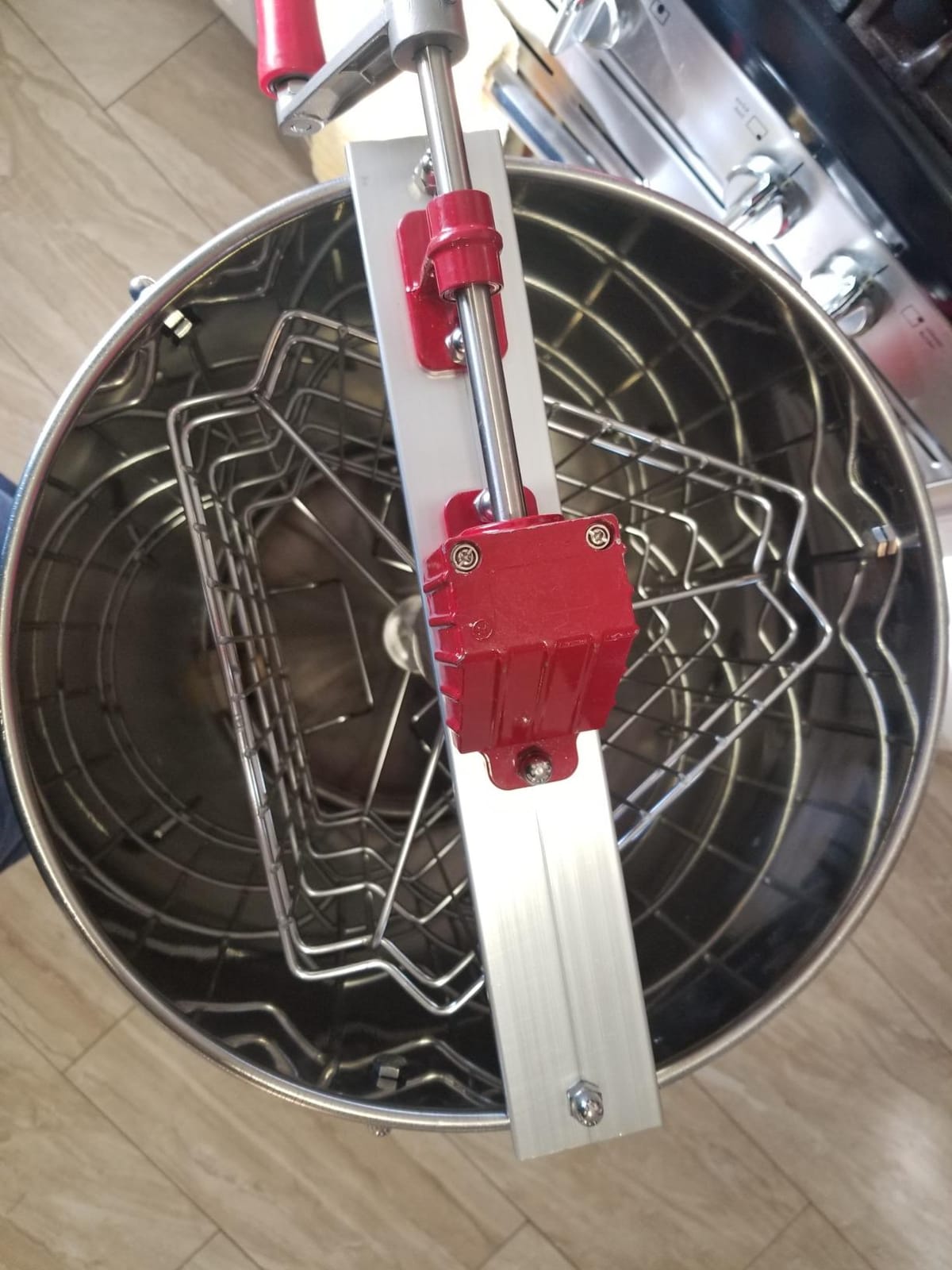
The drum is 22 gauge food-grade stainless steel, which rinses clean with warm water and mild soap and resists the corrosion that eventually pits lesser steel. The crank runs through sealed bearings and steel gears on a low-friction system designed to reduce internal wear, so the spin stays smooth across seasons rather than turning gritty after a year. The frame cage measures about 7 inches tall by 11 inches wide inside a drum roughly 15 by 24 by 15 inches.
The clear Plexiglass lid does more than let you peek. It contains the splatter that a spinning deep frame can throw, which keeps the surrounding area clean and stops you breathing in droplets. The three-piece metal leg stand raises the drum to a comfortable height, and everything runs on the included hand crank assembly with no electricity anywhere in the process.
Its 4.0 average across 137 reviews is honest but less even. A larger share of three-star reports than any other unit here points to a long tail of owners whose drainage and finishing yield fell short of what they expected, rather than one systemic fault. The included parts list is thorough, with the extractor, lid, leg stand, crank assembly and interior frame all named in the box.
Who this extractor suits
It suits a beekeeper with three to six hives who wants more than two frames per pass and would rather not run a cord or a motor. The stand solves the height problem that makes cranked extractors tiring, and the wide drum handles deep, medium or shallow frames in the same batch.
It also suits a beginner with no reliable power who is planning to grow. You can learn every part of the process without any electrical commitment, and move to a motor later without having wasted anything but time.
Where owners report trouble
At 26 pounds the bare machine is a two-person lift, so assemble it where it will live rather than carrying it across a yard alone. The stand is not decorative; it is there for a reason.
Yield expectations are the other honest caveat. Owners who wanted the throughput of an electric unit find three frames and a crank slow going. If you are already past six hives, look up the size ladder rather than buying here and wishing you had not.
6. Little Giant 2 Frame Hand-Crank Extractor – Best Complete Kit
Little Giant® 2-Frame Honey Extractor for Beekeeping | Hand-Crank Manual Honey Extractor Equipment | Stainless Steel | Beekeeping Supplies
18/10 stainless steel
Tangential design, hand crank
Two deep or medium frames
Crank gate cover and legs in the box
The Good
- Cleanest build finish in the group with 18/10 stainless steel
- Hand crank honey gate cover and height-adjustable legs all included
- No one-star ratings in its review pool
- Clear instructions for the initial assembly
The Bad
- Two frames per load only
- Costs close to a large electric unit
- Small review pool of 30 means limited long-term history
The Little Giant is the odd one out here, and that is exactly why it is worth a look. It is a tangential design rather than a radial one, which changes how the honey leaves the comb, and it is built in 18/10 stainless steel from a long-established equipment maker rather than a general importer. Everything you need arrives in the box: hand crank, honey gate, cover and height-adjustable legs, plus instructions that cover the initial assembly.
Within its small review pool the sentiment is unusually clean, with no one-star ratings at all and a high share of five-star reports. Reviewers point to the stainless steel build and to the completeness of the kit, which is a real advantage when you would otherwise be ordering a stand separately. It takes two frames at a time, and it handles either deep or medium frames, so it is not fussy about your box type.
The catch is arithmetic. This costs close to what a much larger electric extractor costs while holding only two frames, and its 30 reviews mean there is not yet a long record of owners running it across multiple seasons. We would rather say that plainly than inflate a small sample into a recommendation we cannot back.
Some initial assembly is required before first use, which is normal, and the instructions cover it. Set it up, run a test load with a frame you can afford to sacrifice, and you will know quickly whether the tangential geometry suits how you work.
Who this extractor suits
It suits a one or two hive hobbyist who wants a tidy, complete, well-finished machine and does not want to chase a missing gate or a separate stand. It also suits a buyer who wants a tangential extractor specifically, since almost everything else in this roundup spins frames differently.
It suits anyone planning to run larger extraction days and stay clear of electrics. What you get here is a well-made small machine, not a growing one, and that is fine if two frames is genuinely enough.
Where owners report trouble
The review pool is the honest weakness. Thirty reviews is a small sample, and a 4.4 average drawn from thirty owners tells you less than a 4.3 drawn from 882. Treat it as a good first impression rather than a proven long-term record.
Two frames per load is a hard limit, and at this end of the market the price per pound extracted will be the highest of anything we list. If you have any real chance of scaling past three hives, buy the two-frame machine you can grow out of comfortably rather than the nicest one.
What Is a Honey Extractor and Why You Need One
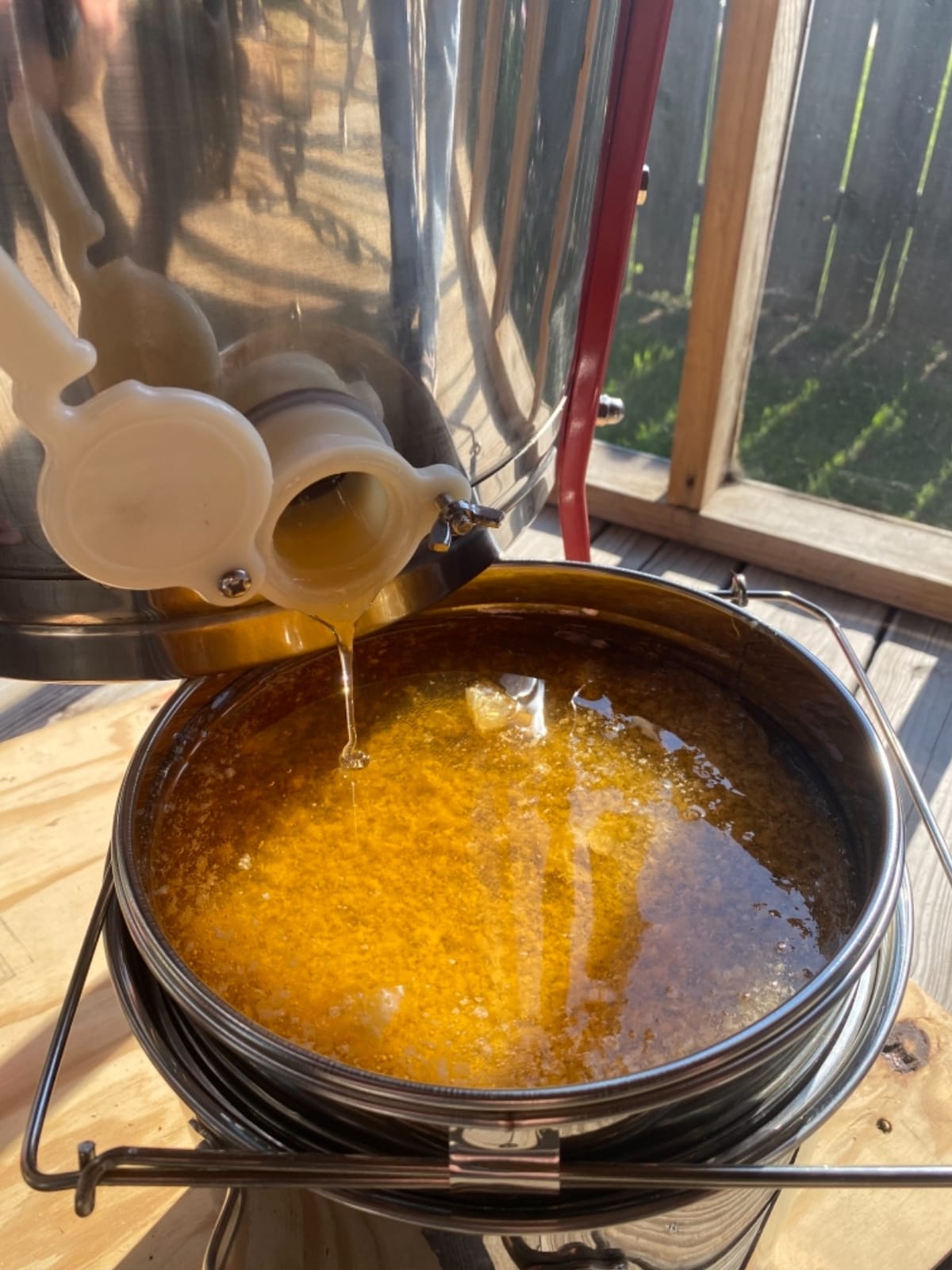
A honey extractor is a drum-shaped machine that uses centrifugal force to spin honey out of uncapped honeycomb frames without destroying the wax comb. Honey leaves the comb because the spinning throws it outward against the drum wall, while the comb stays whole on its frame. The honey runs down the inside of the drum, collects in a conical floor and drains out through a gate into a bucket.
The process itself is four steps. You uncap the sealed cells with a knife or an uncapping fork. You load the frames into a basket inside the drum, balancing opposite pairs so the load spins true. You bring the drum up to speed gradually. You open the gate and let the honey drain into a food-grade container, straining it as it comes out to catch stray wax and bee debris.
Why bother when you could crush the comb and strain it? Because the economics are lopsided. Rebuilding one pound of wax comb from scratch costs the hive roughly seven pounds of honey, and that honey never makes it to your jar. Crush and strain also wrecks comb, so you replace foundation every year and pay for it twice over. A machine that returns comb intact protects the yield and, as owners consistently report, pays for itself inside a season or two.
What to uncapping with is a related question beekeepers ask constantly. The most effective tool is a sharp uncapping knife or a serrated uncapping fork for cappings that will not budge, and experienced beekeepers reach for a dedicated heated uncapping knife in cold weather because warm cappings come off cleanly while cold ones tear. An electric uncapping knife on a timer is the fastest route on a large harvest. Below that, a plain knife and a fork cover almost every small operation, and neither is expensive.
Radial vs Tangential Extractor Geometry
A radial extractor pulls frames outward toward the drum wall, so honey is thrown almost straight sideways out of the comb. Frames sit around the basket with their top bars level, and honey drains freely as the drum turns. This geometry handles deep frames and medium supers with equal ease, which is why it dominates commercial and high-volume equipment.
A tangential extractor pushes frames against the wall at an angle, so honey runs along the comb and down rather than being thrown outward. That makes it better suited to shallow frames, and it means you flip and reposition frames partway through a load to get the far side. Tangential designs are simple, compact and inexpensive, which is why they dominate small manual machines like the Little Giant in this roundup.
The practical difference is labor. Radial saves flips and speeds up each pass. Tangential is cheaper and lighter, and for a hobbyist with a handful of frames that trade is usually worth making. The cost is your arms, and your back, if the drum sits too low.
Manual vs Electric Extractors and How Many Hives You Run
Manual or electric comes down to hive count and available labor, not to quality. A good hand crank pulls exactly as much honey from a frame as a small motor does. The motor buys you speed, quiet and no sore shoulders, and it costs you a power source, a heavier machine and one more thing to fail.
The break-even most experienced beekeepers describe sits around five hives. Under that, the number of batches is small enough that cranking is a minor part of a harvest day. Above it, electric earns its place because the frames pile up faster than you can turn them.
A rough ladder, based on what this lineup actually holds:
1-2 hives: a two or three frame hand crank. Small batches, no power needed, minimal cost.
3-5 hives: a two or four frame electric with adjustable speed. The sweet spot for most hobbyists.
6-10 hives: a four-deep or eight-shallow electric or an eight frame rack. Fewer passes and far less flipping.
10+ hives: a large radial machine, or better, a shared club or commercial unit you borrow for two days a year.
Watch the frame depth trap while you read that ladder. Listings quote a single number, and an eight-frame machine may mean eight shallow frames or only four deep ones. A four-frame machine often means four shallow frames or two deep. Count the frames of your actual box type, not the number in the title.
Why Your Honey Extractor Shakes and How to Stop It
Wobble and vibration are the most repeated complaint in every beekeeping discussion of extractors, and almost all of it comes down to two things: an unanchored machine and an unbalanced load. Neither is a defect. Both are fixable in an afternoon.
Anchor it first. Cut a square of plywood, place the leg plates on it, and bolt through with the holes the manufacturers provide. Most leg plates come predrilled for exactly this. Many owners also find that a sheet of rubber matting between the plywood and the floor absorbs the residual movement that hard bolting does not.
Balance the load second. Load frames in opposite pairs, and put the heavier frame nearer the drum wall so the rest of the load counterweights it. A top bar with a single frame on one side and none opposite is the classic cause of a violent spin, and no machine is designed to fix an uneven load.
Raise the drain third. A drum that drains poorly tips forward violently as honey shifts. Elevation fixes both the drainage and the wobble, which is why the machines with adjustable stands from 39 inches upward tend to receive better stability reports. If your bucket will not fit under the gate, build a riser before you extract, not during.
Cleaning, Crystallized Honey and Off-Season Storage
Rinse the drum the same day you extract. This is the single most useful habit in the whole process, and the reason forum threads keep repeating it. Honey left on warm steel for a week begins crystallising into a hard film in the corners and around the gate threads, and owners report that removing it afterwards is a genuinely miserable job.
Warm water and mild soap do the work. Avoid harsh detergents and anything abrasive, and dry everything thoroughly before storage, because standing water on stainless steel is what leaves marks. Wipe the crank shaft and gear teeth down and put a light film of food-grade oil on them before the machine goes away for the winter.
Store it dry, indoors and covered. A stainless drum left outdoors through winter will pick up surface spotting even if the steel is good, and the bearing and gear areas need to be dry and free of dust. Set it on a pallet or a shelf rather than on a bare concrete floor, which is where most moisture sits.
If you do find crystallised honey in a drum, a long soak in hot water loosens it far better than scraping. Never use a knife inside the drum, because a single scratch becomes a corrosion site that grows every season.
Extractor Safety Before You Spin
Almost every electric extractor in this roundup is powered by a small motor running 120V mains, and two safety habits cover most of the risk. First, run electric units from a GFCI-protected outlet, and never with a wet floor or damp hands, because a spilled bucket of honey and a wet concrete slab is exactly the combination that turns a motor fault into a shock. Second, learn where the switch is before you need it.
The spinning basket is the other hazard. A drum coming up to speed throws frames outward against the wall with real force, and reaching in to steady a wobbly load is how people get hurt. Never put a hand, a tool or a loose sleeve near a running basket. Stop the drum completely before opening the lid, and use the interlock where a machine has one, the way the VEVOR 2/4 Frame does.
Motors get hot. Give a 140W unit clearance on all sides and do not run extraction in an enclosed shed with no airflow. Frames are also hot work when you are uncapping dozens of them under a lamp, so treat the whole extraction evening as a warm job and pace it accordingly.
Finally, wear closed shoes. Leg plates and frame top bars do not stay where you left them, and the single most common minor injury reported around extractors is a crushed foot.
Buying Guide: 7 Things to Check Before You Buy
Frame count and depth. Decide your box type first, then count frames. A machine advertised as four frames may hold four shallow or two deep. This is the most expensive mistake available to a new buyer, because the machine is fine, it just is not the machine you thought.
Bucket clearance. Measure the height of your five-gallon bucket and check the drain height before checkout. A gate that sits too low forces a riser, and a riser is a wobbly machine. The VIVO earns its spot partly by clearing a bucket with no improvisation.
Steel gauge and welds. Heavier gauge stainless is stiffer and lasts longer. A flexing drum vibrates, and vibration damages comb. Sixteen and eighteen gauge are the solid end of the range you will see at this size.
Gear and bearing construction. Sealed bearings and enclosed metal gears keep honey out of the drivetrain. Exposed plastic gears are a sign the machine was designed for occasional use, not seasons of harvests.
Speed control and interlock. Adjustable speed lets you ramp up gently and protects fragile comb. A lid interlock that cuts power when the lid opens is worth more than it sounds, because lids do get lifted out of habit.
Support and parts. Ask who answers the phone and where a replacement motor comes from. A US-based manufacturer with a one-year warranty is a different long-term proposition from an import listing with slow responses, and this shows up exactly when a season depends on it.
Warranty length. A stated one-year limited warranty is the current norm in this category and a reasonable baseline. A listing with no warranty information at all is worth avoiding regardless of the specifications.
One more practical check. Ask your local bee club whether they own a shared extractor and when it next runs. Members frequently get access for a nominal fee or in exchange for helping, and a season of borrowed extraction is the cheapest way to learn which frame depth and which batch size you will actually need.
Frequently Asked Questions
Which is better, manual or electric honey extractor?
A hand crank pulls exactly as much honey from a frame as a small motor, so the choice is about speed and labor rather than yield. Below about five hives the batch count is small enough that cranking costs you little. Above five hives an electric unit earns its place because frames pile up faster than you can turn them. Manual also wins outright if your apiary has no reliable power.
Are VEVOR honey extractors any good?
Generally yes, for a first extractor, and beekeepers in the forums describe them as acceptable once you bolt them down. The 2 Frame Manual has the largest owner review pool of anything in this roundup and holds a 4.3 average across 882 reviews, with fast assembly and easy cleaning the most praised points. The recurring criticism across both models is a light tripod stand that flexes and walks unless it is anchored to plywood.
What is the most effective tool for uncapping honey?
A sharp uncapping knife or a serrated uncapping fork covers almost every small operation, and a dedicated heated uncapping knife is the fastest route on a large harvest because warm cappings lift cleanly instead of tearing. Experienced beekeepers reach for the heated option in cold weather, when cold cappings shred the comb. An electric uncapping knife on a timer is the quickest method of all when you are processing dozens of supers.
How long does it take to extract honey with an electric extractor?
Time is driven by batch size more than by motor. A two or four frame electric extractor handles a load in a few minutes, and the limiting factor is how quickly you uncap, load and unload. An eight frame rack roughly halves your number of passes compared with a two frame manual, so the savings show up across a whole harvest day rather than in any single batch. Budget most of a day for a moderate backyard harvest.
Why does my honey extractor shake so much?
Two causes account for almost all of it. First, the machine is unanchored, so cut a square of plywood and bolt the leg plates to it, which is why most leg plates come predrilled. Second, the load is unbalanced, so load frames in opposite pairs and place the heavier frame nearer the drum wall. A poor drain that forces you to tip the drum forward adds to the movement, so raise the machine enough for your bucket to clear.
What is the 7/10 rule in beekeeping?
It is a rule of thumb for timing a hive inspection rather than an extraction rule. Most beekeepers wait about seven days after the queen is seen laying before judging whether she is laying, and look for eggs, larvae and capped brood across roughly ten frames in total. Applied in practice, check a small sample of frames rather than the whole hive, judge the pattern rather than a single frame, and record what you saw so you can compare the next visit.
Once the honey is extracted and strained, it is worth having a plan for what happens next rather than storing it in a warm kitchen. A honey butter recipe is a good way to use a small early batch, and a honey mustard dressing turns another jar into a keepsake rather than a cupboard ornament. The same goes for tomato and feta with honey and a chipotle honey vinaigrette, which are simple ways to move early honey before it has a chance to granulate.
Conclusion: Which Honey Extractor Should You Buy
The best honey extractors for most beekeepers start with one question, which is how many hives you have. One to two hives means a hand crank, and our pick is the VEVOR 2 Frame Manual because 882 owners say more about it than any other machine in this roundup. Three to five hives means a compact electric, and the VEVOR 2/4 Frame Electric gives you adjustable speed and a lid interlock without a large footprint. Six hives or more means capacity, and the VIVO BEE-V004E handles four deep frames or eight shallow frames per load with a gate that clears a standard bucket.
Whichever one you choose, bolt it to plywood before the first spin, balance your loads in opposite pairs, and rinse the drum the same day. Those three habits will do more for your comb and your machine than any feature on any spec sheet, and they are the reason the same handful of extractors keep appearing as recommendations year after year in 2026.