
A heated water bucket is a water container with a thermostatically controlled electric heating element built into its base or walls, designed to keep water just above freezing in stalls, pens, and paddocks through sub-zero weather. The thermostat cycles the element on near 35F and off near 60F, so animals get liquid water without it being heated to drinking temperature.
That last point matters more than it sounds. A frozen bucket is not a minor inconvenience; it is a water source that does not exist until somebody chips out a block of ice at 6am in the dark. Horses and cattle will drink noticeably less when water is near freezing, and goats are especially prone to urinary calculia when water intake drops. Poultry keepers see the same thing as a sudden drop in egg output. If you keep animals through winter, water reliability decides whether the rest of your winter plan works. Our emergency food bucket guide covers the other half of that same preparedness picture.
We compared ten heated water buckets and pail heaters on the things that actually decide whether one survives a winter: rated wattage, thermostat behaviour, body material in deep cold, cord length and chew protection, and the certifications printed on the label. The list covers horses, sheep, goats, poultry and large dogs, and it includes two options for barns that have no power at all. If you came here for a general cold-storage read instead, our ice bucket picks cover that side of the market.
One thing to say plainly before the picks: a heated bucket keeps water liquid, it does not make it warm. Several listings blur that line, and a few owners buy expecting a hot bucket. Every thermostatically controlled unit in this roundup is a freeze-prevention device, and only one of the ten is a warming device, and we label it as such.
Top 3 Picks for the Best Heated Water Buckets in 2026
Our best rated livestock bucket, our strongest large-animal option, and our best certified budget option sit at the top because they cover the widest range of real barns. The winner has the highest average rating in the group by a wide margin and the second-largest review count of any bucket here.

Farm Innovators FB-120 5…
- 120W thermostat controlled
- Turns on 35F off 60F
- Anti-chew cord protector
- Hideaway cord compartment

Farm Innovators 16 Gallon 200W
- 16 gallon capacity
- 200W element
- Replaceable concealed element
- Easy-grip handles

API 20FB 5 Gallon 115W
- 115W over-temp protection
- CSA and UL listed
- Impact-resistant polyethylene
- 6 inch chew-proof cord
Best Heated Water Buckets at a Glance in 2026
Everything below is a freeze-prevention or bucket-warming device, and the last row is a different category entirely. Read the best-for column before the wattage column, because the right wattage for a five-gallon poultry waterer in a Tennessee winter is not the right wattage for a sixteen-gallon tub outside a Michigan barn.
| Product | Key Specs | Buy |
|---|---|---|
|
|
Check Latest Price |
|
|
Check Latest Price |
|
|
Check Latest Price |
 |
|
Check Latest Price |
 |
|
Check Latest Price |
 |
|
Check Latest Price |
 |
|
Check Latest Price |
 |
|
Check Latest Price |
 |
|
Check Latest Price |
 |
|
Check Latest Price |
Two rows deserve a flag before we get into detail. The K&H unit is a submersible de-icer you drop into a bucket you already own, not a heated bucket, and the Powerblanket is a warming blanket that does nothing to prevent freezing. Both are in the list because owners ask for them by name, and both are reviewed honestly on their own terms.
1. Farm Innovators Heated Flat-Back Water Bucket 5 Gallon 120W – The Best Rated Bucket for Horses, Goats and Sheep
Farm Innovators Heated Flat-Back Water Bucket, 120 Watts, 5 Gallon
5 gallon plastic
120 watt element
Turns on 35F off 60F
Anti-chew cord
4 lb empty
The Good
- Highest average rating in the group
- 4.7 stars across 945 reviews
- 87% of reviews are five-star
- Thermostat only runs the element between 35F and 60F
- Flat back hangs level and stable on a wall or fence
- Hideaway cord compartment so it doubles as a plain bucket in summer
The Bad
- 120W is the weakest element among the livestock buckets here
- Five gallons empties fast with several large animals drinking
- Plastic body can crack after a few seasons in service
This is the bucket we would put in a stall first. It carries a 4.7 average across 945 reviews with 87% of those reviews at five stars, and that combination of rating and volume of feedback is what put it at the top of our list rather than one of the higher-wattage models. Owners running it for horses, sheep and goats through ordinary winters report ice-free water without a daily chip-out routine.
The thermostat is the part worth understanding. It switches the 120 watt element on at 35F and off again at 60F, which means the bucket holds the water in that band instead of driving it hot. Reviewers notice the same behaviour we would expect from that spec: the element idles through mild spells and only works hard when the water actually approaches freezing.
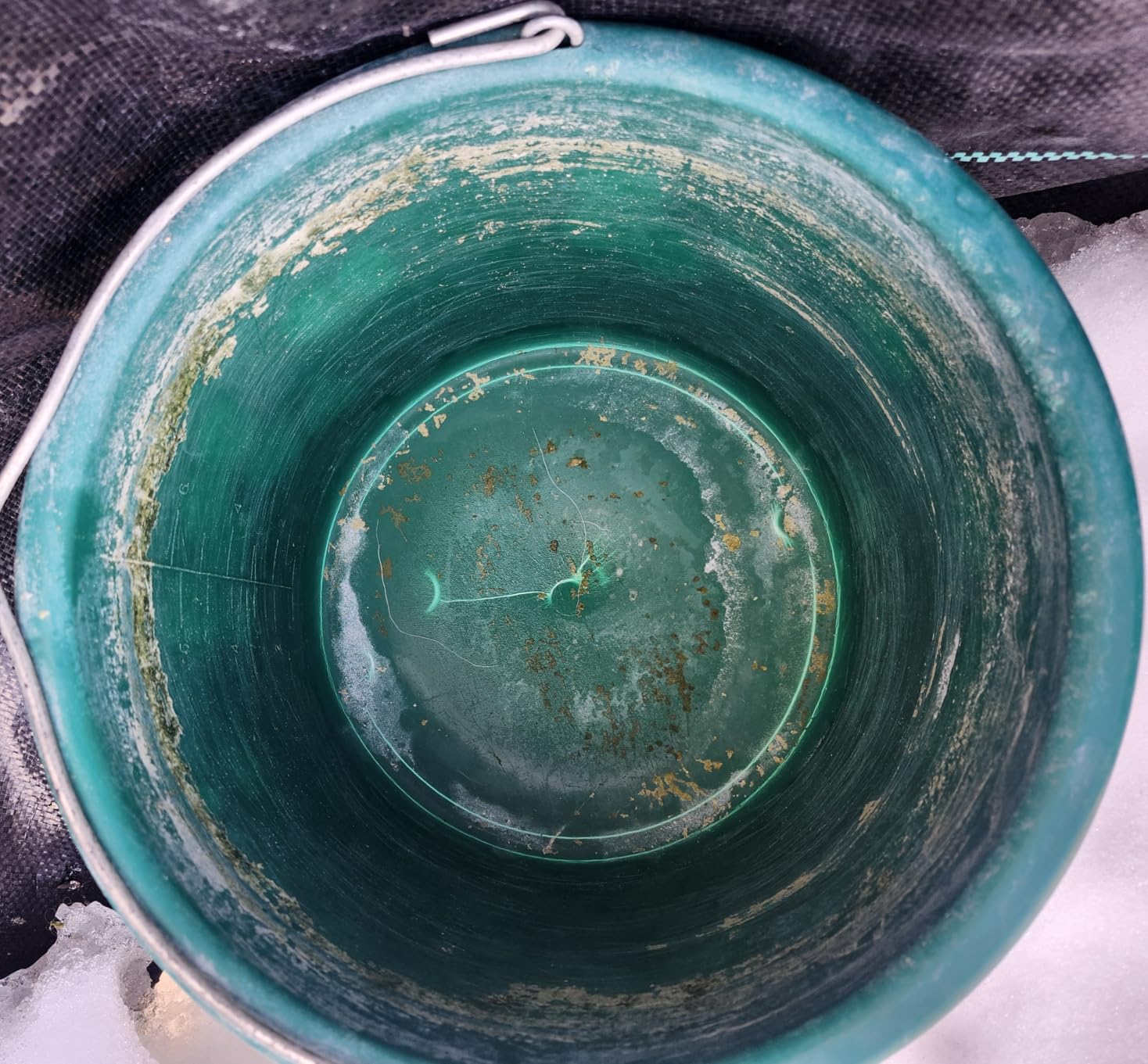
The flat back is the practical reason this hangs rather than tips. It sits flush against a wall or fence rail and stays level, so a horse pushing at the bucket cannot swing it and tip the water out. A spill-free pour spout and an etched measurement table inside the wall make dosing electrolyte or medication far less guesswork than eyeballing a round pail.
There is a hideaway cord compartment, which turns a winter-only appliance into a usable year-round bucket. That matters for barns with limited storage, where dedicated winter water containers tend to disappear into the back of the shed until January. We also appreciate the heavy-duty anti-chew cord protector, though it is a sheath rather than a guarantee.
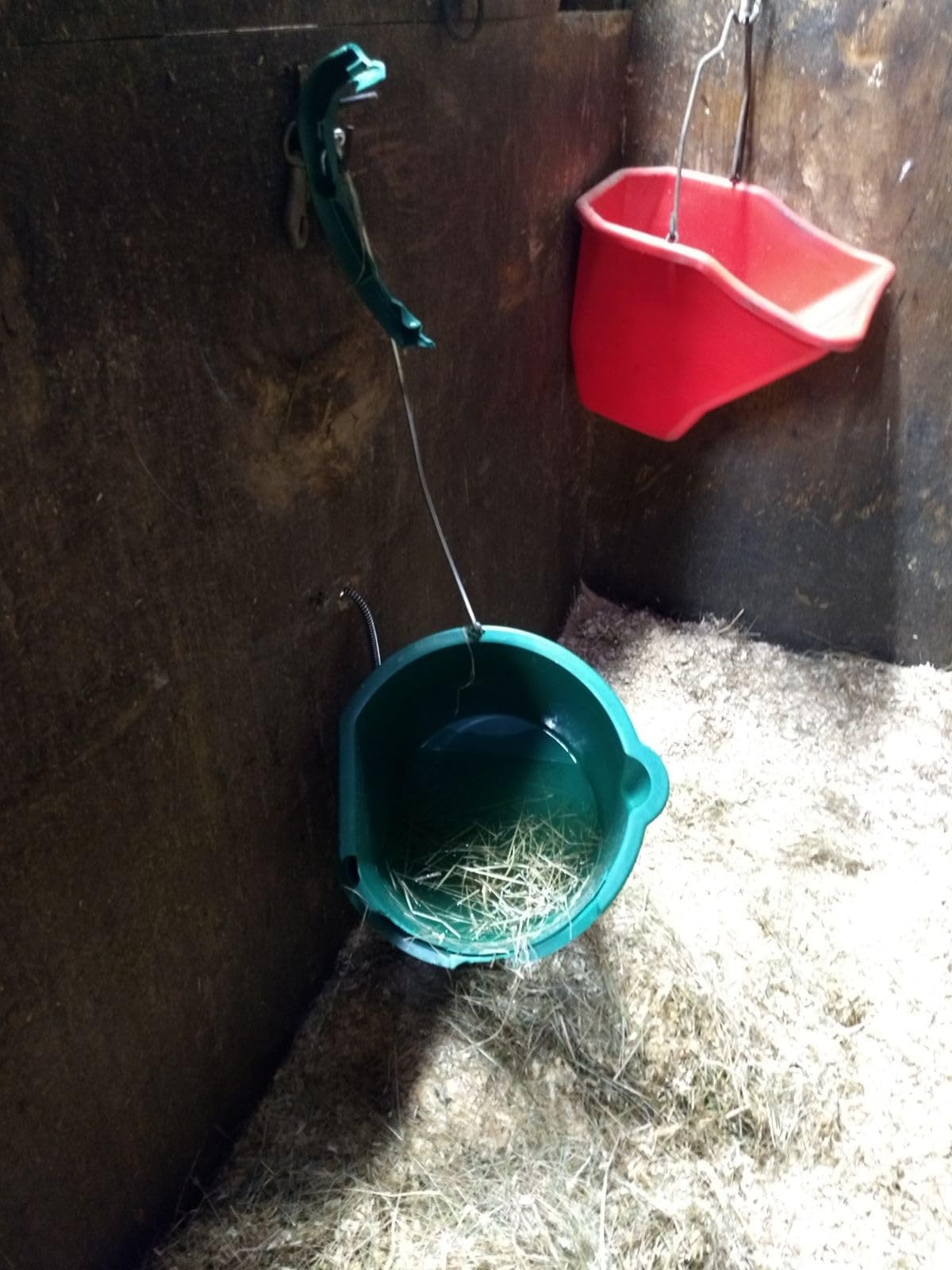
Is 120 watts enough for a horse stall in deep winter
For ordinary winters, in a sheltered stall or a lee of the barn wall, reviewers report this holds without intervention. The weakness shows up in sustained deep cold with wind exposure, where a minority of owners note a thin skim of ice at the surface before it clears. If your barn sits in an exposed position or you regularly see sustained single-digit temperatures, step up to a 200 or 260 watt model rather than adding blankets or insulation around this one.
For a horse, five gallons is a working water capacity rather than a full-day supply. Several animals drinking from it will empty it faster than you expect, and more frequent filling is normal. If you want fewer trips to the bucket without moving to a tub, the sixteen-gallon picks later in this list are the step up.
What breaks first on this bucket
The plastic body is the weak point, and owners report the pail eventually developing stress marks and cracks after a few seasons of use. That is the expected trade for a lightweight container that is easy to carry and easy to hang. The element itself draws far fewer complaints than the body does.
The cord protector slows down chewing but does not stop a determined foal or goat. Our advice is to assume every cord will be tested by an animal at some point and to plan the protection before winter, not after the first bite mark appears.
2. Farm Innovators 16 Gallon Heated Bucket with 200W Replaceable Element – Best for Horses, Cattle and Multi-Animal Barns
Farm Innovators Heated Water Bucket, 16 Gallon 200W Livestock Waterer
16 gallon plastic
200 watt element
Replaceable hidden element
6.8 lb empty
The Good
- Largest capacity among the plastic pails here at 16 gallons
- 200 watts handles serious cold
- Replaceable element extends the life of the bucket
- Element hidden in the wall where livestock cannot reach it
- Thermostatic control avoids wasted power in mild weather
The Bad
- Heavy to move when full and needs a level surface or wall mount
- No cord storage so it stays a winter-only item
- Some buyers report the element or cord failing after several seasons
This is the one to buy when a bucket is shared by more than one large animal. At 16 gallons it holds 4.5 times what the five-gallon pails on this list hold, and reviewers with horses and cattle say that is the difference between filling twice a day and filling once. It scores 4.5 stars across 857 reviews with 80% of those at five stars.
The 200 watt element is the reason it works where smaller buckets struggle. The thermostat controls it, so it idles in mild weather, but when a hard snap arrives there is meaningfully more heat to give than a 90 or 120 watt unit can produce. Owners in northern climates report it holding through conditions that iced over smaller pails on the same property.
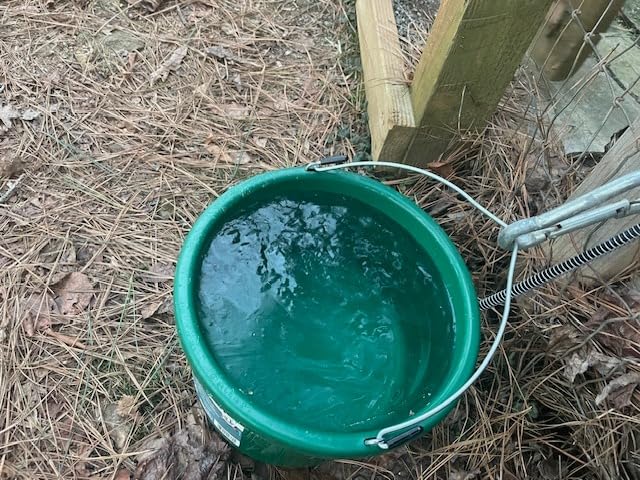
The replaceable element is the standout feature and the one competitors do not match. When a heating element dies, you can swap it rather than throwing away a whole pail. The element is hidden inside the bucket wall where animals cannot reach it, which removes the single most common way a submersible heater gets pulled out of the water or damaged by hooves and beaks.
Easy-grip handles help with transport, and reviewers praise them for exactly the situation you would expect. Empty, the pail weighs 6.77 pounds and measures 24 by 24 by 16.5 inches, so you want a clear path between the tap and wherever it lives.
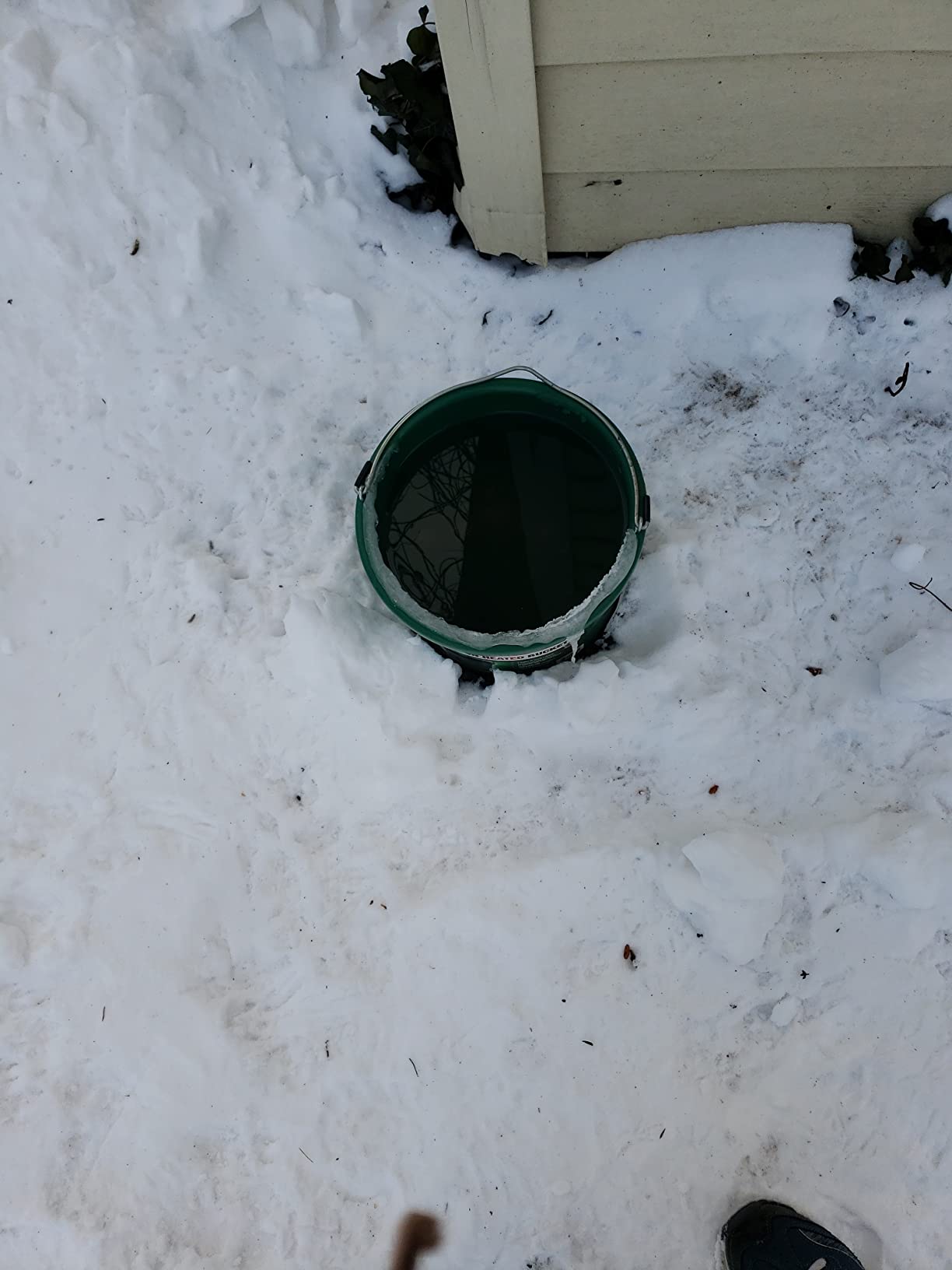
When a 16 gallon bucket is the right size and when it is overkill
It is the right size for a barn with two or more horses, a mixed goat and sheep group, or cattle, where refilling a five-gallon pail several times a day becomes a chore you will eventually stop doing properly. It is overkill for two house goats or a pair of barn cats, where a smaller pail is easier to move, easier to empty and cheaper to run.
Be honest about the weight. A full sixteen-gallon bucket is close to 140 pounds of water plus the pail, and owners specifically flag that a full bucket needs either a wall mount or two people. Set it before you fill it, and do not plan to reposition it once it is full.
What to check before the first hard freeze
There is no cord storage compartment on this model, so plan to store it with the cord clear of the water and out of the way of hooves when it is not in use. A coiled cord stored damp in a barn is exactly the condition that leads to a failure at the junction.
Reviewers do report some element and cord failures after several seasons, which is normal for any heated water appliance. The difference here is that the element is replaceable, so a failure is a parts cost rather than a replacement cost.
3. API 5 Gallon 115 Watt Heated Flat Back Bucket 20FB – The Most Versatile for Safety-Conscious Buyers
API 5 Gallon 115 Watt Heated Flat Back Bucket 20FB
20 quart polyethylene
115 watts
Over-temp protection
CSA and UL listed
5 lb empty
The Good
- Over-temperature protection stops the water cooking
- Impact-resistant polyethylene resists warping and stress cracking
- CSA and UL listed
- a real differentiator on a wet-barn product
- Flat back sits flush for stable hanging
- Also made in a 10 quart size for smaller herds
The Bad
- 6 inch cord is very short and usually needs an extension cord
- 115 watts is modest for the harshest climates
- No markings and no cord storage so it is purely a winter item
API has been building heated buckets long enough that the 20FB is a known quantity, and at 4.3 stars across 825 reviews with 74% at five stars it holds up over time. The thing that separates it from cheaper generic pails is the paperwork: it is both CSA and UL listed, and it carries built-in over-temperature protection rather than relying on the thermostat alone.
That combination matters in a wet barn. Dual certification means the whole unit, not a component, has been tested to North American electrical safety standards, and the over-temperature cutout is a second line of defence if the primary thermostat ever sticks. Forum owners treat UL and CSA marks as a genuine buying criterion rather than marketing, and this is one of the few buckets in our lineup that earns the question.
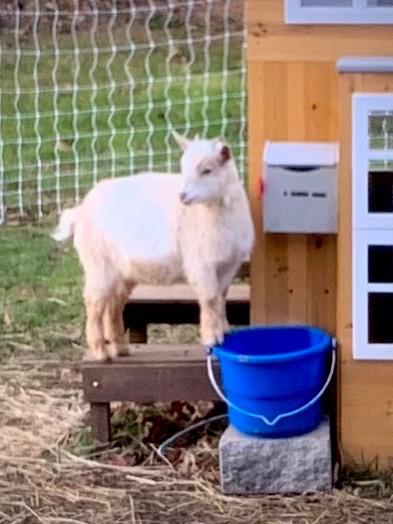
The impact-resistant polyethylene body is a deliberate choice over cheaper resin, and it resists the warping and stress cracking that turns a plastic pail useless after a season of freeze-thaw cycles. It also handles being knocked around by livestock in a way a thin-walled bucket does not. Reviewers with horses rank this model in the top tier of horse watering options for exactly that reason.
The flat back sits flush for hanging, which keeps the water level steady when an animal leans on it. The same family is made in a 10 quart size, which is a practical way to fit a smaller herd without dropping to a completely different product.
Plan for the short cord before you buy
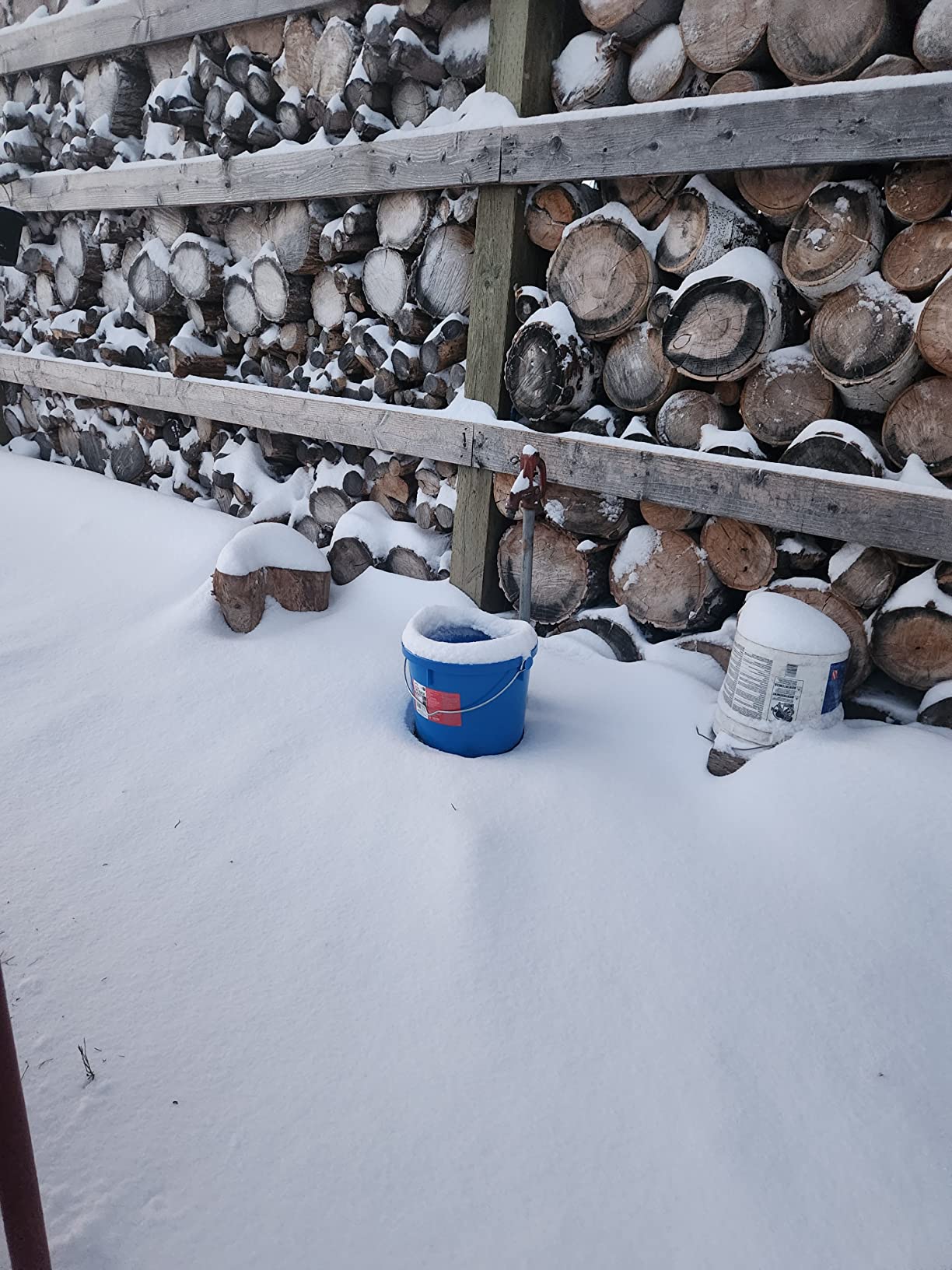
The most repeated complaint in reviews, and the one we would act on before anything else, is the 6 inch cord. It is sheathed for chew resistance, but it is far too short to reach a wall outlet in most stalls, which means an outdoor-rated extension cord is effectively part of the purchase. Buy a heavy-duty outdoor-rated extension, keep the connections above ground and out of any water trough, and use a GFCI-protected outlet.
Some early units also failed within the first couple of seasons, and one-star reviews tend to cluster on element failure or on buckets that froze over in extreme cold. At 115 watts, this is a moderate-output heater: it is comfortable in most climates and marginal in sustained deep cold with wind exposure.
What owners like after the first winter
Reviewers consistently come back to the same two things: the body holds up and the protection features mean they are not constantly checking it. There is no cord storage and no measurement marking, so it stays a winter item in the shed and dosing has to be done by eye.
That is the trade for this pick. You give up a few convenience features and get a certified, protected, well-made bucket at a price tier most barns can justify. For anyone nervous about electricity in a damp building, that is the right order of priorities.
4. Premier 1 All-Season Heated Poultry Waterer 3 Gallon – Best for Chickens and Ducks
Premier 1 All-Season Heated Poultry Waterer for Chickens & Ducks – 3 Gallon
3 gallon
100 watt thermostat
Nipple drinkers
16 ft detachable cord
6.3 lb
The Good
- Rated for up to 35 adult chickens
- Keeps water open through repeated hard winters
- Recessed nipples keep water far cleaner than an open trough
- Detachable 16 ft cord lets the unit work year-round
- Three spare nipples included and each one is replaceable
The Bad
- Insulated lid can freeze to the basin in extreme cold
- Some ice forms around the nipples in the harshest weather
- A replacement cord requires calling the manufacturer
- Instructions advise against an extension cord
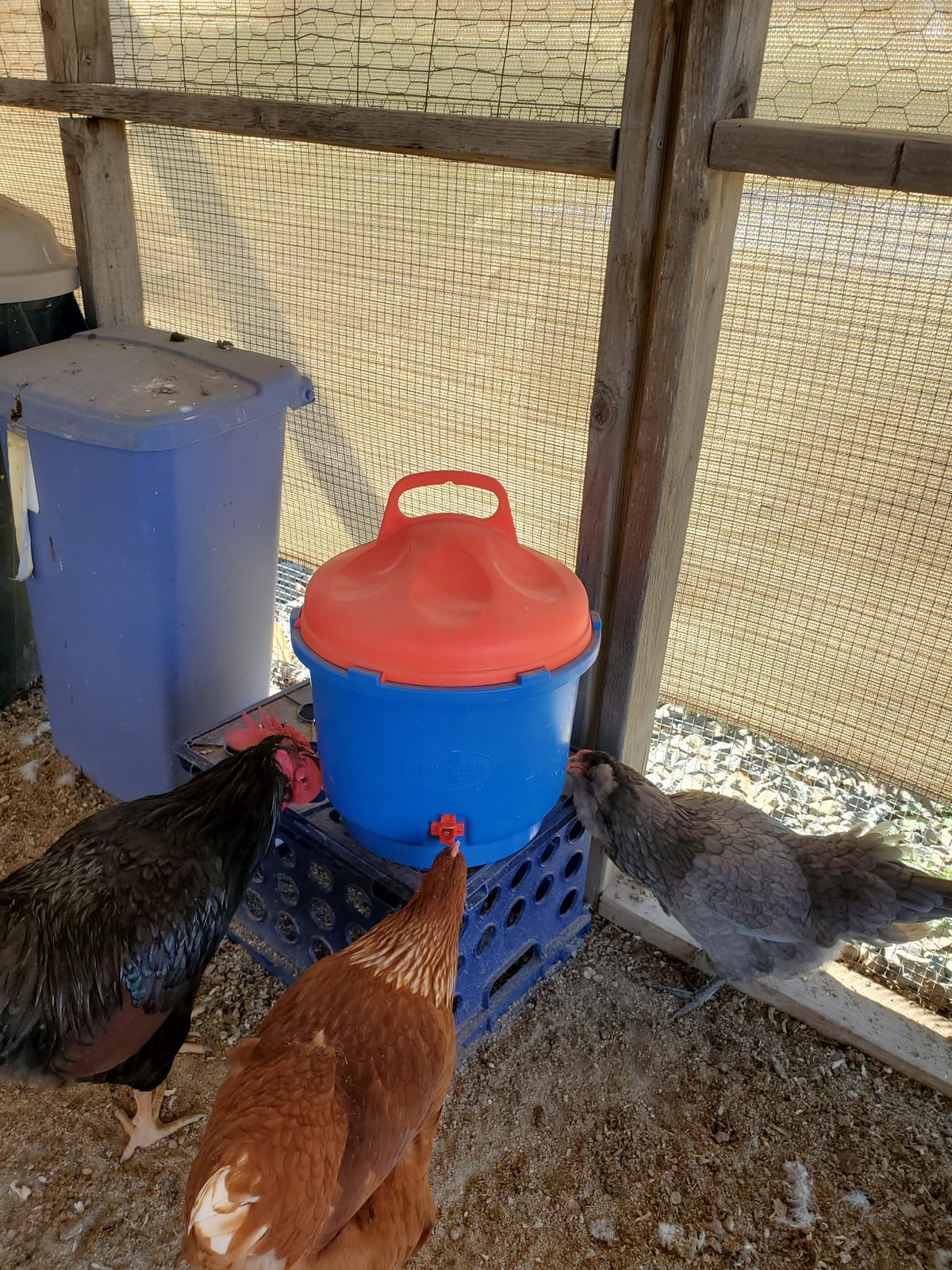
Poultry waterers solve a problem that heated buckets do not. A bucket of water in a chicken run freezes solid, and worse, it fills with bedding, droppings and feed dust within days. This 3-gallon unit is rated for up to 35 adult chickens and delivers water through three recessed horizontal nipples with three spares, so the birds drink from a small raised port and the reservoir stays covered.
Reviewers care most about two things: that it keeps water liquid through hard winters, and that the water stays clean. This is a 4.3-star unit across 840 reviews with 71% at five stars, and the recurring note is that nipple drinkers eliminate the daily scrub-and-refill routine. Chickens learn the nipples fast, and owners report the main learning curve lasting a day at most.
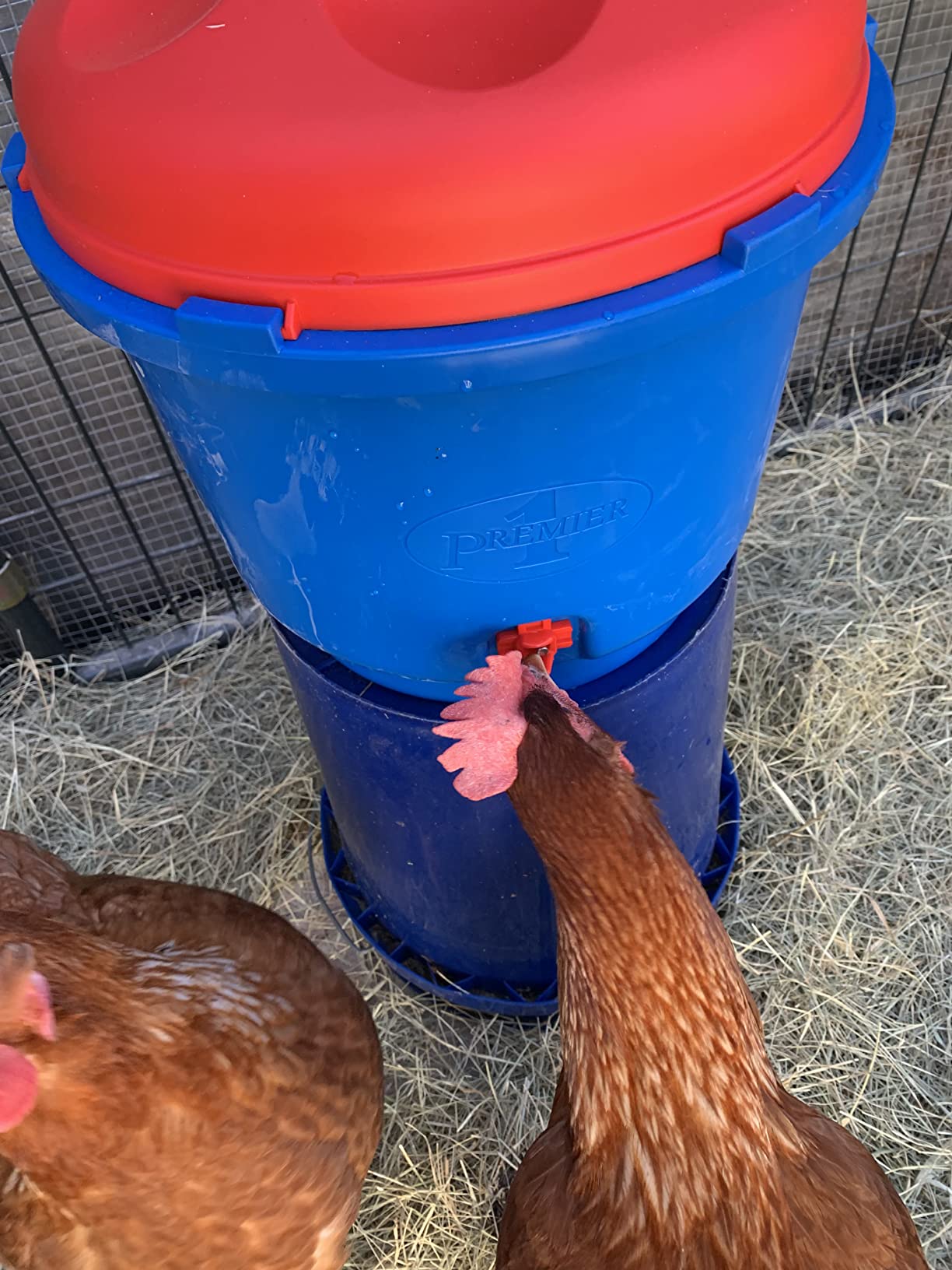
The 100 watt element is switched on below 40F and off at 60F. That setpoint is slightly warmer than most livestock buckets, and the design intent is explicit: the water is never hot or lukewarm, only liquid. In a coop where ambient temperature sits near freezing all day, a 100 watt element in a well-insulated body is enough, which is why the draw is modest compared with the submersible heaters later in this list.
The 16 foot detachable cord is the feature that turns this into an all-season piece of equipment. Unplug it in summer and the unit becomes a plain waterer, which roughly doubles its useful life and removes the awkwardness of storing a dedicated winter appliance for half the year. A hinged quick-fill cap accepts a hose or a watering can so you do not have to lift the whole insulated lid.
Coop placement matters more than wattage here
The dominant failure pattern in reviews is not the element. It is placement, and a power plug that was not fully seated in the outlet. Reports of ice-up cluster around exposed locations, coops with poor insulation and drafts straight through the water line, not around the thermostat. If your coop is unheated and drafty, expect to bring this unit inside during the coldest stretches rather than fight it.
Another real problem is the insulated lid freezing to the basin, which can mean thawing the whole unit out to refill it. Owners in the harshest climates treat that as an acceptable part of the deal in exchange for never doing a morning ice break.
Why the extension cord warning matters
The instructions advise against running an extension cord, and poultry keepers should take that seriously because coops are often damp and the run to an outlet can be long. If you need more reach, plan the outlet location before winter, ideally on a GFCI-protected circuit with a weatherproof cover, rather than improvising a run across the floor of the coop.
Replacing a damaged power cord means contacting the manufacturer directly rather than grabbing a generic cord, which is a real inconvenience if the cord fails in a hard season. Budget for that when you set the unit up, and inspect the cord each autumn.
5. API 16 Gallon 260 Watt Heated Bucket 16HB – Maximum Heat Output for Below-Zero Barns
API 16 Gallon 260 Watt Heated Bucket 16HB
16 gallon
High-wattage element
Overheating protection
Chew-proof cord
9.9 lb empty
The Good
- Highest heat output among the buckets in this roundup
- Built-in thermostat aimed at below-zero conditions
- Overheating protection built in
- Chew-proof cord suits animals that get at wiring
- Same family also made in a 9 quart size
The Bad
- Most expensive conventional bucket per watt here
- Weighs nearly 10 pounds empty so a full bucket is a two-person lift
- Some early element failures in the 1-star reviews
- Listing details conflict on wattage so confirm the model
If your winters are genuinely severe, wattage is the deciding spec. This 16-gallon API runs the highest heating output of any bucket we tested, and it is built for below-zero conditions rather than for a typical winter. At 4.4 stars across 576 reviews with 78% at five stars, it holds a strong rating with a smaller but committed user base.
It carries the same safety architecture as the smaller API bucket: a built-in thermostat plus separate over-temperature protection, so a stuck thermostat does not translate into cooked water. The chew-proof cord matters here because 16-gallon buckets are invariably used with animals large enough to reach and pull at wiring.
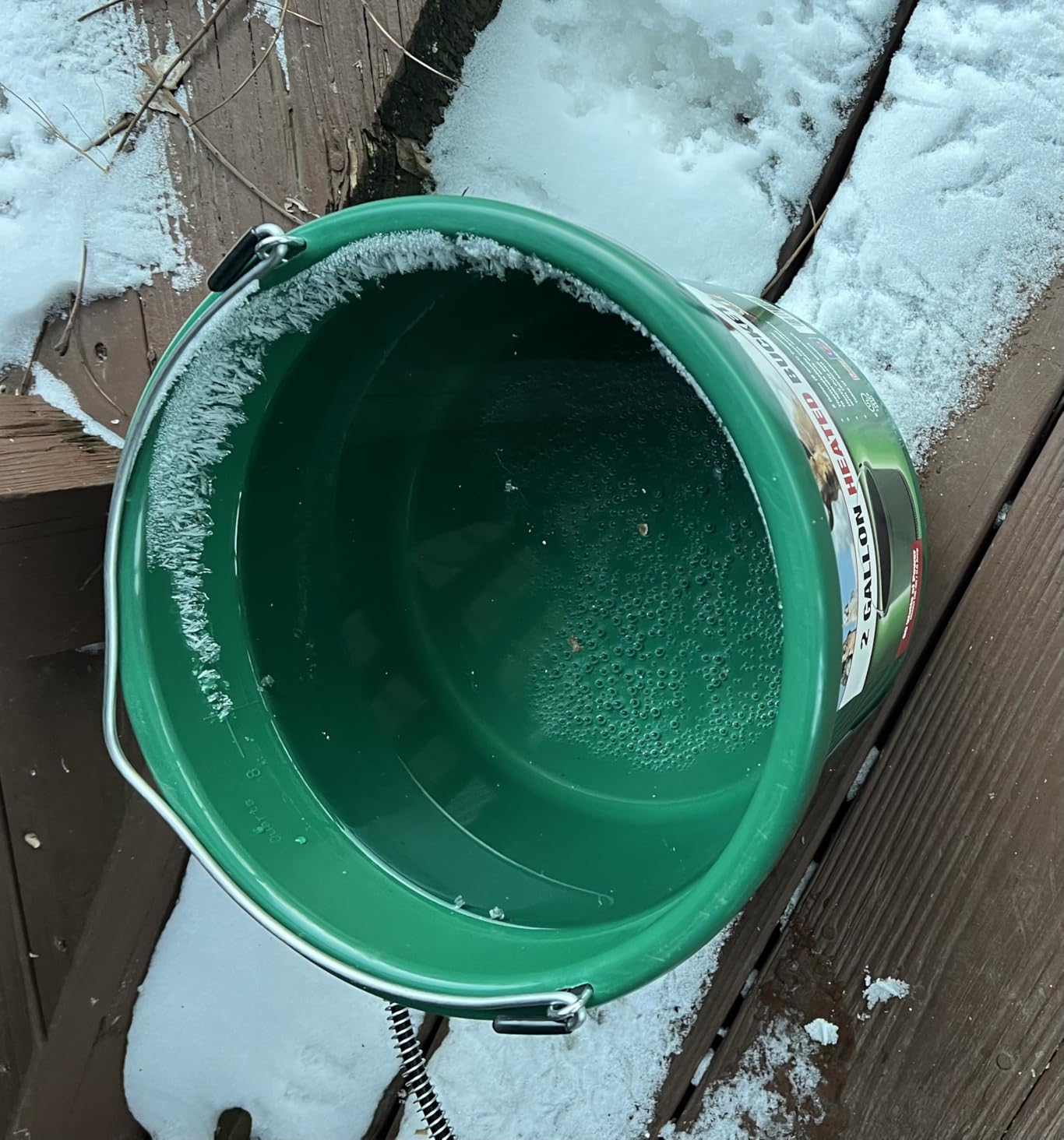
The listed use cases run wider than horses: cattle, calves, sheep, ostriches and large dogs all appear in the specification, which tells you something about the scale of animal this is built around. A large dog owner is the most unusual user in this roundup and this bucket is the most sensible option for one, since a five-gallon pail tips over and a drinking dog spills it.
The same family is made in a 9 quart size, roughly 2.25 gallons. If you are running one large animal on a small budget, that smaller version gets you the same thermostat and protection design in a package your back will thank you for.
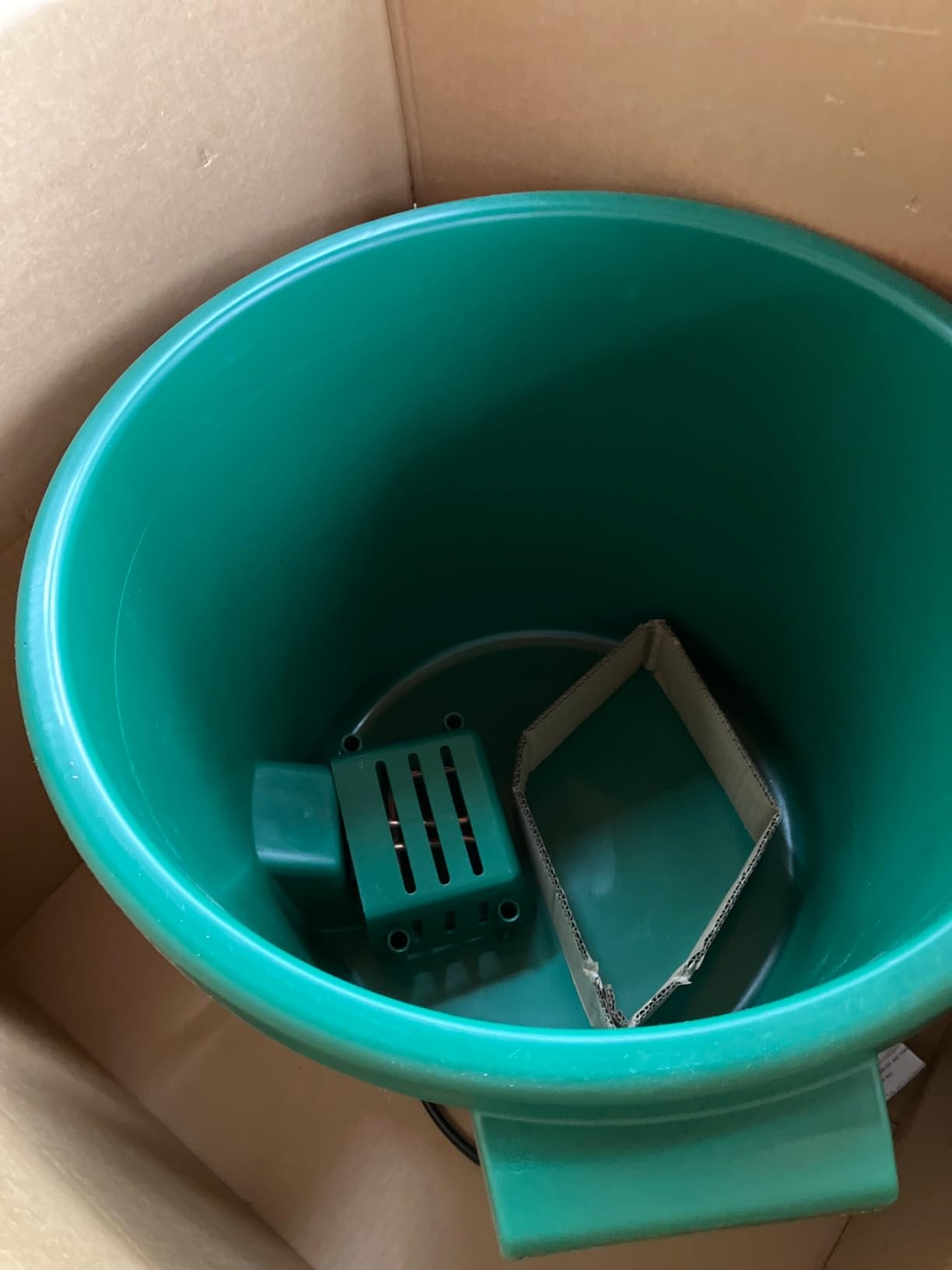
Check the wattage listing carefully
There is a genuine documentation conflict on this product. The bullet text on the listing shows one wattage figure while the model designation is a high-wattage unit, and reviewers flag this confusion directly. Confirm the model number is 16HB and treat the high-wattage specification as the one that applies, because that is the number that determines whether it holds in your climate.
We flag it because the difference is not academic. Owners who bought this expecting the lower figure and found themselves in sustained cold weather are the ones leaving one-star reviews, along with a minority reporting early element failures.
Weight and cost versus output
Empty, the bucket weighs 9.9 pounds and measures 23.25 by 21.5 by 16.75 inches. A full bucket is a two-person lift, so wall mounting or a permanent location is not optional. Plan where it goes before you fill it, and put it on a level surface where it cannot be knocked by a horse.
This is also the highest cost per watt of the conventional buckets in our lineup. We would still pay for it in a place that regularly drops well below zero, and we would not in a place that does not. The Farm Innovators 16-gallon model gets you most of the way there for less, and covers a 200 watt load instead.
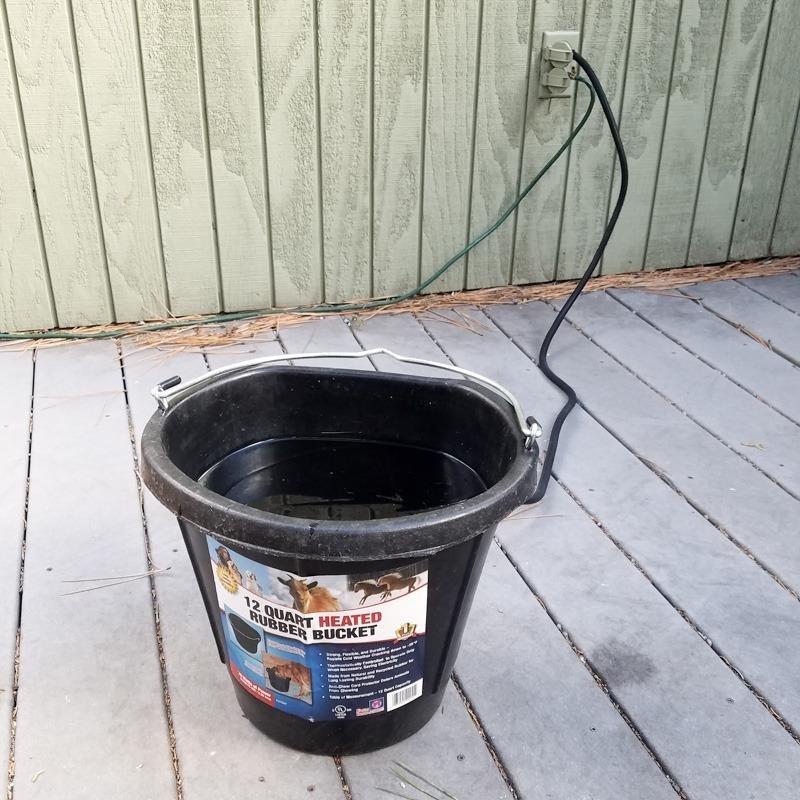
6. Farm Innovators FB-15R Heated Rubber Bucket 4.5 Gallon 90W – The Rubber Body Rated to -35F
Farm Innovators FB-15R Heated Flat-Back Rubber Bucket, 90 Watts, 4.5 Gallon
4.5 gallon rubber
90 watt thermostat
Rubber rated to -35F
Element inside the wall
The Good
- Only rubber body in the group with a -35F rating
- Long-term owners report 15 year service lives on these pails
- Flat back hangs flush instead of swinging
- Concealed element is out of animal reach
- Three-prong grounded plug with anti-chew cord
The Bad
- Lowest average rating here at 4.0 with a 15% one-star share
- 90 watts is the lowest output in the group
- Some owners report the element dying within a year
- Cord connection at the bucket is a recurring weak point
This is the answer for anyone whose plastic buckets crack in the cold. The rubber body is rated to -35F without cracking or splitting, and long-term owners describe pails from this line lasting 15 years or more in barns and lean-tos. When a rubber pail outlasts several plastic ones, the material pays for itself quickly.
The flat back hangs flush on a fence hook rather than swinging, which keeps the water level steady and stops the bucket rotating as an animal leans on it. The 90 watt element is controlled by a built-in thermostat, so it idles in mild weather, and it is concealed inside the pail wall where livestock cannot reach it.
The cord has a three-prong grounded plug and an anti-chew sheath, and the inside wall carries a molded measurement table. Grounding matters more than most buyers realise in a wet building, and it is a detail we look for on every product in this roundup. Only some of them have it.
These pails are offered in 3 gallon and 4.5 gallon sizes, singly and in multi-packs, so a barn running several goats can match the buckets to the group rather than over-provisioning a single animal.
The rating hides a durability story in both directions
At 4.0 stars with a 15% one-star share, this is the lowest-rated product in our lineup, and we want to be direct about why. A meaningful minority of owners report the element filling with water and dying within a year, which points to water ingress around the element rather than to the rubber body failing. Reviewers also flag the cord connection at the bucket as a recurring weak point that owners reinforce themselves.
So the split is clear: the bucket is the most durable container we tested, and the heater is the least reliable. Owners who address the cord junction in the first season, before the connection point is worked hard, get the best out of it.
When rubber earns its higher cost
Rubber costs more than the equivalent plastic bucket, and the owner base divides sharply on whether that is worth it. In our view it is worth it in USDA hardiness zones 3 through 5, where sustained sub-zero nights are the norm and plastic pails develop stress cracks season after season. In milder zones, a plastic bucket that still has three or four seasons left in it is the more sensible purchase.
One more expectation to set: rubber has a noticeable smell for the first few weeks, which is normal for new rubber pails and fades with airing. Owners who mention it treat it as expected rather than a defect.
7. K&H Bucket Heater Ultimate Pail Deicer 250W – The Best Submersible De-Icer for Any Bucket You Own
K&H Bucket Heater, Ultimate Pail Deicer, Safety Listed, 250W, Red
Submersible 250 watts
110 and 120V
MET Labs listed
1.5 pounds
The Good
- Most reviewed product in the roundup with 1543 ratings
- Works in any bucket or pail so one heater covers several containers
- Entire unit is MET Labs certified rather than just the parts
- Included cord clip keeps wiring away from curious animals
- Efficient 250 watt draw for continuous cold-weather use
The Bad
- One-star share of reviews is relatively high at 13%
- Prevents freezing but does not warm water for drinking
- Submersible design means the bucket cannot be moved while plugged in
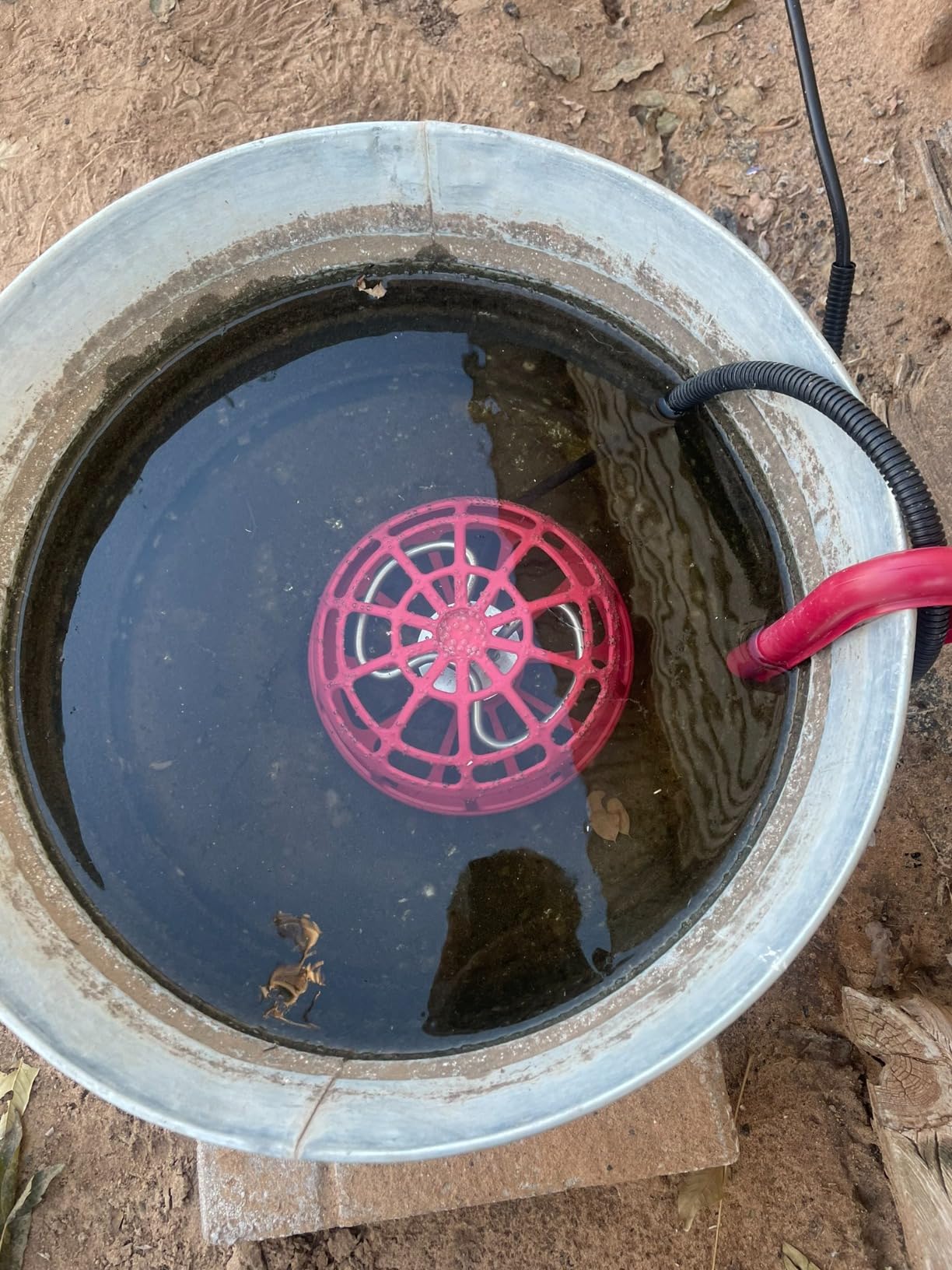
With 1543 ratings, this is the most reviewed product in our entire lineup, and it is not a heated bucket. It is a 250 watt submersible de-icer that drops into a bucket you already own. Buyers credit reliable freeze protection in cold barns and yards, a genuine safety certification, and the included cord clip, and the recurring criticism is that the water stays cold rather than warm.
That last point is the whole framing. This device melts ice and keeps water from freezing; it does not make water comfortable to drink on a freezing morning, and no thermostatically controlled freeze-prevention device does. Owners expecting a hot bucket are the source of a meaningful share of the 13% one-star reviews.
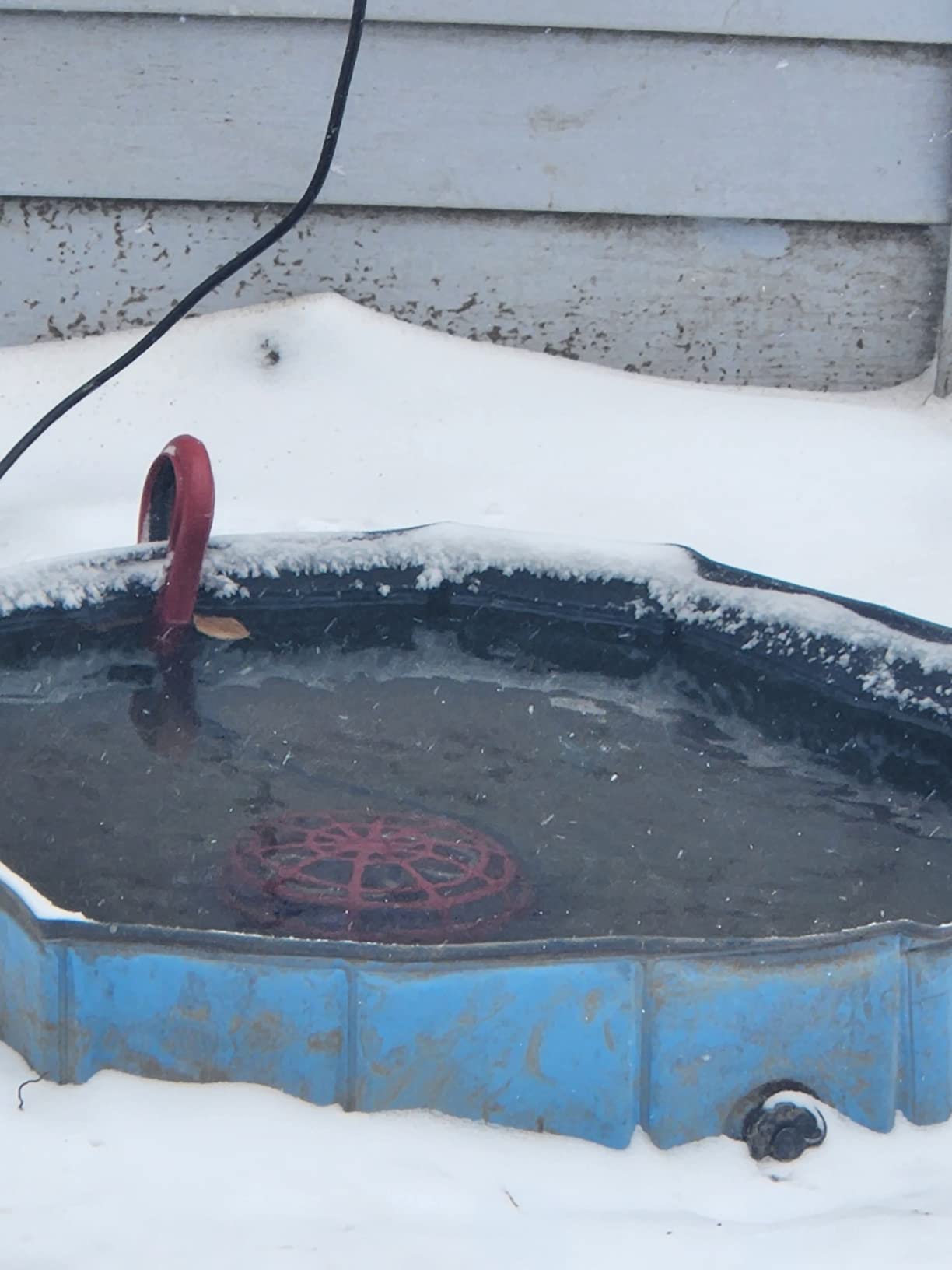
The strength of this approach is flexibility. One heater works in any bucket or pail you own, which means you can move it between a five-gallon bucket at the gate and a twenty-gallon one at the trough as conditions change, without owning a heated container for each. For an owner with a rotating setup, that flexibility is worth more than an integrated element.
The certification is the strongest in the roundup in one respect: MET Labs listed, covering the whole unit against US and Canadian electrical safety standards. It measures 7.25 by 7.25 by 4.5 inches and weighs 1.5 pounds, and it runs on 110 and 120V for outdoor use.
Why a submersible de-icer is not a heated bucket
There is a real safety distinction here, and it is the top question on livestock forums. A submerged element sits in water that animals can reach, and horses in particular will pull a drop-in heater out of an open bucket or trough. Owners who prefer heated buckets over drop-in heaters do so specifically for that reason.
Poultry keepers give a second reason. Submersible heaters in a damp, dusty, poorly wired coop are exactly the configuration that worries them about fire, and some avoid them for that reason alone. If animals can reach the water surface, an element built into the wall is the safer architecture, and that is what the first six picks in this roundup give you.
What to know before you submerge it
Because the heater is submerged, the bucket cannot be moved while it is plugged in. Fill and position the bucket first, then submerge the heater, and never lift the pail by the cord. Cord durability over many winters is the most common long-term complaint, so inspect the cable and the strain relief each autumn before the season starts.
Use the included cord clip, and route the cord where animals cannot reach it. A submersible heater plus a chewed cord is the combination that produces the small fires and shocks owners report in forums, and it is entirely preventable.
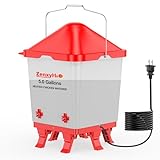
8. ZenxyHoC 5 Gallon Heated Chicken Waterer with 4 Nipples – Best Rated New-Generation Poultry Waterer
5.0 Gal Heated Chicken Waterer Bucket with 4 Horizontal Water Nipples
5 gallon
Heating below 35F
Four drinking nipples
10 ft cord
6.1 lb
The Good
- Highest rated new-generation waterer here at 4.6 stars
- Owners report water staying liquid at -15F and around 0F overnight
- Adjustable legs keep the unit off wet coop floor
- Semi-transparent body shows the water line without lifting the lid
- Chickens usually learn the nipples within a day
The Bad
- Only four nipples for larger flocks
- Legs could be taller so blocks are often used to raise it
- Semi-transparent plastic scratches over time
- Long-term freeze performance is still unproven
This is the strongest-rated poultry waterer in the group, at 4.6 stars across 85 reviews with 80% of those at five stars. It is also a recent listing, so the rating reflects early enthusiasm and first-season performance rather than a long record of winter service. We think it is worth watching closely rather than treating as proven.
Owners across genuinely cold states, including Michigan and Tennessee, report water staying unfrozen at -15F and below, and holding overnight near 0F. The heating engages below 35F and disconnects near 77F, so the element works in short bursts rather than running continuously, which is the behaviour you want from a unit that is expected to sit unheated in a coop.
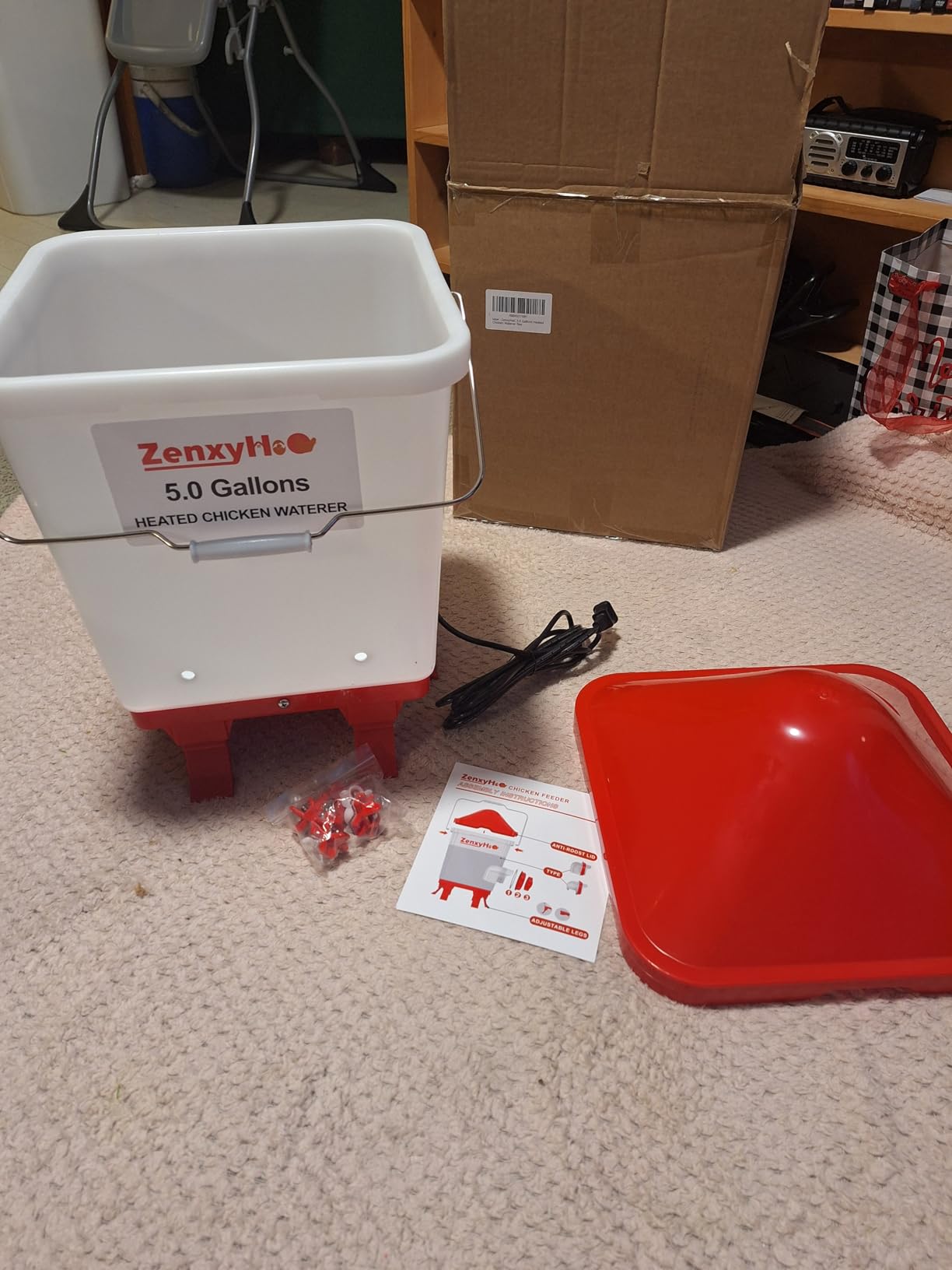
Six adjustable-height legs keep the unit off a wet coop floor, which matters more than it sounds. Water sitting on damp ground is cold water, and pad-style heaters that rest flat on the floor lose the ground clearance that keeps the container itself at a workable temperature. Owners with wet coops call this out as a specific improvement.
The anti-roost cone lid blocks perching, leaves and dust getting into the reservoir, and the semi-transparent body lets you read the water line without lifting the lid, which is a small daily convenience you appreciate more than you expect. A fill lasts about a week for 8 to 10 birds, and the 10 foot cord gives reasonable placement freedom.
How many chickens is five gallons right for
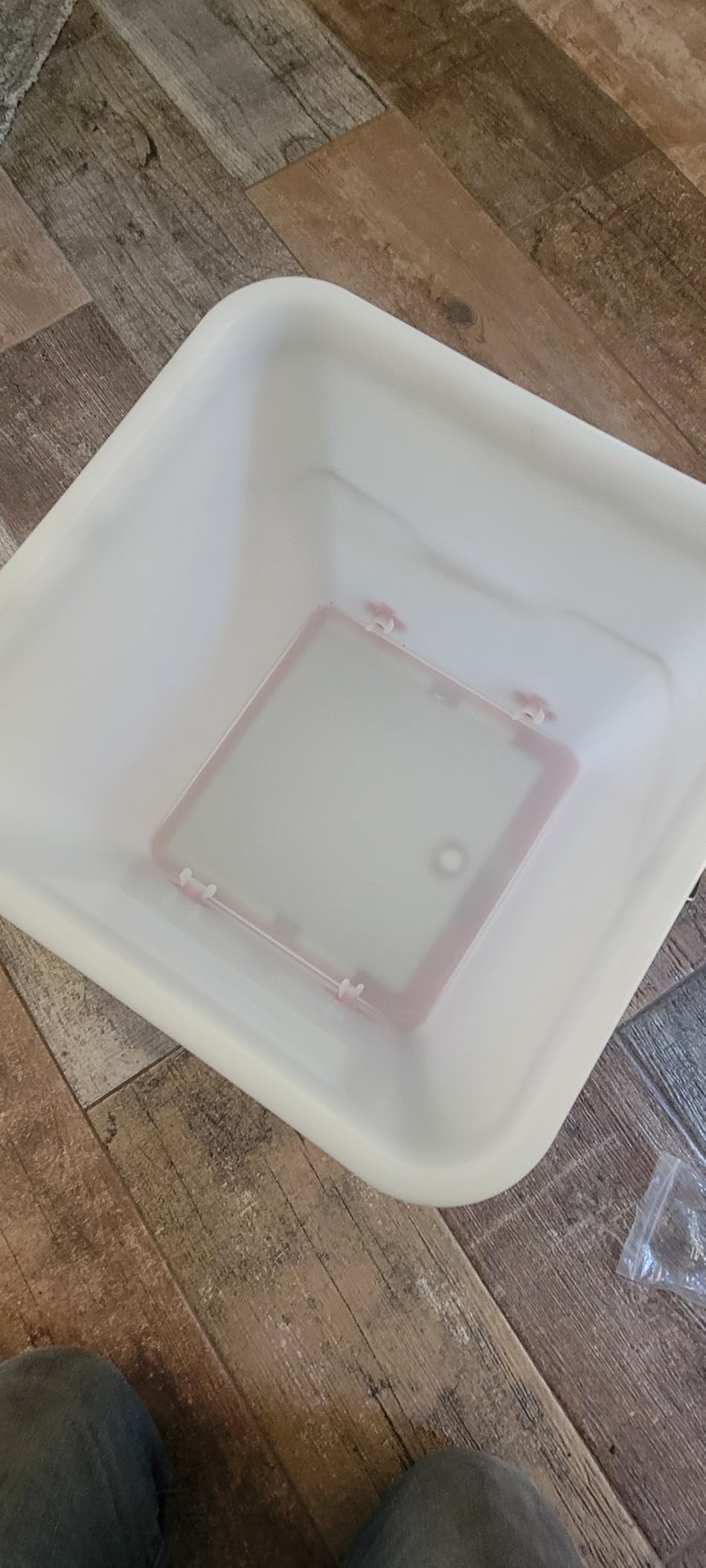
At 5 gallons this sits between the Premier 1 unit rated for 35 birds and the smaller 3-gallon waterers rated for around 10. The limiting factor is the nipple count rather than the volume. Four horizontal drinking nipples serve a flock comfortably, but owners running larger groups want more outlets, and that is the most common request on the wish list.
For a backyard flock of 8 to 10 birds this is well matched. Beyond roughly 20 birds you would want more nipples or a second unit, and we would run two smaller waterers rather than one larger one anyway, because redundancy matters when a freeze is on the way.
The honest caveat on a new listing
Freeze performance reported over a single winter is not the same as freeze performance proven over five. Several owners note that the real test of sustained multi-day sub-zero weather is still ahead of them, and we would not fault them for it. It is the reason we did not put this at the top of the poultry category despite the higher rating.
Other gripes are minor: the legs could be taller, and the semi-transparent plastic scratches and shows water line marks over time. If your coop is exposed to deep cold and you want the highest-rated option available today, this is the one. If you want a decade of known winter service, the Premier 1 unit has the review history.
9. Lilyang Heated Chicken Waterer 3 Gallon 250W – Most Power for a Small Flock
Lilyang Heated Chicken Waterer 3 Gallon, 250W Thermostat Control
3 gallon
250 watt thermostat
Cast aluminum element
Detachable plate
4 lb
The Good
- 250 watt element is the most powerful in this group
- Cast aluminum element is intended to protect the plastic base
- Detachable heating plate lets one unit work year-round
- Includes legs and a lid so it stands or hangs
- Sized for about 10 chickens or 30 chicks
The Bad
- One reviewer reports it ran hot enough to melt through the container
- Several owners report the element freezing up in sustained cold
- Lid is awkward to remove and reseal for daily refills
- Thin narrow legs can be tipped by a determined flock
This is a newer listing with a 4.1 rating across 114 reviews and a 63% five-star share. Owners like the detachable heating plate and the nipple-fed design, and the 250 watt element gives it more raw heating power than any other unit in this roundup. That power is both its appeal and its problem.
The thermostat switches on at 35F and off at 70F, and it melts ice rather than heating water. The cast aluminum element is designed specifically to keep the plastic base from melting, which is a known failure mode on cheaper waterers, and the detachable plate means you can strip the heating part in warm months and use the container as an ordinary waterer.
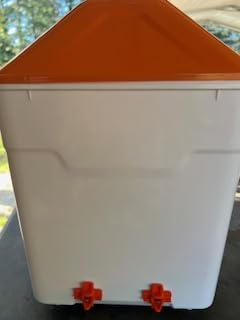
Sizing is clear: 3 gallons covers about 10 chickens, or about 30 chicks for two to three days. It includes legs for standing use plus hanging hardware, and a removable 50 degree lid that deters perching. The 6.5 foot cold-weather cord is longer than some competing cords and shorter than the Premier 1 unit’s 16 feet.
The product carries a 6-month manufacturer warranty, which is shorter than most owners would like on an appliance that runs all winter, and it is worth factoring that into the decision if you are far from the seller.
A serious overheating complaint you should read
One reviewer reports the unit running hot enough to melt through the bottom of the container. That is a single report, and individual reports do not establish a pattern, but it is specific enough that we will not bury it. A 250 watt element in a small 3-gallon body is a lot of heat for a container that may sit in a warm coop on a mild day, and the wide 35F to 70F thermostat band leaves room for overshoot in an enclosed space.
Our practical advice is to give this unit airflow and a GFCI-protected outlet, and to check it during the first cold spell rather than trusting it unattended through the whole season.
Where this one fits and where it does not
Several owners report the element freezing up in sustained cold, so we would call this a temperate-zone unit rather than a deep-winter one. If your winters involve regular nights well below freezing, the 100 watt poultry unit in this lineup is a better-matched design, despite the lower headline wattage, because insulation and enclosure do more work than raw element power.
The lid is awkward to remove and reseal, which slows the daily refill, and the thin narrow legs can be tipped by a determined flock. For a small backyard flock in a moderate climate, the removable plate and the included spares make it a workable unit.
10. Powerblanket BB05 Insulated 5 Gallon Pail Heater Blanket 120W – For Honey and Oils, Not for Freeze Protection
Powerblanket BB05 Bee Blanket 5 gal Pail Heater, Honey/Bucket, 120W, 120V, Charcoal Gray
Wrap-around blanket
120 watts
Raises contents to 110F
ETL listed
2 lb
The Good
- Wraps around a bucket instead of sitting in the contents
- Works with any poly or steel pail
- Raises contents toward 100F without cooking them
- Very low running cost on a 120W setting
- ETL certified to UL
- CSA and CE standards and only 2 pounds
The Bad
- Not a freeze prevention device and does not stop ice forming
- Slow
- taking many hours or a week for fully crystallized honey
- Bottom of the pail is heated least so sludge often remains
- Strap and cinch closure is awkward and tends to slip
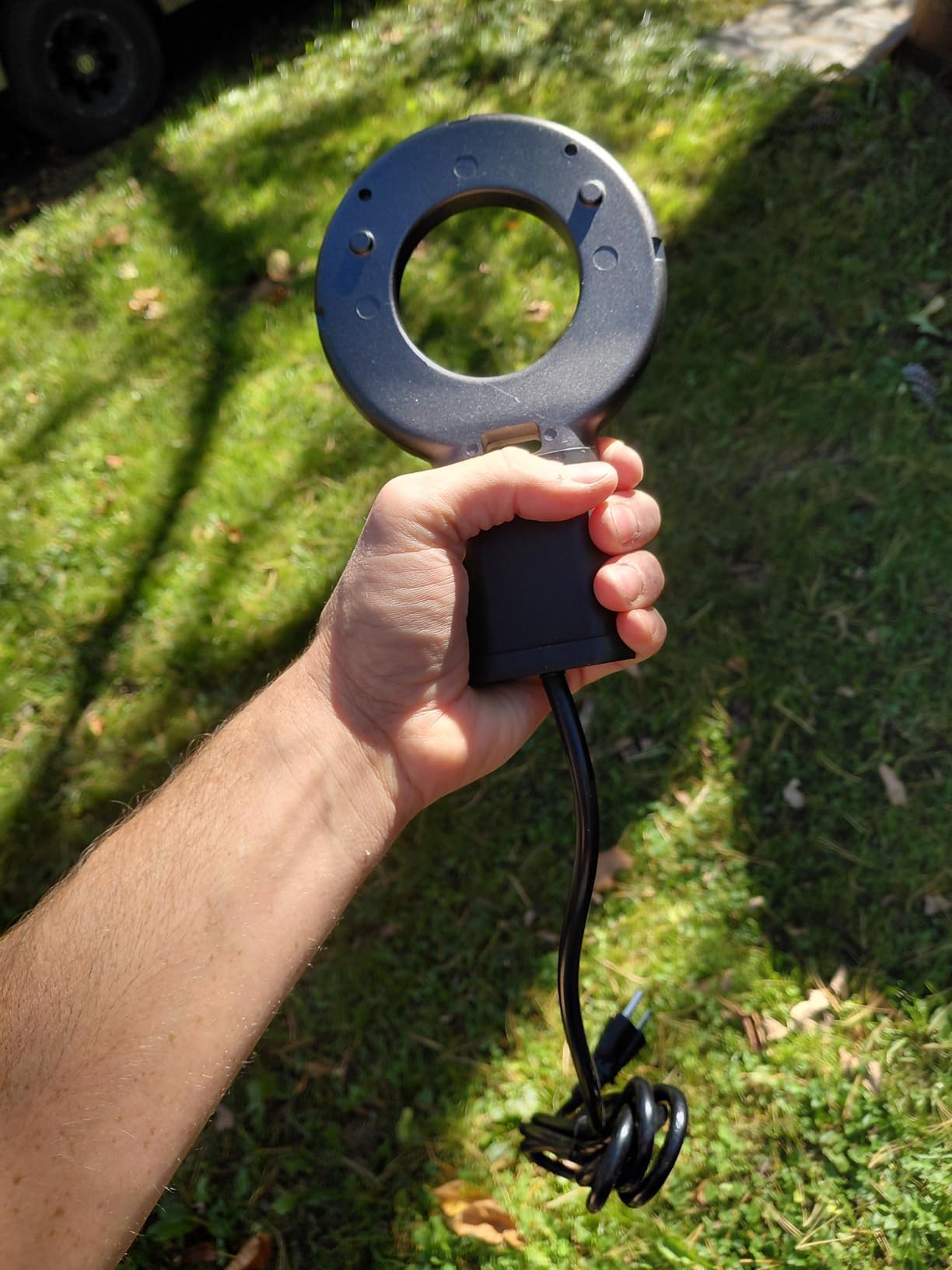
We are including this one because it is searched for constantly alongside heated buckets, and it does a genuinely useful job, just not the winter watering job. This is a wrap-around heating blanket that raises the contents of a bucket toward 90F to 110F. It is a beekeeping-first product for liquefying crystallized honey without cooking it, and it is also used for melting coconut and palm oil.
At 4.2 stars across 137 reviews with 65% at five stars, owners running it on honey confirm that it liquefies crystallized honey while preserving the enzymes and flavour that direct heat destroys. That is a real and specific benefit, and for beekeepers pulling supers in late winter it is worth having.
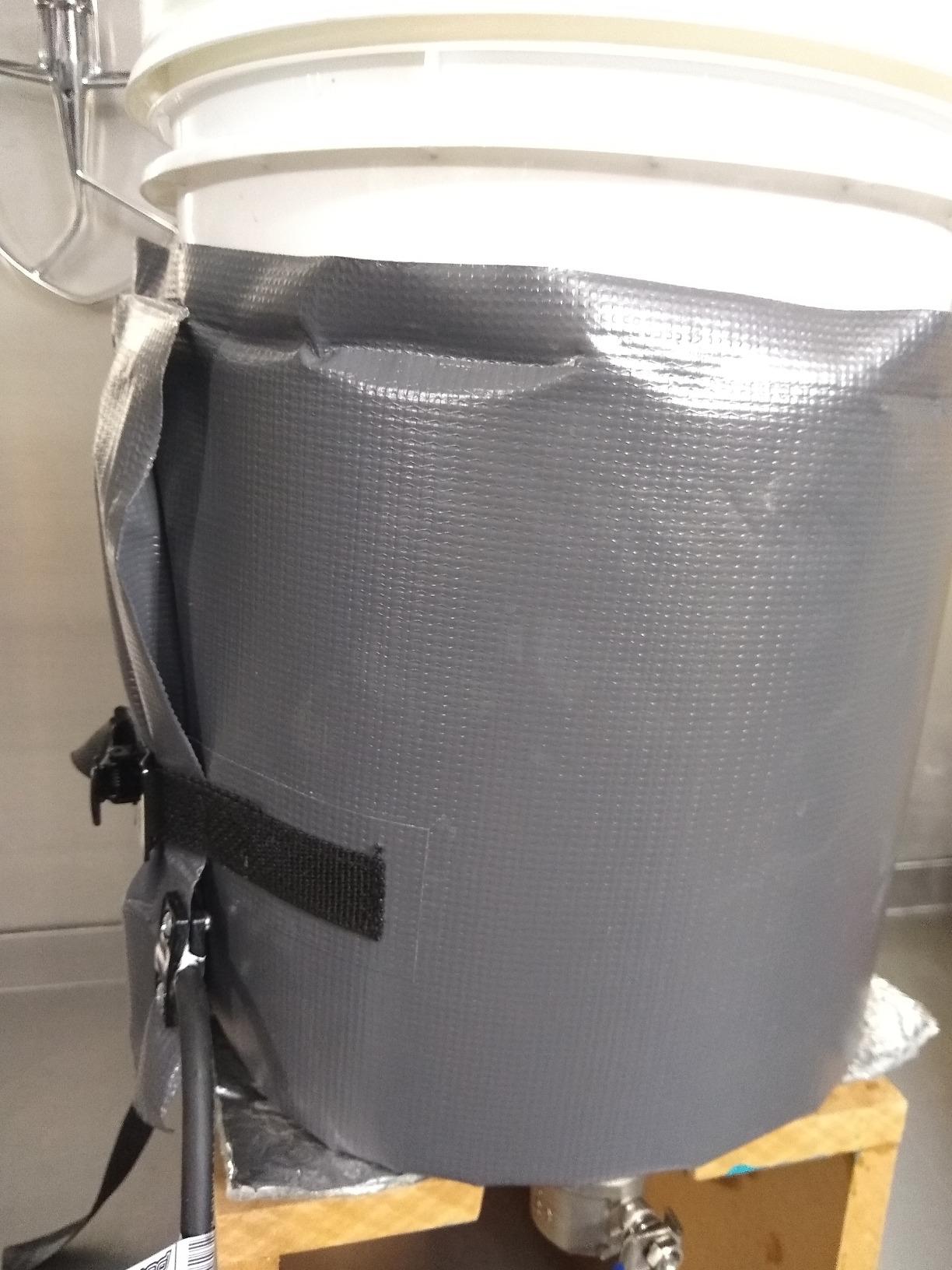
The wrap-around architecture is the key design choice. Because it works on the outside of the container, it fits both poly and steel buckets and pails, and it never sits in the contents. Heating is radiant with a conductive thermal method, covering roughly half a square foot, and the temperature range is controlled rather than open-ended.
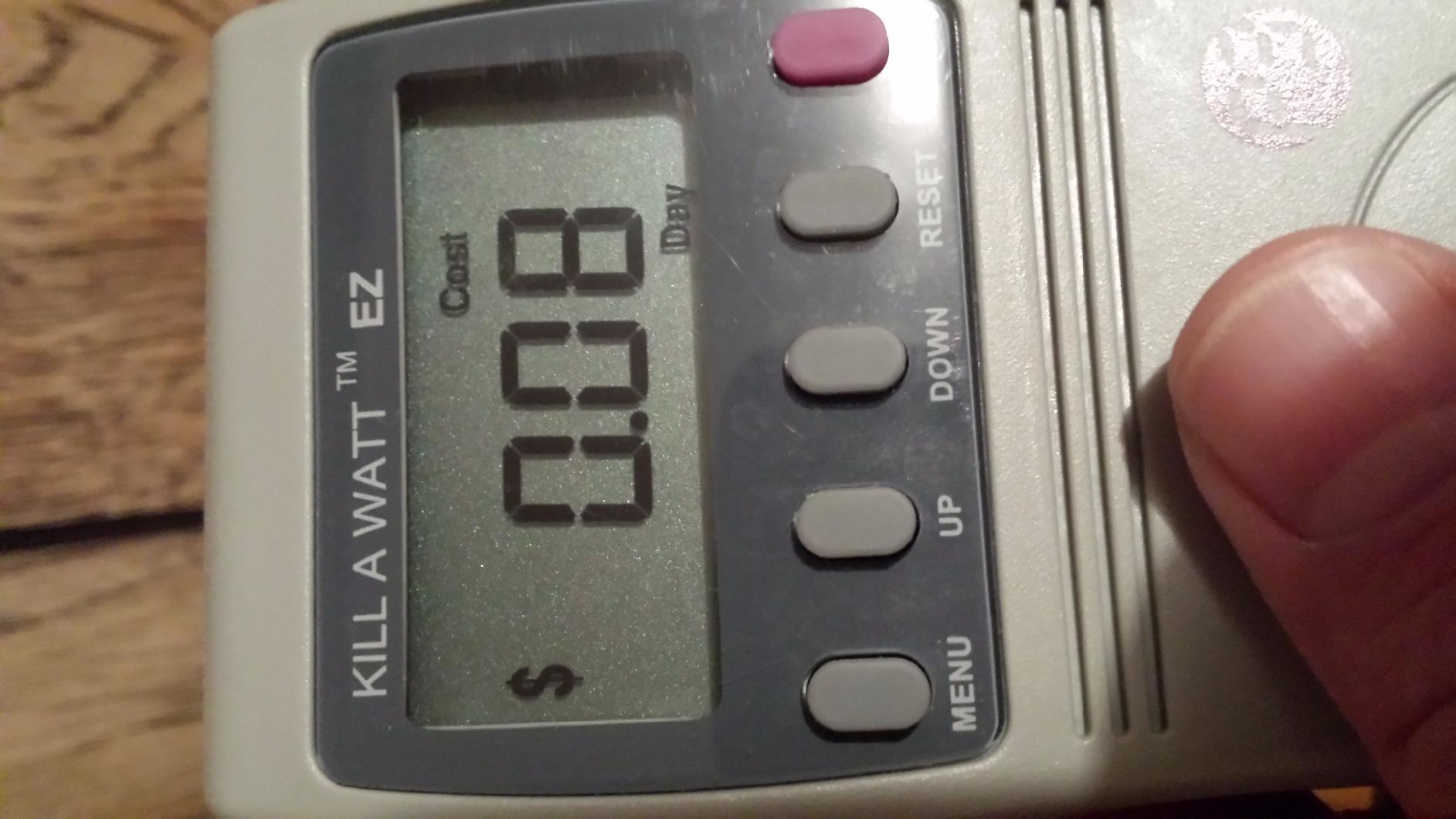
It is ETL certified to UL, CSA and CE standards, weighs 2 pounds, and measures about 10 by 10 by 2.4 inches. Owners report running costs of around 8 cents a day on the 120W setting, which is the lowest running cost of anything in this roundup.
Read this before you consider it for livestock water
This device does not prevent freezing and is not intended to. Its job is to warm contents toward hive temperature, which is a completely different requirement from keeping water liquid in a barn at 10 below zero. Nobody should hang a Powerblanket on a livestock bucket expecting winter watering performance.
It is also slow. Fully crystallized honey can take many hours or up to a week, and the bottom of the pail receives the least heat, so a layer of sludge commonly remains that has to be dealt with by hand. The criticism across reviews is remarkably consistent on that point.
When it is the right purchase anyway
Beekeepers, soap makers and small-batch producers who work with oils and honey in five-gallon pails get a lot of value from it. The blanket travels between containers, works with plastic or steel, and runs at a very low draw. Buyers who expected more heat than it delivers are the main source of disappointment, so set the expectation to a slow, gentle, controlled warm-up.
The strap and cinch closure is the most-criticised mechanical detail; owners consistently wish for a Velcro strap instead because the cinch slips. It is a 2 pound blanket, so it is easy to reposition, but secure it properly before leaving it unattended.
How to Choose a Heated Water Bucket That Survives Winter
Most disappointed buyers we read about bought the wrong category, the wrong size, or the wrong wattage. The fixes are straightforward once you know which of the three you did wrong.
Size the bucket to the number of animals, not the size of the animal
A horse drinks somewhere between 5 and 15 gallons a day, so a single five-gallon pail is a twice-daily job for one animal and a runaway for three. For one to three large animals, a 16-gallon tub or a pair of five-gallon flat-back buckets works. For a barn of goats or sheep, a three to five gallon bucket per two or three animals is the practical ratio, and for a flock of ten chickens a 3-gallon waterer with three or four nipples is right.
The flat back matters in exactly the situations where you are most likely to mount the bucket on a wall or fence. A flat-backed bucket sits flush and stays level when an animal leans on it; a round bucket hangs from a hook and swings. If your plan involves hooks, buy flat backs.
Match wattage to exposure, not to bucket size alone
Wattage is the most-copied spec and the least useful on its own, because the thermostat cuts the element in and out. The number that matters is how much heat is available when the thermostat calls for it, and that depends on exposed versus sheltered placement, wind, and how cold your nights really get.
For a sheltered stall or an unheated but enclosed coop, 90 to 120 watts is the working range. For an exposed outdoor run, a paddock, or a region with sustained sub-zero nights, look for 200 watts and up. The arithmetic is simple: at 120 watts an element running flat out uses about 2.9 kWh a day, and at 260 watts about 6.2 kWh. The thermostat is what keeps actual usage well below those figures in mild weather, so running cost scales with how hard the element is worked rather than with its label.
Buying guide rounding: a 15 amp circuit has roughly 1800 watts of headroom at 120V, so several buckets can share one circuit, but a single 16-gallon unit at 260 watts plus two smaller buckets is already a meaningful load on a long barn run. Have an electrician confirm the circuit before you fill a barn with heaters.
Understand the thermostat setpoints
Most units in this category cut in near 35F and cut out between 60F and 77F. The Farm Innovators FB-120 is explicit about both numbers, and the poultry units run slightly warmer on the off point. A wider band means fewer cycles and lower wear; a narrower band keeps the water closer to a target temperature. Either way the water stays cold to drink, which is the correct behaviour for livestock.
Over-temperature protection is a separate circuit from the thermostat and is worth paying attention to. A thermostat that fails closed is the failure mode that matters, and only some of the products in this roundup have a second layer of protection.
Material and cold-weather rating
Plastic is lighter, cheaper and easier to carry, and it is what most owners replace every few seasons. Rubber holds to -35F and can last a decade or more, and it is the right call in hardiness zones 3 through 5 where plastic develops stress cracks season after season. Impact-resistant polyethylene sits between the two and resists warping better than thin-walled plastic.
The one common complaint about rubber is a strong smell for the first few weeks. It is normal, it fades with airing, and it is not a sign of a defective pail.
Cord length, chew protection and certification
Cord length varies enormously across this category. The API 5-gallon flat back has a 6 inch cord, which effectively means you are buying an outdoor extension cord. The Premier 1 poultry waterer ships with a detachable 16 foot cord, which is the best in the group. The K&H de-icer includes a cord clip that keeps wiring out of reach of curious animals.
For certification, MET Labs listed, ETL, UL and CSA marks all indicate the unit was tested as a whole. Dual CSA and UL listing appears on the API buckets and is rare in this category, and forum owners treat it as a genuine differentiator rather than a marketing line.
What matters more than any of the above
A grounded three-prong plug and a GFCI-protected outlet. Every heated water bucket on this list operates in or beside water, in buildings that are frequently damp, with animals that can reach cords. That combination is where the real risk sits, and it is a cheap fix. If a bucket is worth buying, the outlet it plugs into is worth the same afternoon.
Heated Bucket vs Drop-In De-Icer: Which One Do You Actually Need?
This is the most-asked question in the category and almost nobody answers it head to head, so here is the framework we use. The decision comes down to one question: can an animal reach the water surface?
If the answer is no, because the bucket has a flat back hung above reach or sits in a caged stall corner, a drop-in de-icer is cheaper and more flexible. The K&H 250 watt unit in this roundup runs in any bucket you own, so one heater can move between a small pail and a large one as the weather changes. It is also the most reviewed product we tested, at 1543 ratings, which means a large body of real winter experience sits behind it.
If the answer is yes, buy a heated bucket with a concealed element. Horses pull drop-in heaters out of open water, and owners who have seen that happen are the loudest advocates for built-in elements. Poultry keepers report similar behaviour and add a fire concern, because a submerged heater in a damp, dusty coop is the configuration they worry about most. The Farm Innovators 16-gallon model and the rubber FB-15R both conceal the element inside the wall, where hooves and beaks cannot reach it.
There is a third option for open water, which we have not tested here: a floating or perimeter de-icer sized for a large trough rather than a bucket. One owner on a livestock forum reports a much higher-wattage de-icer working an entire winter without complaint on the electricity bill, which tells you raw wattage buys cold-weather headroom in open water. It is not a bucket, but it is the answer for anyone with a trough rather than a pail.
Our rule of thumb: built-in element for anything an animal can reach, drop-in for sealed or elevated containers, and a dedicated trough heater for open water. Solar options come up constantly in related searches, and we would treat current products in that category as unproven for livestock water rather than rely on them.
Safety and Installation: Keeping Electricity Away From Animals
Wet barn conditions plus electricity is the number one fear among the owners we read, and one poster on a horse forum described themselves as completely comfortable only after moving every barn outlet onto GFCI protection with covers. That reaction is the correct one. Here is the sequence we would follow before the first freeze.
First, put the bucket on a GFCI-protected outlet. A ground-fault circuit interrupter is the single most effective protection against both shock and fire when water and damaged insulation meet. If your barn outlets are not GFCI protected, that is a weekend project and a licensed electrician, and it should happen before you buy a single heater.
Second, cover the outlet. A weatherproof in-use cover costs little and protects the connection from splashing and dust. Keep the plug fully seated, because an incompletely seated plug is the most common setup fault in poultry waterer reviews.
Third, route the cord where no animal can reach it, and never through standing water. If the cord is too short, as it is on the API 5-gallon model, use a heavy-duty outdoor-rated extension cord and secure it along the wall or post. Better still, install the outlet closer to where the bucket lives rather than running cord across a wet floor.
Fourth, protect the cord at the animal end. Anti-chew sheaths slow animals down, and owners report that wrapping the cable in wire coil makes chewing effectively impossible. Poultry, goats and foals will all test a cord given a reason.
Fifth, never run the element dry. A dry element at full temperature is the fastest way to destroy a heater, and some units include dry-run or over-temperature protection. Fill the bucket before plugging it in, and never lift a pail by its cord.
Sixth, make sure the bucket is on a level surface or properly hung, and that the animal cannot tip it. Full buckets weigh far more than people expect, and a tipped bucket in a stall is both an injury risk and a lost water supply.
If you are running several buckets in a cold barn, the clothing you wear while working in there is worth sorting out too; our heated vest picks are aimed at exactly that kind of early-morning barn shift.
What To Do When the Power Goes Out in a Cold Snap
Every heated bucket in this roundup fails the moment the circuit opens, and none of them has a battery backup. Owners ask this question constantly and almost no roundup addresses it, so here is the plan we would keep on the wall of the barn.
Keep a reserve of unfrozen water on the property for at least one night for the animals in the most exposed location. A covered reserve of clean water stored indoors, where it is not relying on the same circuit, is the cheapest insurance available and it costs nothing but space.
Know which animals are most vulnerable. Goats are the priority because urinary calculi risk climbs sharply when water intake drops, and young poultry dehydrate faster than adults. Move those animals closer to the remaining water first.
Insulated non-electric waterers exist and are the right long-term answer for barns with no reliable power. Owners treat them as the solution for off-grid barns, and they work well in moderate cold, but the same forum consensus is that they still ice up in genuinely deep cold. If your barn has no power at all, buy the insulated waterer as a supplementary supply and keep a generator or a plan for moving animals rather than relying on it alone.
Check the thermostat behaviour after an outage rather than immediately. A bucket that has been cold for hours and then has power restored will run its element hard until the water reaches the cut-out temperature, so leave it alone and check it once rather than adjusting anything.
Frequently Asked Questions
What is the best water bucket heater?
For horses, sheep and goats the Farm Innovators 5-gallon flat-back heated bucket is the strongest all-round choice in our testing, with a 4.7 average across 945 reviews, a thermostat that runs between 35F and 60F, an anti-chew cord protector and a hideaway compartment for the cord in summer. If your winters are consistently well below freezing, step up to a 200 or 260 watt model for more heat reserve.
Which heated chicken waterer is best rated?
The ZenxyHoC 5-gallon heated chicken waterer is the highest rated in our group at 4.6 stars from 85 reviews, with owners reporting water staying liquid at -15F and adjustable legs that keep it off a wet coop floor. It is a newer listing, so long-term winter performance is not yet proven. The Premier 1 3-gallon unit has the deepest review history at 840 reviews and 4.3 stars.
Can a heated water bucket overheat?
It can, and that is why over-temperature protection matters. Quality units run two separate safeguards: a thermostat that cuts the element out, plus a second over-temperature cutout. Choose a model that lists both, plug into a GFCI-protected outlet, and never run the element dry. One reviewer of a high-wattage poultry waterer in our lineup reported the container melting through, so ventilation and a supervised first cold spell are sensible precautions.
What is the best electric water heater for buckets?
If you want an electric heater rather than a heated container, the Ku0026amp;H 250 watt submersible pail de-icer is the most reviewed product we tested at 1543 ratings and is MET Labs listed as a complete unit. It runs in any bucket you own, which makes it flexible, but because the element sits in the water it is only appropriate where animals cannot reach the surface. For reach-in buckets, choose a concealed element instead.
What are the best water bucket heaters for horses?
For one or two horses, the 5-gallon flat-back heated buckets are the right size, and the Farm Innovators FB-120 leads our ranking. For two or more horses sharing a source, the 16-gallon models are far more practical because a horse drinks 5 to 15 gallons a day and a small pail becomes a constant filling job. Wall mounting matters for horses, since a swinging round bucket gets pushed over.
What are the best heated water buckets for livestock?
It depends on species and exposure. Horses and cattle want a 16-gallon tub in cold climates. Goats and sheep do well with a 4.5 to 5 gallon bucket, and rubber construction is worth considering in USDA zones 3 through 5 where plastic cracks. Chickens need a nipple waterer rather than an open bucket, for water cleanliness as much as freeze protection. Large dogs do well with a large low-profile tub they cannot tip.
How to keep horse water from freezing without electricity?
Insulated non-electric waterers are the standard answer, and they use double-wall construction to slow heat loss rather than adding heat. They work reliably in moderate cold but owners report they still ice up in genuinely deep cold, so treat them as a supplement rather than a guarantee. Filling buckets with hot water at bedtime, keeping them in a sheltered wind-protected spot, and having a plan to move horses closer to remaining water all help.
How much electricity does a heated water bucket use?
Usage scales with wattage and with how hard the thermostat works the element. A 120 watt element running continuously would use about 2.9 kWh in 24 hours, and a 260 watt element about 6.2 kWh. In practice the thermostat cycles the element between roughly 35F and 60F, so mild-weather usage is a fraction of those figures. Several units on a 15 amp circuit can share a branch, but confirm the load with an electrician first.
The Final Verdict on the Best Heated Water Buckets
The Farm Innovators 5-gallon flat-back heated bucket takes our Editor’s Choice for the best heated water buckets in 2026. It is the highest-rated bucket in the group at 4.7 stars across 945 reviews, the thermostat spec is published rather than vague, the flat back hangs properly, and the hideaway cord compartment means it earns its space in the barn all year instead of nine months of it.
Our other winners each solve a specific problem. The Farm Innovators 16-gallon 200 watt model is the answer when more than one large animal shares a bucket or the nights get seriously cold, and its replaceable element stops a heater failure from meaning a new pail. The API 20FB is our budget pick for anyone who wants dual CSA and UL certification and over-temperature protection in a durable polyethylene body, provided you plan for its short 6 inch cord.
For poultry, the Premier 1 unit carries the deepest review history and the nipple system keeps water clean. For a very small flock in a mild climate, the ZenxyHoC is the highest rated option available today. For a barn with no power, an insulated non-electric waterer plus a stored reserve of water is the honest answer rather than a heated bucket that cannot run.
Whatever you choose, sort the electrical side first: GFCI protection, a covered outlet, and cord routing that no animal can reach. A certified bucket with a proper outlet lasts a lot longer than a better bucket plugged into a damp extension run. Then check current pricing and availability for the models that fit your animals and your climate.