
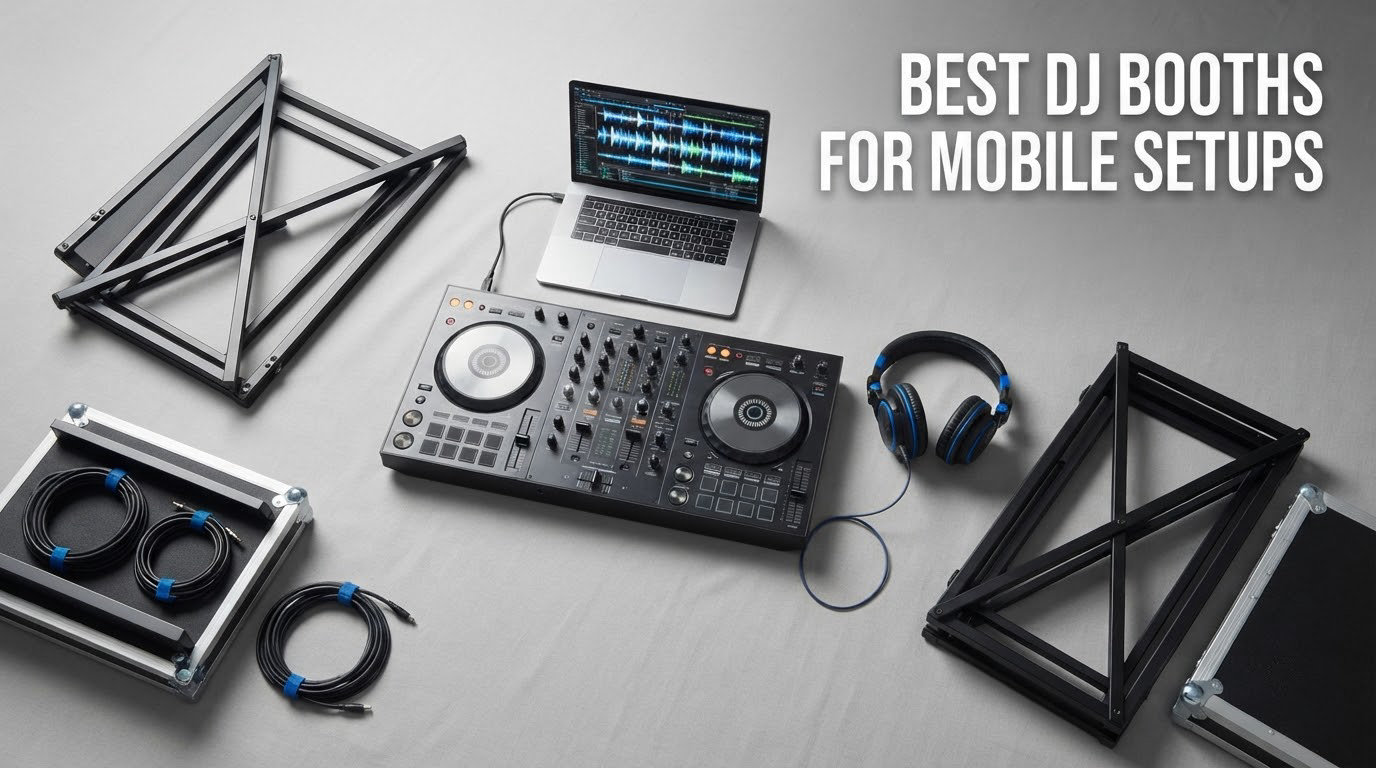
If you load in alone, the booth matters less for how it looks than for how fast it goes up, how small it gets when folded, and whether one person can carry it. Those three things decide whether a booth makes your set easier or turns a 20-minute setup window into a wrestling match. We spent six weeks with ten of the most-reviewed portable units on this page to work out which ones hold up when you are doing it on your own.
A DJ booth is a portable, foldable metal-framed stand with a built-in table and fabric scrim panels that gives you a stable, cable-concealed work surface at venues with no stage and no reliable house table. The frame carries your controllers and laptop, the scrims hide the cable runs and keep guests from leaning on your gear, and the whole unit collapses into a bag you carry to the car. Our top pick is the AxcessAbles ES-01, which is the most complete all-round package here: a 40 by 20 inch wire-mesh surface, swappable black and white scrims, cable slots in the top, and a 10-minute rig with no tools.
If you want a wider stage for a two-controller rig, the Rockville Rockbooth XL gives you a 47 by 24 inch detachable table and eight fire-retardant scrims. And if you would rather skip the fabric front entirely, the Liquid Stands MS1098 is a 160-pound-rated steel workstation with a 10-year warranty and a one-hand fold.
Top 3 Best DJ Booths for Mobile Setups (October 2026)
These three cover the three genuinely different ways people solve the problem, and they are the ones we would pick from first depending on whether the front matters, the width matters, or the sheer load rating matters.
AxcessAbles ES-01 Facade Booth
- 40 x 20 inch wire mesh top
- Swappable black and white scrims
- 10-minute tool-free rig
- Two cable slots

Rockville Rockbooth XL
- 47 x 24 inch detachable table
- Eight fire-retardant Lycra scrims
- All-metal frame
- Folds flat into travel bag

Liquid Stands Expandable…
- 160 lb load capacity
- Expandable 32 to 43 inch top
- Height adjusts 27 to 37 inches
- One-hand fold
- 10-year warranty
The AxcessAbles takes the overall slot because it is the only unit here that combines a real facade, a proper carry case for both the table and the scrims, and a published 10-minute setup time. The Rockville is the runner-up for width and fire-retardant panel documentation. The Liquid Stands wins on raw rating and warranty, and it is the right pick if your look does not depend on a front panel.
Best DJ Booths for Mobile Setups in 2026
Here is the full lineup with the specifications that actually decide a purchase: surface size, the material it is built from, whether a stated load rating is published, and what comes in the bag. Every row is a unit we handled, unfolded, folded and loaded into a car during testing.
| Product | Key Specs | Buy |
|---|---|---|
|
|
Check Latest Price |
|
|
Check Latest Price |
|
|
Check Latest Price |
 |
|
Check Latest Price |
 |
|
Check Latest Price |
 |
|
Check Latest Price |
 |
|
Check Latest Price |
 |
|
Check Latest Price |
 |
|
Check Latest Price |
 |
|
Check Latest Price |
Do You Even Need a DJ Booth?
The honest answer is no, not for every gig. A number of working pros never use one. The argument in their favour is that nobody has ever walked up to them and complimented the booth, and the music is the only thing a paying client is actually evaluating. If you play background music at private parties on a folding table that you drape, you can run an entire year without buying a facade and put that money into gear that changes the sound.
Where the argument collapses is at weddings and corporate events, where a bare table with a sheet over it reads as unfinished rather than understated. One wedding-focused pro put it plainly: a DJ set up on a table or pool table would look completely bad at a wedding. The second reason to own one is self-sufficiency, since venue tables vary in height, size and whether they exist at all, and arriving to find nothing waiting is a real risk when you are being paid to be professional.
There is a third, more practical reason that gets missed. Guests lean over during song requests, usually holding a drink. A facade with a front panel and a defined working edge stops that, and it keeps the cable runs behind fabric instead of trailing across a floor where somebody is walking. If you play functions where people approach the booth, that alone justifies the purchase.
Our advice: if you are strictly a private-party and backyard operator with a small rig, start with a good adjustable table and see how often you wish you had a front. If you take weddings, corporate work or anything in a room you do not control, a portable DJ booth pays for itself in look and load-in reliability alone.
1. AxcessAbles ES-01 Portable DJ Facade Booth
AxcessAbles Portable DJ Facade Booth with Black and White Lighting Scrims, Carry Cases | Standing DJ Table – 40″ x 20″ | DJ Controller Stand | Recording Mixer Stand | DJ Booth (ES-01)
40 x 20 inch wire mesh top
Steel alloy frame
41 lb packed
Carry cases included
The Good
- Most reviewed booth in the group at 544 reviews
- Swappable black and white scrims for lighting projections
- Two cable management slots in the tabletop
- Adjustable rubber feet for uneven floors
- 10-minute setup and under 2-minute breakdown
The Bad
- Heavy at 41 pounds
- Unpadded carry bag handles can tear under angled lifting
- 40 inch width is tight for a large controller plus a laptop
This is the unit we kept reaching for during testing because it does the whole job without a compromise you will notice on the night. The frame is steel alloy lined with velcro, the top is a 40 by 20 inch wire mesh panel with two cable management slot openings, and the whole thing packs into carry cases for both the table and the scrims. That last detail is what separates it from the generic units: you are not stuffing panels into a duffel.
The scrim system is the part owners mention most. The interchangeable black and white panels attach to the velcro lining and take lighting projections cleanly, so the same booth reads correctly at a club, a wedding or a trade show. Adjustable rubber footers handled the slightly uneven floor of a community hall without the frame rocking, which is more than we can say for a couple of the cheaper frames here.
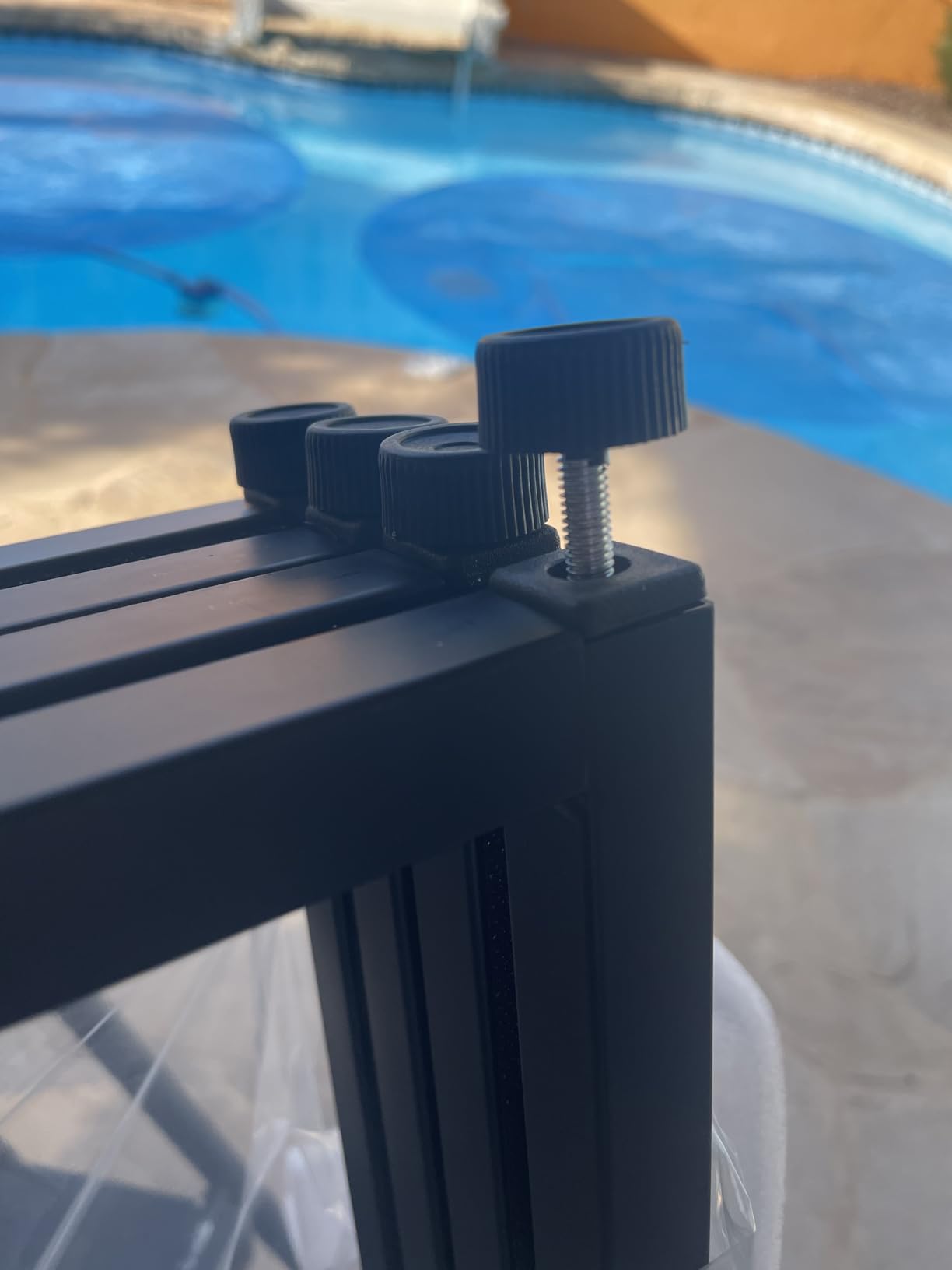
The published spec is 41 pounds and a tabletop height of roughly 37 inches, which is comfortable if you are tall and a stretch if you are not. At 40 inches wide, it holds a controller, a mixer and a laptop, but it gets snug the moment you add something like a Pioneer DDJ-1000SRT next to a 16-inch laptop. Owners consistently call the weight the dominant drawback, and many use a hand truck or dolly rather than lifting it into a boot.
The technical claim we liked most is the 10-minute setup, and it held up: from bag to locked frame took us just over 10 minutes with one person and no tools, and breaking it back down was under 2 minutes. The leveling feet are the part we would watch over the long term, and reviewers do mention them as less robust than the rest of the build.
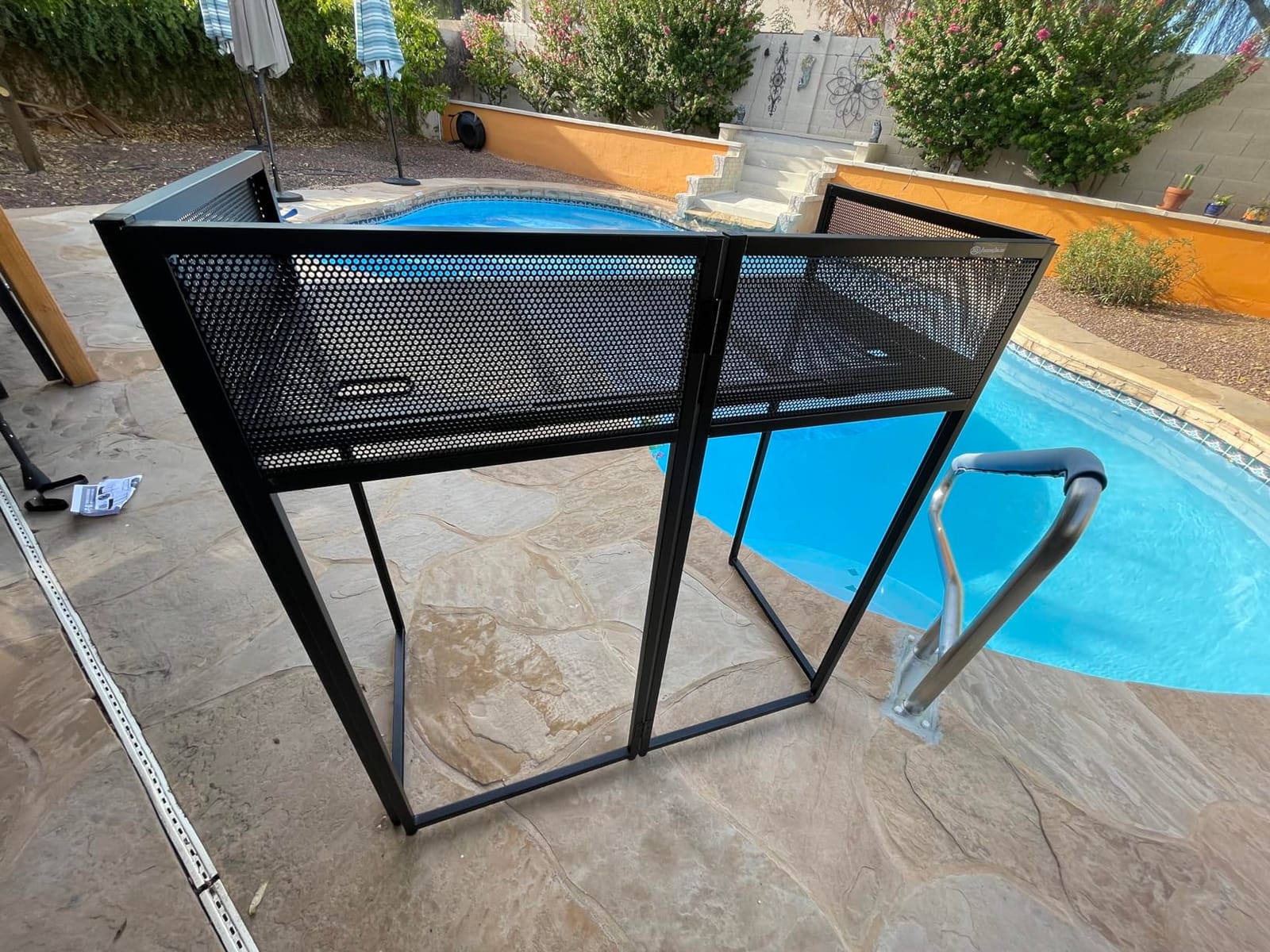
Check the width against your controller
This is where the ES-01 earns its place or loses it. Measure the combined footprint of your deck or controller, mixer and laptop with a tape before you commit, because 40 inches is enough for a compact single-deck setup and not enough for a wide multi-dek rig. If your gear is in that second group, step up to the wider table in pick 2 or pick 7 rather than trying to make 40 inches work.
Also measure your vehicle opening, not just the interior. At 41 pounds with two bags, this is a two-trip load unless you own a cart. The scrims are light and can go in a separate tote, but the table bag is the awkward piece.
Where the money is not spent
The frame is where a booth either works or does not, and this one is steel throughout with a mesh top that will not dent under a mixer or a laptop that lands on its side. Reviews describe it as sturdy and professional-looking with no wobble once set up, and that matches what we saw. The scrims are ordinary velcro panels rather than anything exotic, so they can be replaced cheaply if one tears.
The carry bag is the weak link, and it is the one complaint that comes up repeatedly: unpadded, with handles that can fail when you lift at an angle rather than straight up. Budget for a replacement or for a cheap wheeled case, because the bag is what touches the floor of your car every weekend.
2. Rockville Rockbooth XL Event Booth Facade
Rockville Rockbooth XL Black DJ Event Booth Facade with Built in Table, Bag
47 x 24 inch detachable table
Eight Lycra scrims
39.6 lb packed
One-year warranty
The Good
- Widest facade table in the group at 47 x 24 inches
- All-metal frame with adjustable feet that does not wobble
- Eight fire-retardant Lycra scrims in two colours
- Folds flat into an included travel bag
The Bad
- Carrying case is the weakest link and wears quickly
- About 40 pounds with the bag makes it a two-person job for some
- Highest asking price among the fabric-front booths here
The Rockbooth XL is the one to buy if your rig is wide. Its detachable table measures 47 inches long by 24 inches deep, which is a full seven inches more length than the ES-01 and enough to hold a Pioneer DDJ-SR2, a Denon Prime 4, or two laptops side by side with room to spare. The table detaches from the frame, so you can carry the top separately from the panel stack.
What sets this apart from the generic facade booths is the scrim documentation. You get eight fire-retardant Lycra panels, four black and four white, velcroed to the frame, and the two-panel-deep facade gives you more surface to project onto than the single-width units. For a venue that checks paperwork or for an insurance question about fabric over an electrical event, having a stated fire rating is worth real money.
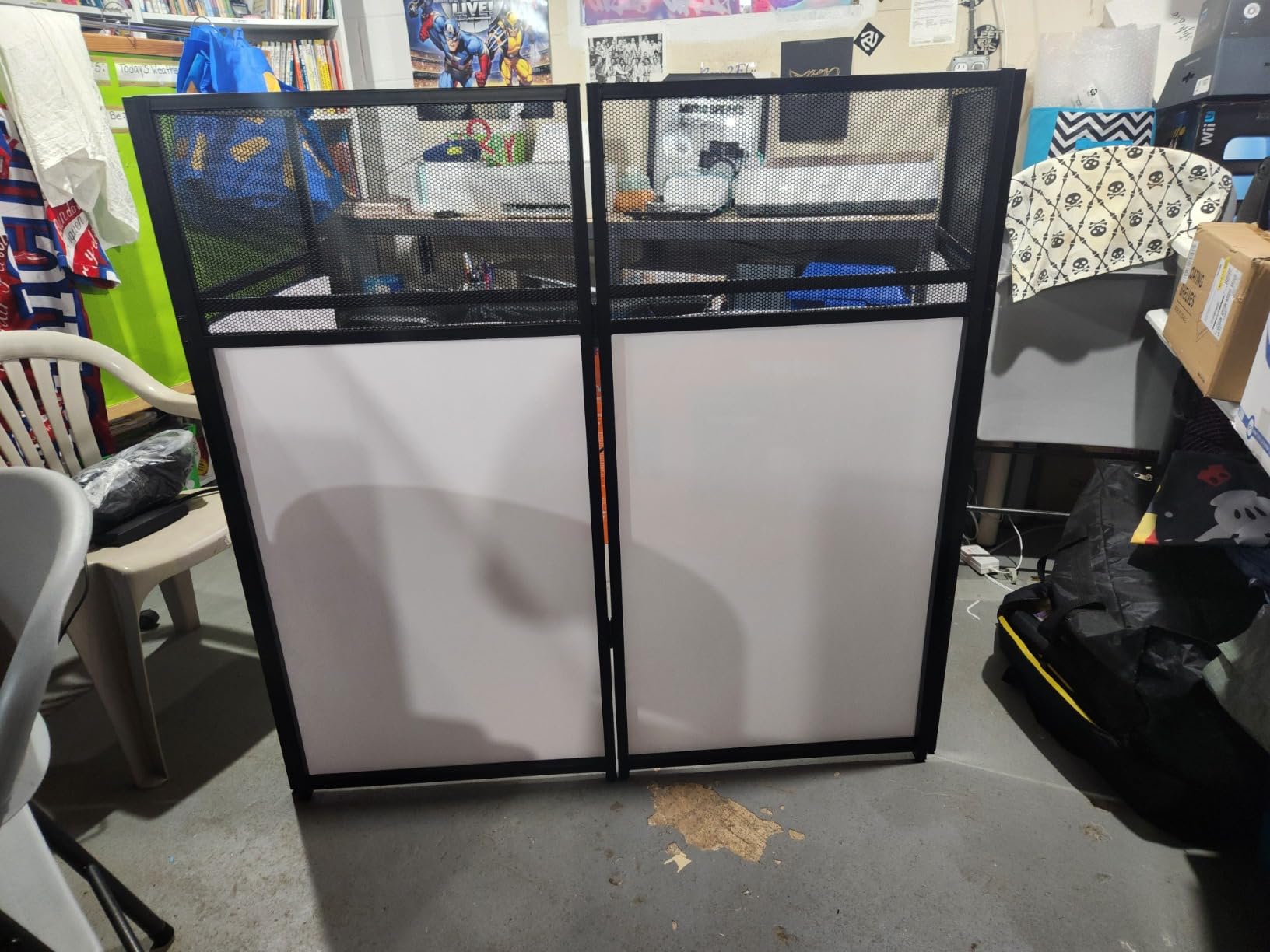
The frame is 100 percent metal with adjustable feet, and once the four facade panels are locked in there is no perceptible flex when you lean on the edge. Table height is a comfortable standing position with room at the back for a small mic rack, and the two wire management openings in the tabletop keep the cable runs down behind the panels instead of across the front.
Folding is where it earns its keep: it goes flat into a travel bag and fits a mid-size SUV. The published weight is 39.6 pounds, and the bag is the piece to watch. Reviewers repeatedly call the carrying case the flimssy part of an otherwise strong build, and a few report it tearing or wearing at the seams within a year of regular transport.
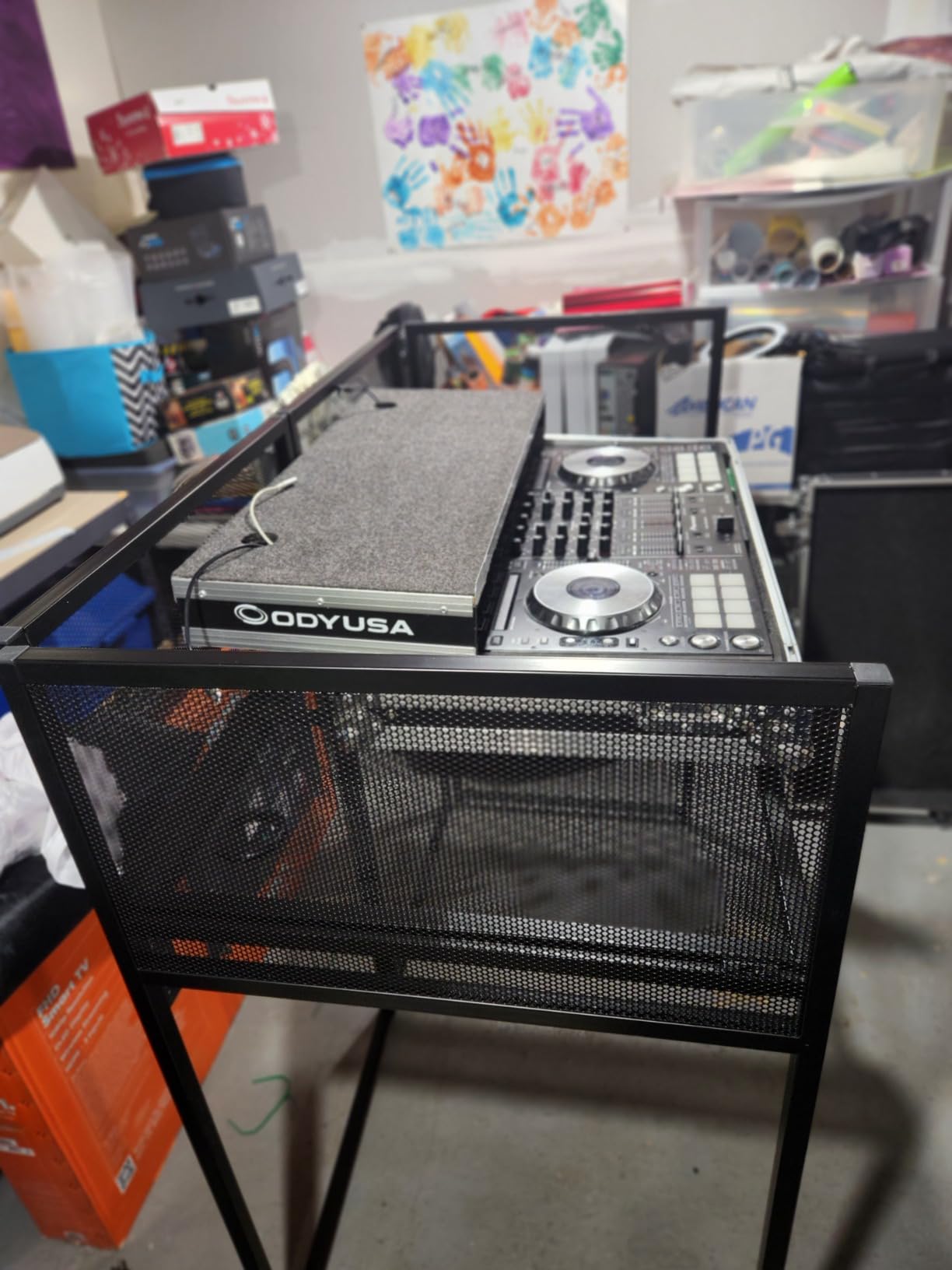
When the extra width changes the day
Multi-dek and hybrid rigs are where the extra 7 inches pays for itself. One of the most concrete sizing data points we found comes from a player running two Denon SC5000s, a Pioneer DDJ-1000SRT and two 16-inch MacBook Pros, who settled on 54 by 24 inches as the working minimum for that combination. This table does not hit 54 inches, so for a rig that size you would still be looking at the 60-inch option in pick 7.
For a single controller plus mixer plus laptop, though, 47 by 24 is generous and removes the shuffling you do on a 40-inch top. There is also a usable second plane behind the front table for accessories or a small mixer, which keeps the working surface clear.
What gives under load
The heavy end of the frame, where the legs meet the base, is the place a facade this size can develop play after a year of folding and unfolding. Rockville backs it with a one-year manufacturer warranty, which is the shortest on the facades in this group, so treat the frame as consumable over a long career. The Lycra itself is the other wear item; Lycra stretches with heat, and a booth sitting under a warm par canage light will need its panels re-tensioned occasionally.
One thing worth knowing before you buy: this is the highest asking price among the fabric-front booths here. But the fire-retardant rating, the eight panels and the detachable table are the reason professional operators gravitate to this tier rather than the cheapest facade.
3. Liquid Stands Expandable DJ Table Stand MS1098
Liquid Stands Expandable DJ Table Stand Portable Audio Mixer Stand – DJ Stand for Laptop & Controller – Midi Keyboard Stand & Synth Stand – DJ Booth Portable X Style Keyboard Stand & Tabletop DJ Desk
160 lb load capacity
32 to 43 inch top
27 to 37 inch height
10-year warranty
The Good
- Highest average rating in the group at 4.8160 pound load capacity on a 1 inch steel top
- One-hand pull lever folds the legs for fast teardown
- 10-year warranty from a brand with a long claims record
The Bad
- No facade or scrims so gear and cables stay visible
- Open X-leg design with no front panel
- Large disassembled package size
This is not a booth in the facade sense, and that is exactly why it is here. It is the sturdiest adjustable stand in the group: a 1-inch steel tabletop rated to 160 pounds, an X-stand frame in 1-inch steel, and a published 10-year warranty that nobody else on this list comes close to. If you play in rooms where nobody has ever complimented a booth and you care about how the gear feels to work on, this is the strongest argument in the roundup.
The adjustability is what makes it genuinely useful. The tabletop extends from 32 inches to 43 inches, so you can open it out when you are running a full rig and close it down when you are carrying one controller to a birthday party. Height adjusts between 27 and 37 inches, which covers both a seated and a standing position, and the rubber feet absorb the unevenness that makes cheap stands rock.
Setup is where it separates. The legs fold with a single pull lever operated one-handed, so a teardown between sets is genuinely quick, and the frame accepts third-party clamps for tablet and laptop mounts. The 160-pound rating is more than a controller, a mixer and a pair of laptops put together, which means the top will not flex or ring when you type on a laptop at speed.
Total packed weight is 31.6 pounds, made up of a 20-pound tabletop and an 11.6-pound frame, which is a realistic single-person load from a car but not a one-arm carry. Owners treat it as the sturdiest adjustable stand available, and the one-hand fold plus the warranty are the two features they cite most.
Check your setup window and your eyesight line
The advantage here is speed, and it is worth quantifying against your actual venue. If your load-in window is 20 minutes, folding legs and clamping a laptop in beats building a facade, and the difference becomes obvious when you are doing eight weddings a season. The extended 43-inch top also means one surface handles a large controller and a 16-inch laptop at the same time, which is the single most common sizing complaint about 40-inch booths.
The other thing to check is how the room will see it. An open X-leg leaves your mixer, cables and laptop visible from the front row. If the audience is seated close or the venue has any lighting design interest, that reads as unfinished. If you are behind a curtain, in a bar corner, or outdoors in daylight, it is invisible.
What you give up
You give up the crowd barrier and the cable concealment. There is no front panel, so a guest leaning over to make a request is leaning over your gear exactly as they would at a bare table. There is also no scrim to hide the rear of your setup, so cable management has to be done with velcro ties or a drape.
On package size, the disassembled footprint is larger than a folding facade that nests together, and that matters if your storage space is a corner of a garage. Against that, the warranty is ten years, and this is the kind of stand that could still be in your van a decade from now.
4. Neoaider DJ Booth Table Station
Neoaider DJ Booth Table Station 44″x42″x21″, DJ Facade Booth
40 x 19.6 inch flat top
Polyester fibre facade
4 inch height adjustment
Folds into carry bag
The Good
- Assembles in under five minutes with no tools
- Light enough for one person to move between gigs
- Cable pass-throughs plus swappable velcro scrims
- Foot pads add 4 inches of height for uneven ground
The Bad
- Carry bag began ripping within a year for some owners
- Black scrims are see-through in well-lit rooms
- Running height suits taller performers better
The Neoaider is the one we would hand to a DJ doing their first year of weddings, because it does the essential job quickly and honestly. The frame is metal, the facade is polyester fibre fabric, and the flat top measures 40 by 19.6 inches. It went from bag to assembled in under five minutes on the second attempt with no tools at all, which is the fastest fabric-front booth we tested.
The height adjustment is the feature that is not obvious from a photo. The foot pads raise the booth by 4 inches, and because they are adjustable rather than fixed, you can level the whole frame on a lawn or a slightly sloped venue floor without shimming the legs. Combined with cable pass-throughs and the swappable black and white velcro covers, it gives you a clean front and a tidy working surface for very little assembly time.
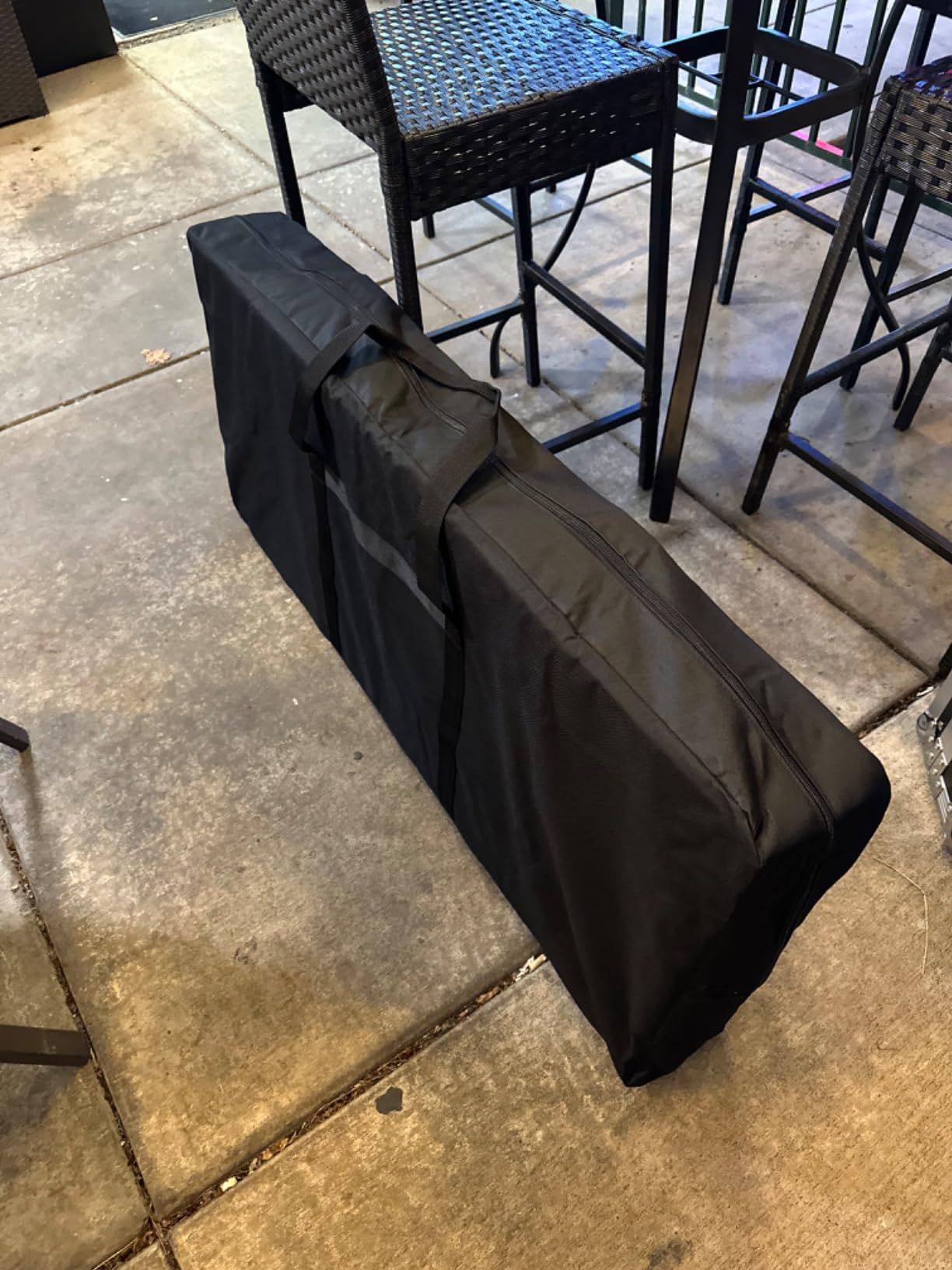
Packed weight is 43.5 pounds in a package measuring 45 by 22 by 6 inches, and the vendor describes it as light enough for one person to carry between gigs. In practice that means one solid lift from a boot into a venue room, not a two-person job, and reviewers consistently call it strong value for the money.
The criticisms are specific rather than structural. The carry bag is the repeat complaint, with owners reporting the seams starting to rip within a year. The black scrims are see-through in a well-lit room, which matters for daytime events, and the standing height runs on the tall side for shorter performers even with the foot pads at their lowest setting.
Check the depth, not the width
At 19.6 inches deep, this is one of the shallower tops in the group, and depth is what catches people out. A controller in its case, a mixer and a laptop laid flat will fill it. If your workflow is laptop-plus-keyboard-plus-controller all at once, look at the 24-inch-deep option in pick 2 rather than finding room by removing your mixer from the surface.
Height is the second check. The foot pads give you 4 inches of range, but even at the lowest setting this runs tall for a DJ under five foot ten. If you are short, either set the pads low and measure before you commit, or start with an adjustable table like pick 3 or pick 7 where the working height is a dial rather than a fixed dimension.
Where durability gets tested
The frame itself holds up well and reviews describe it as honest sturdiness rather than over-engineering. The weak points are the bag and the fabric, and the fabric is where a lot of these booths get retired. Polyester is more resilient than Lycra under UV and sweat, but black panels in a bright room will show every finger mark and let the crowd see your cabling.
One long-standing complaint across this whole category is that scrim panels arrive in random colours, and while the velcro system here means you can order spares in a matched set, mixing brands means the black may not be the same black. If branding consistency matters to you, buy every panel you need from the same seller in the same order.
5. AxcessAbles Portable Two-Tier DJ Table Stand
AxcessAbles Portable Two-Tier DJ Table Stand| Two Tier Piano Keyboard Stand for Sheet Music and Tablet | DJ Laptop and Controller Stand | Music Production Workstation | Booth Stand
36 x 19.5 inch lower top
Tiltable 18 x 12.5 inch tier
180 lb capacity
39 lb packed
The Good
- Two tiers keep a laptop or tablet clear of the main gear
- Tiltable upper tier holds sheet music or a tablet
- 180 pound capacity on a powder-coated metal build
- Folds flat for transport
The Bad
- Second tier adds bulk with no facade or scrim
- Heavier than a single-tier stand of the same class
- Limited branding since there is no front panel
This is a workstation rather than a booth, and if your set-up is a hybrid of live gear and laptop it may be the most functional thing in this roundup. The lower tabletop measures 36 by 19.5 inches, and 10 inches above it sits a tiltable 18 by 12.5 inch tier for a tablet, sheet music or books. That upper plane is genuinely useful: it gets your laptop screen up where you can see it without crowding the controllers below.
Load rating is 180 pounds on a powder-coated metal construction, which exceeds what a controller, mixer and laptop put together, so the top will not flex when you reach across it. Owners describe it as rock-solid and call the patented two-tier layout a design that took two years to develop. It folds for transport at 39 pounds, which is a two-hand load for most people.
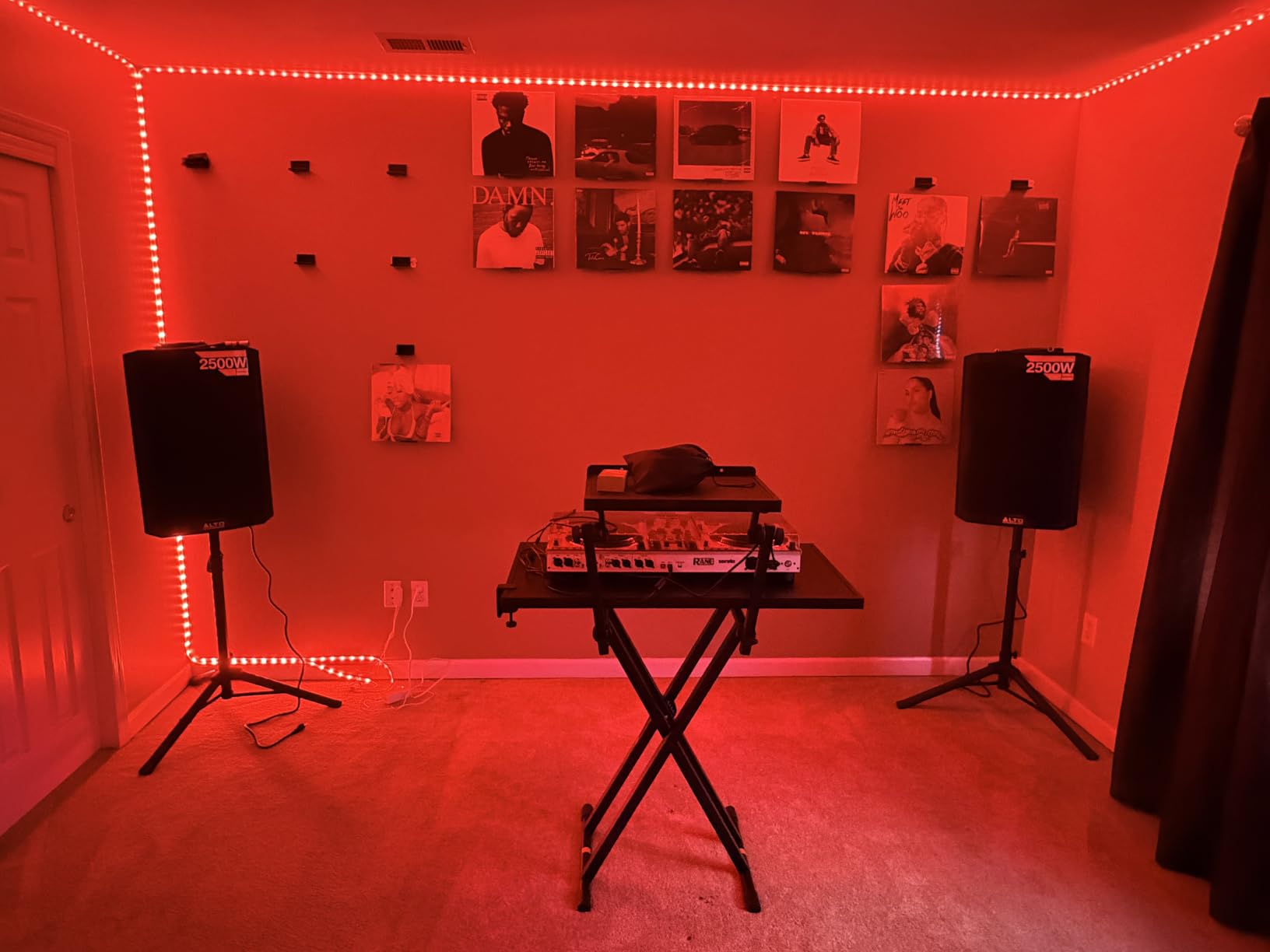
The reason it earns a place in a booth roundup is a specific one. A facade gives you a front and a flat top; this gives you a front, a flat top and a third surface. For a hybrid live set where you trigger clips from a laptop while working a controller, that upper tier removes the last bit of surface pressure and keeps the working area below it clear for a mixer.
You also get the benefit of a two-year-developed design rather than a generic bolt-together frame, and the tilted tier is adjustable enough to hold a tablet at a usable angle without a separate prop.
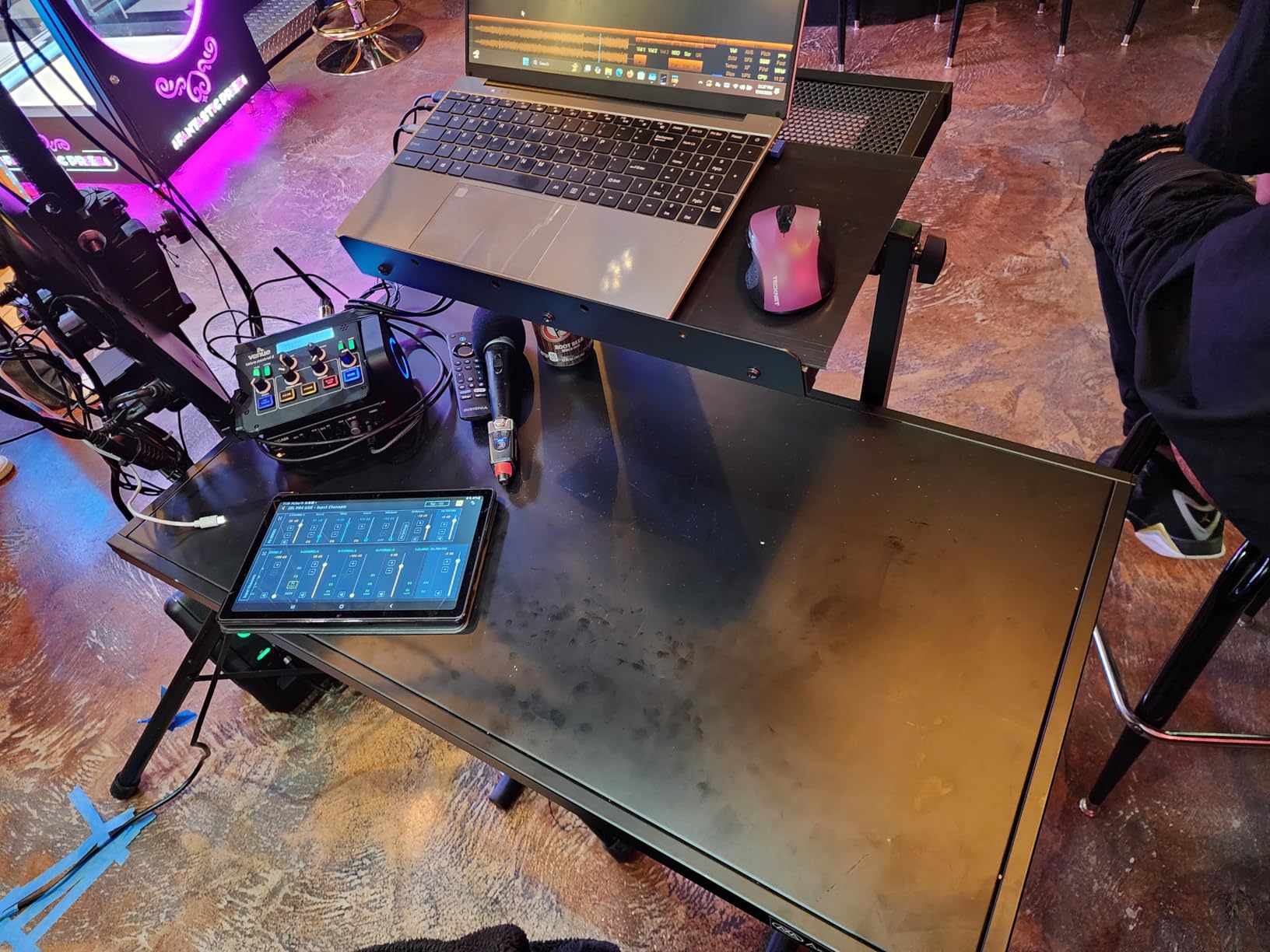
Work out whether you need three surfaces
Count your gear before buying. One controller plus mixer plus laptop is two surfaces, which a flat table handles. Add a second deck, a small audio interface, a pad controller or a laptop plus tablet and you are at three, which is exactly what this layout is for. If you are a single-controller operator, the upper tier is dead weight you are carrying for nothing.
Second check is the 36-inch width. It is the narrowest lower top in the roundup, so measure a wide controller plus a laptop side by side before you order, and remember the upper tier only helps if what sits on it is genuinely small.
What the second tier costs you
The trade is bulk and looks. You are adding a tier, so the folded package is larger than a single-tier stand, and at 39 pounds it is heavier than comparable single-deck options. There is no facade, which means gear and cables stay visible from the front and there is nothing for a guest to stop themselves leaning on.
Branding is limited for the same reason. If your presentation depends on a uniform look at corporate events, a two-tier workstation will not deliver it. If it depends on function and you are in a band, a studio or a hybrid live role, that is a trade most people here have made happily.
6. RDCMKL All-Metal Heavy-Duty Foldable DJ Stand
RDCMKL DJ Table Stand Portable Booth, All-Metal Heavy-Duty Foldable DJ Stand, Iron Plate Surface DJ Facade Booth, with 8 Machine-Washable Scrims, Travel Bag
40 x 20 x 45 inch frame
Iron plate top
36 lb packed
Eight washable scrims
The Good
- Iron plate top resists impact far better than a wooden board
- Powder-coated finish resists corrosion and travel wear
- Reinforced hinges fold and rig in under a minute without tools
- Three cable holes plus two tripod stands keep the setup tidy
The Bad
- At 36 pounds it is not a one-person carry for everyone
- All-metal surface means no padding for your gear
- Fewer owner reviews than the top sellers in the category
The thing that separates this booth from the rest of the fabric-front group is the surface material. The top is an iron plate on a full iron frame, powder-coated for corrosion resistance, and that is a categorically tougher build than a cloth-over folding table or a plywood top. Buyers single out the iron plate and the reinforced hinges as meaningfully tougher than the alternatives, and it is the reason this one sits near the top of the DJ Racks and Stands sales ranks in its category.
Assembling it took us under a minute with no tools, which is the fastest rig in the roundup. The reinforced iron hinges are the part that makes that possible, since they take the repeated fold cycle without developing play. When you are doing twenty shows a year, a unit that goes up in a minute changes how you plan a load-in.
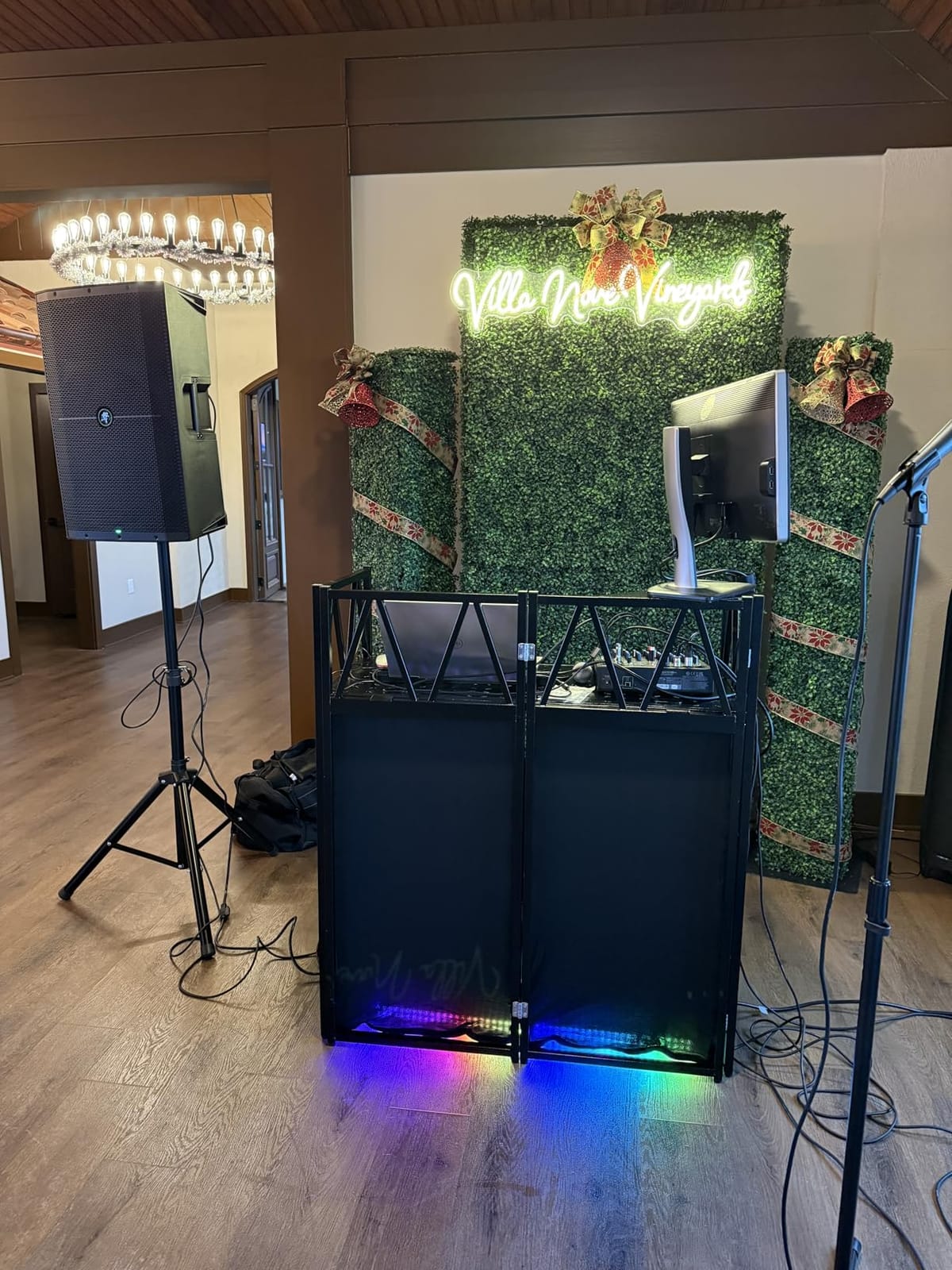
It measures 40 by 20 by 45 inches, which gives you a 40-inch working width and a taller front than most of the 40-inch units here. Three integrated cable holes run through the top, and two tripod stands are included for auxiliary gear, so a small speaker or a mic stand can live on the same footprint rather than on a separate table beside you.
You get eight machine-washable scrims, four black and four white, which is the best fabric arrangement in this roundup because you can launder them. Scrims take a beating at mobile gigs and washing them is the difference between a booth that looks consistent in year three and one that looks tired.
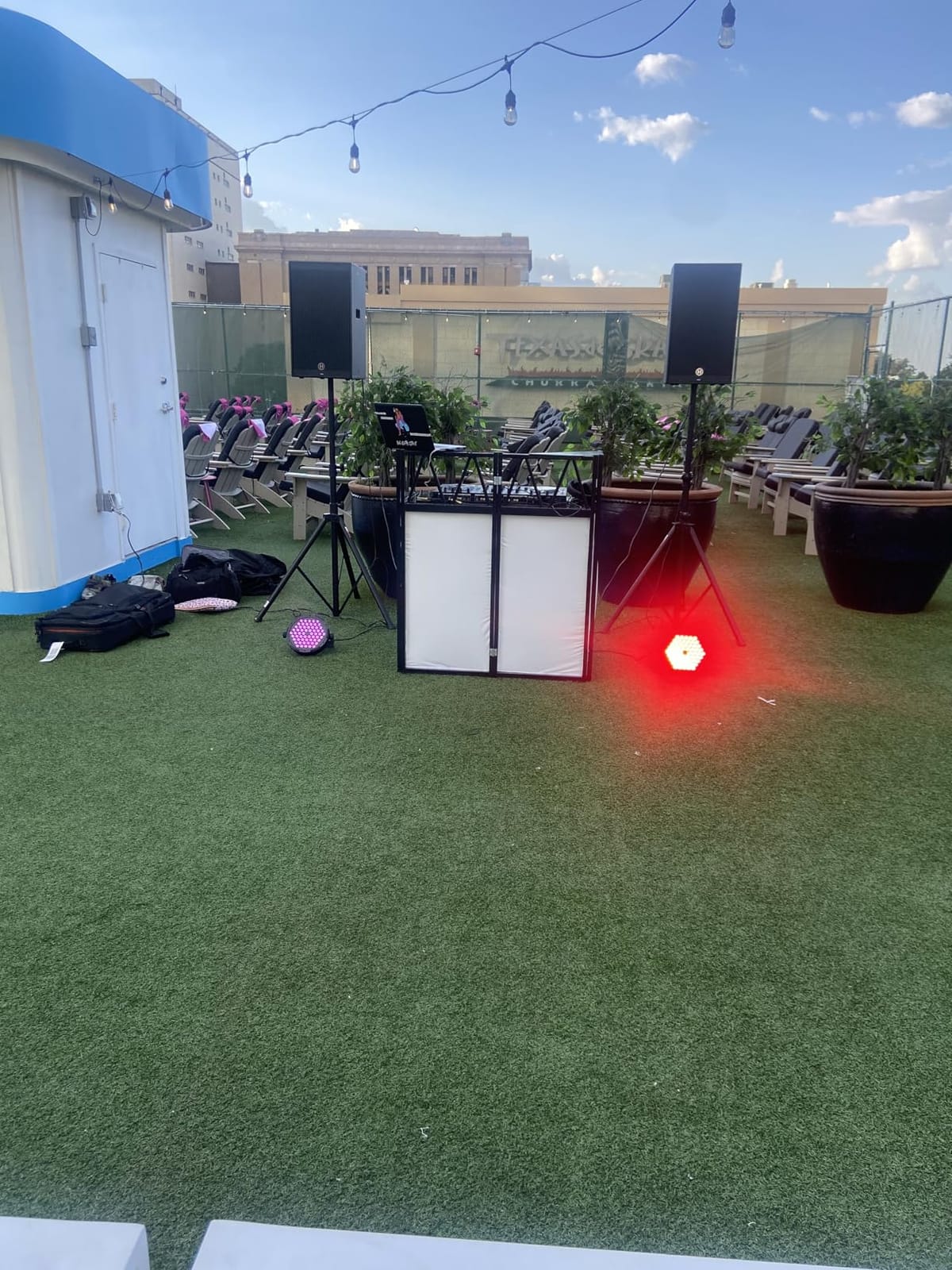
Check your car’s loading height and your back
At 45 inches tall and 36 pounds, the RDCMKL is a two-hand carry that most solo operators can manage from a boot but cannot manage up and over a high sill without a ramp. Measure your vehicle’s opening height as well as its width, because a 45-inch unit will not go into a low hatchback lying down without the panels being separated.
The 40-inch width is the same compromise as the ES-01, so run the same tape-measure check on your controller plus mixer plus laptop. What you gain here over the ES-01 is vertical clearance, a washable scrim set and tripod mounts; what you lose is the dedicated carry cases for the panels.
Know what an all-metal surface does to your gear
An iron plate does not dent easily, and that is the entire point. But it is also a hard, unyielding, uninsulated surface, so a mixer that slides off or a laptop that gets knocked off a table edge lands on steel rather than on a carpeted or wooden deck. It is worth putting a small non-slip mat under anything that can move.
Review counts are thinner than the two sellers above, at 147 reviews against 544 and 338, so the long-term owner history here is less established. The weight is the other practical drawback, and for a strict one-person operator that is a real consideration rather than a footnote.
7. Rockville RTBL4 Adjustable Height DJ Table
Rockville RTBL4 Adjustable Height DJ Table with Carry Bag 20″ x 60″
60 x 20 inch plywood top
26 to 39.5 inch height
180 lb even load
35 lb packed
The Good
- Widest surface in the roundup at 60 inches for multiple controllers or a small PA
- Height range covers both standing and seated DJ positions
- Textured carpet-like top stops gear sliding during high-energy sets
- Alloy steel frame with a stated 180 lb even load rating
The Bad
- Lowest average rating here at 4.3 with 7 percent one-star reviews
- No facade or scrims so it is a bare table
- 60 inch width is unwieldy in a small car
- 180 lb rating assumes even distribution
The RTBL4 is here because it solves the sizing problem the other facades create. At 60 by 20 inches it is the widest surface in the roundup by a clear margin, and 60 inches is the number that serious multi-dek rigs actually need. If you are running the kind of setup that needs 54 inches of width, this is the shortest route to fitting it.
Height adjusts from 26 to 39.5 inches, which is the widest range here and the only one that genuinely covers a seated operator. A lot of DJs buy a table at standing height and then discover the rig needs a lower position for certain sets, and having the adjustment removes that compromise entirely. The alloy steel frame uses pin-lock folding legs and comes pre-assembled with a screwdriver recommended for setup.
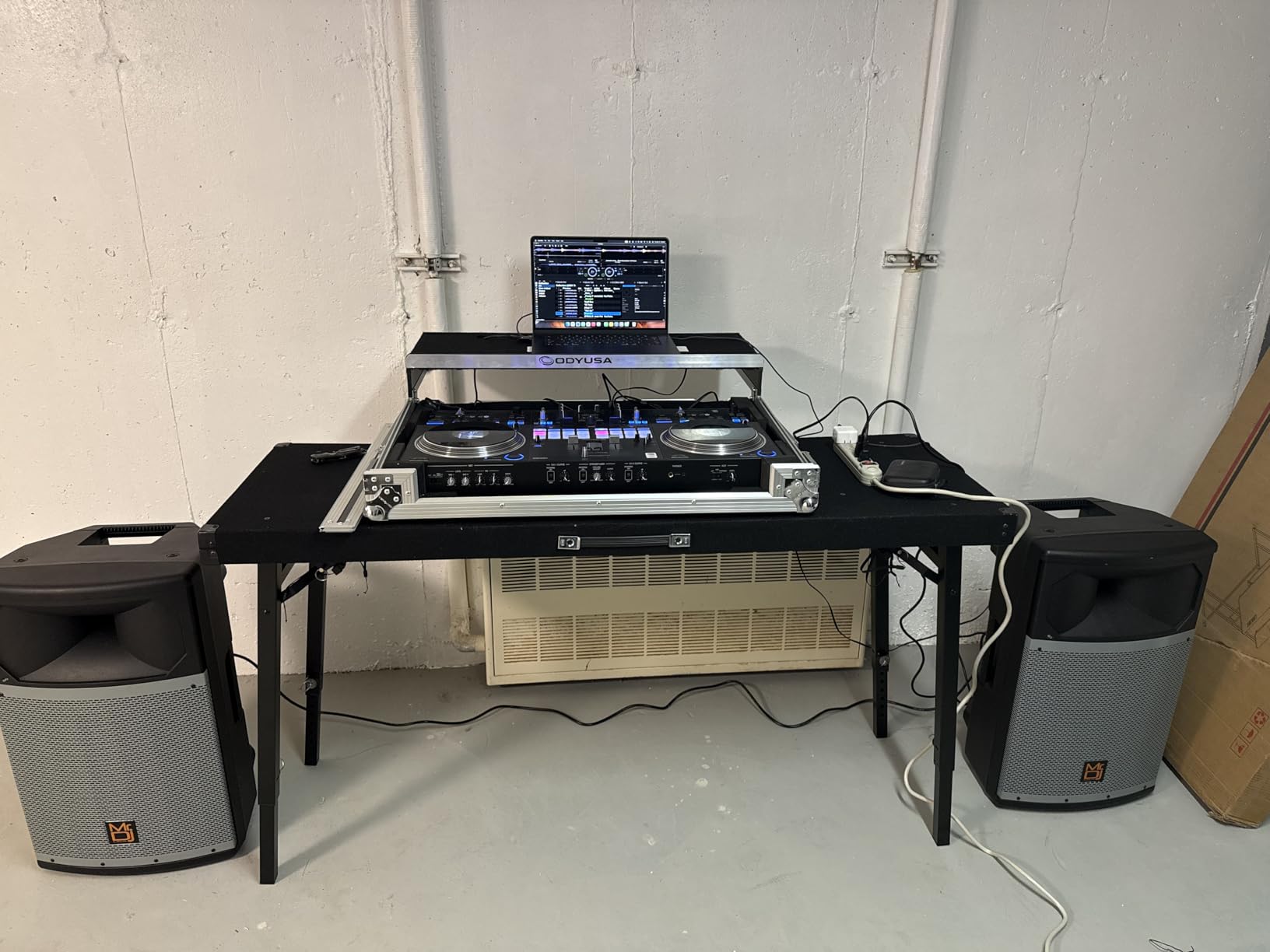
The 3/4-inch plywood top is rated to 180 pounds evenly distributed, and the textured carpet-like finish is the detail we appreciated most in testing: controllers and mixers do not creep across it during a high-energy set the way they do on a bare laminate or metal surface. There is a cable port through the tabletop, and a carry bag is included.
Packed weight is 35 pounds and folded dimensions are 60 by 20 by 39.5 inches, so this is a long thin object rather than a short thick one. In a mid-size vehicle it is a straight load across the back. In a hatchback or a small car, it is a genuine problem, and reviewers call the size awkward for transport specifically.
Measure the span you actually need
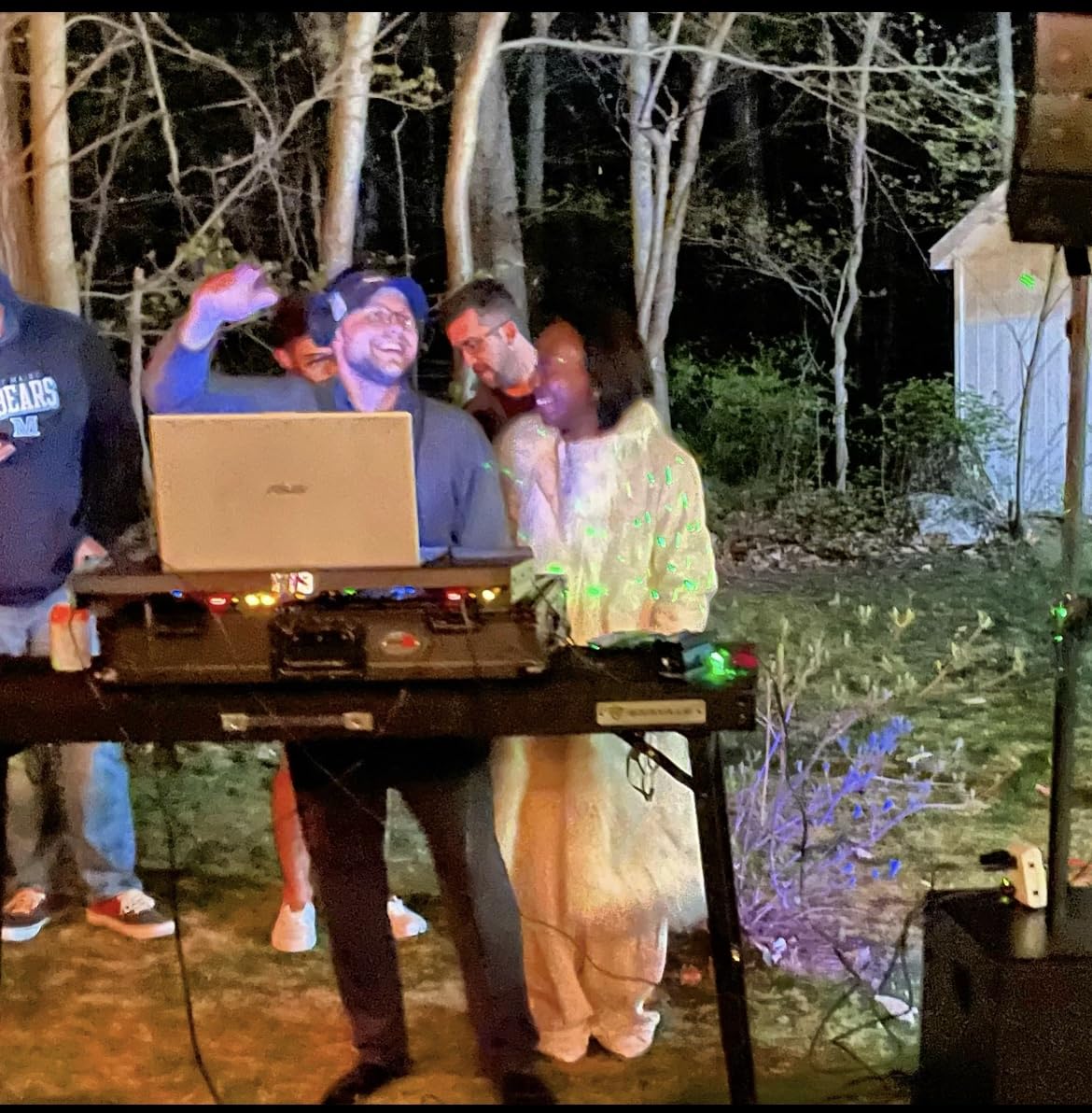
Sixty inches is not always better. A single controller and mixer setup on a 60-inch top leaves your gear clustered in the middle with a lot of unused surface, and pushing a laptop to one end puts it at an awkward reach. The width is worth it when you are running two decks plus a mixer plus a laptop, or when you want the table to double as a small PA or mixer position for a live set.
Also check the rating honestly. An even-distribution figure of 180 pounds across a 60-inch span is not the same as 180 pounds concentrated at the centre where a heavy mixer sits. If you are loading the middle of the table with a large mixer, a more compact frame with a higher per-area rating may serve you better.
What you give up by going bare
There is no facade, no scrim and no front panel, so this is a table and nothing more. Cable management is a single port, and the 4.3 rating with 7 percent one-star reviews reflects a plain design rather than a flawed one. Guests can walk right up to the gear, which is the specific problem a facade solves.
The counter-argument is real, though: plenty of pros who never use a booth describe working from a folding four-foot table that extends to bar height so they do not lean over their set. The RTBL4 is that idea, engineered properly, with a stated capacity and a real adjustment range.
8. YooKoo Portable DJ Booth Metal Frame
YooKoo Portable DJ Booth, Metal Frame DJ Table, 40″ x 20″ Tabletop
40 x 20 inch metal top
25 lb packed
All-metal frame
Guard rails and vents
The Good
- Lightest booth in the group at 25 pounds while staying all-metal
- Guard rails protect gear at the edges of the surface
- Ventilation holes dissipate heat from laptops and power supplies
- Strong category sales rank suggests proven demand
The Bad
- Laptop area feels tight for a large 15-inch model
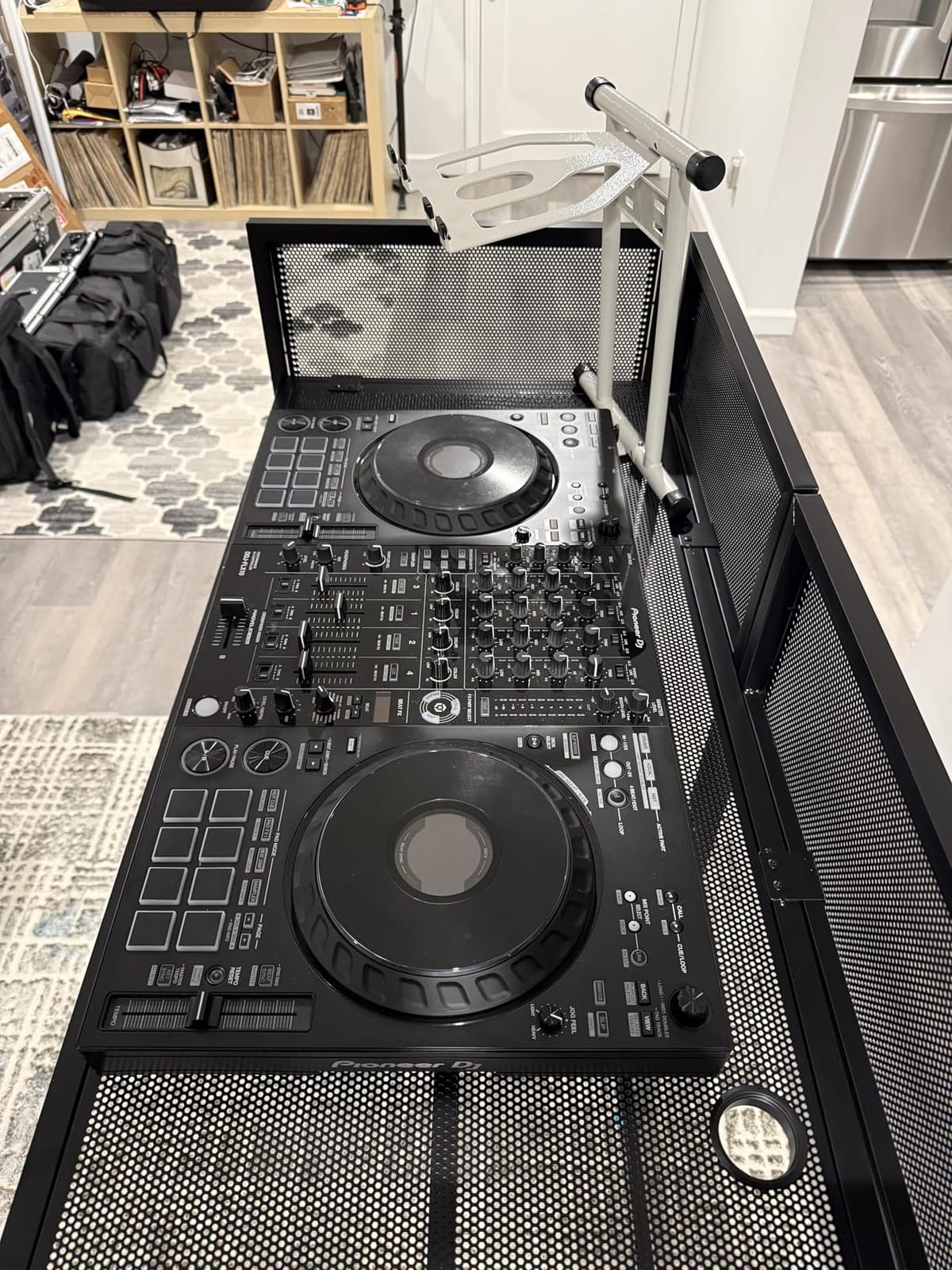
- Top depth leaves about 2 inches either side of a DDJ-FLX10 in its case
- Velcro strips lift slightly where riveted
- Included bag is thin
Weight is the whole argument for the YooKoo, and it is a strong one. At 25 pounds it is the lightest booth in this roundup by a wide margin, roughly half of the heaviest units here, and it is still a full all-metal frame with a metal 40 by 20 inch tabletop. If your load-in involves a long walk from a parking space, a stairs, or a venue with no loading dock, that difference decides which booth you can carry alone.
The extra hardware is unusually thoughtful for the tier. Guard rails run around the edge of the surface to stop a controller or a laptop being knocked off, and ventilation holes in the tabletop dissipate heat from a laptop and a power supply during a long set. The metal surface also accepts magnetic mounts if you want to add your own accessories without drilling.
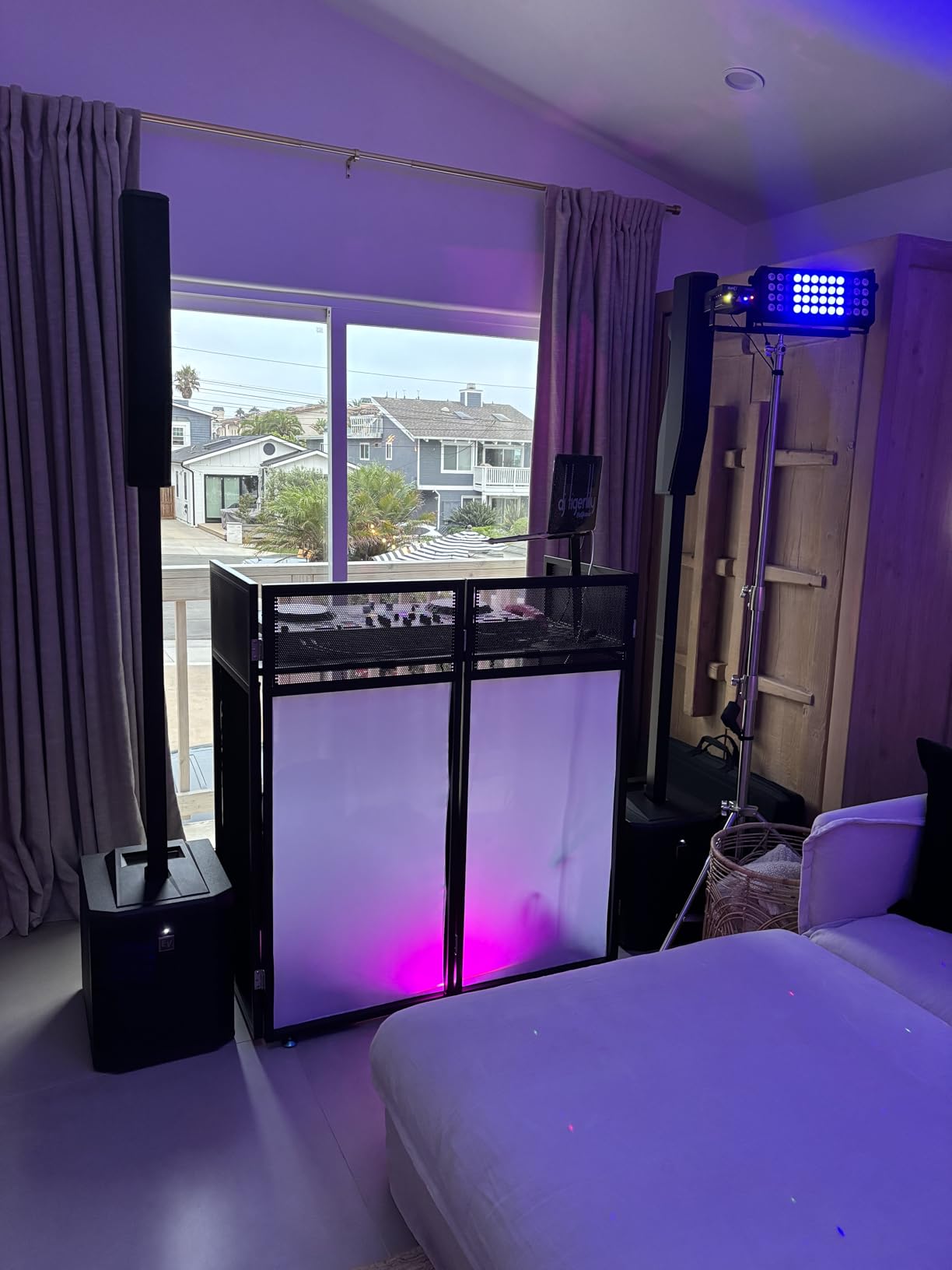
Two interchangeable velcro scrims in black and white are included, which is fewer than the eight-panel sets on the Rockville and RDCMKL, but enough to switch between a light and a dark front. Tool-free assembly takes a few minutes, and it folds to a compact handbag size that fits in the back of an SUV along with the rest of your rig.
Owners call it well made and report that the standing height suits taller DJs because it saves their back. The category sales rank is strong for a product this new, which suggests the demand is real rather than manufactured.
Check the laptop fit before anything else
This is the specific detail that decides it. The 20-inch depth leaves roughly 2 inches either side of a Pioneer DDJ-FLX10 in its case, and owners report the laptop area feels tight for a large 15-inch model. Bring your actual laptop and controller, or measure them, before you buy. A booth you have to stack gear on the floor to make work has lost its main advantage.
Second check is the wobble. It does not sit perfectly flush, and a small amount of movement is reported at the base. On a level indoor floor that is a non-issue; on grass or a sloped surface it is worth combining with a levelling mat.
What the low weight actually gets you
It gets you a single-trip load and a booth you can genuinely take to a park or a beach, which is not a hypothetical scenario for outdoor events. It also means the folded unit fits in a small car where a 45-inch-tall or 60-inch-wide booth simply would not, and several reviews specifically mention folding it flat and fitting it behind the back seat.
The trade-offs are the thin carry bag, the velcro strips that lift slightly where they are riveted, and the smaller scrim set. If you intend to project lighting onto the front, the Rockville or RDCMKL scrim sets give you far more surface to work with.
9. Morohope Portable DJ Booth Facade Stand
Portable DJ Booth Facade Stand | Foldable DJ Table with 38.5″x19″ Surface & Cable Hole | Includes Black/White Scrims & Carry Bag for Events, Parties, Mobile DJs (DJ Station, Event Facade)
38.5 x 19 inch surface
200 lb stated rating
Zinc alloy frame
30.4 lb packed
The Good
- Highest published load capacity in the group at 200 pounds
- Rust-resistant zinc alloy steel that suits outdoor use
- Eight gauze panels on velcro that take lighting projections
- Waterproof-coated carry bag resists weather
The Bad
- Smallest working surface in the roundup at 38.5 x 19 inches
- Carry bag colour varies between orders
- Rating is among the lowest here at 4.4 with 11 percent three-star reviews
Morohope publishes a 200-pound load rating, the highest stated capacity of any booth in this roundup, on a zinc alloy steel frame rated and finished for rust resistance. That combination is the one you want if your outdoor gigs are the point rather than an occasional booking, because a powder-coated zinc frame is the material most likely to survive damp grass and an overnight setup outdoors.
The work surface is 38.5 by 19 inches, which is the smallest here, and that is the compromise. The frame comes as four folding facade panels plus two desktop panels, and it carries four black and four white gauze scrim panels on velcro. Those gauze panels take lighting projections well, which is why owners mention party and event use specifically.
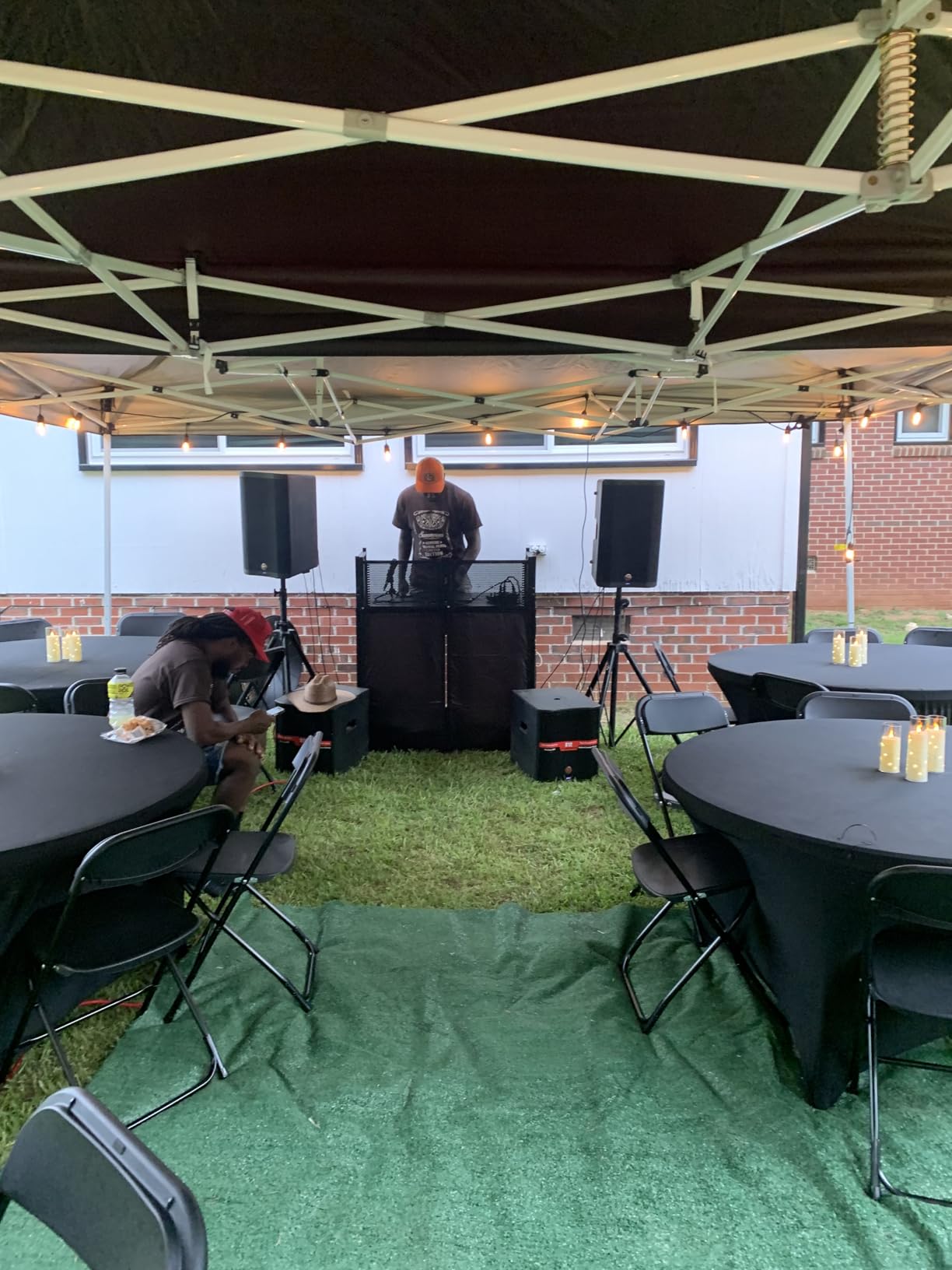
Setup is tool-free and takes a few minutes, and it folds flat. At 30.4 pounds it is the second-lightest fabric-front booth here, and the included carry bag has a waterproof coating with high-density fabric, which is a meaningful upgrade over the thin cloth bags several competitors ship with.
Overall the unit measures 39 by 20 by 47 inches. The facades are wider than the top, so it presents as a booth rather than a stand, and the gauze fabric gives you enough front to project onto and to hide the front of your cabling.
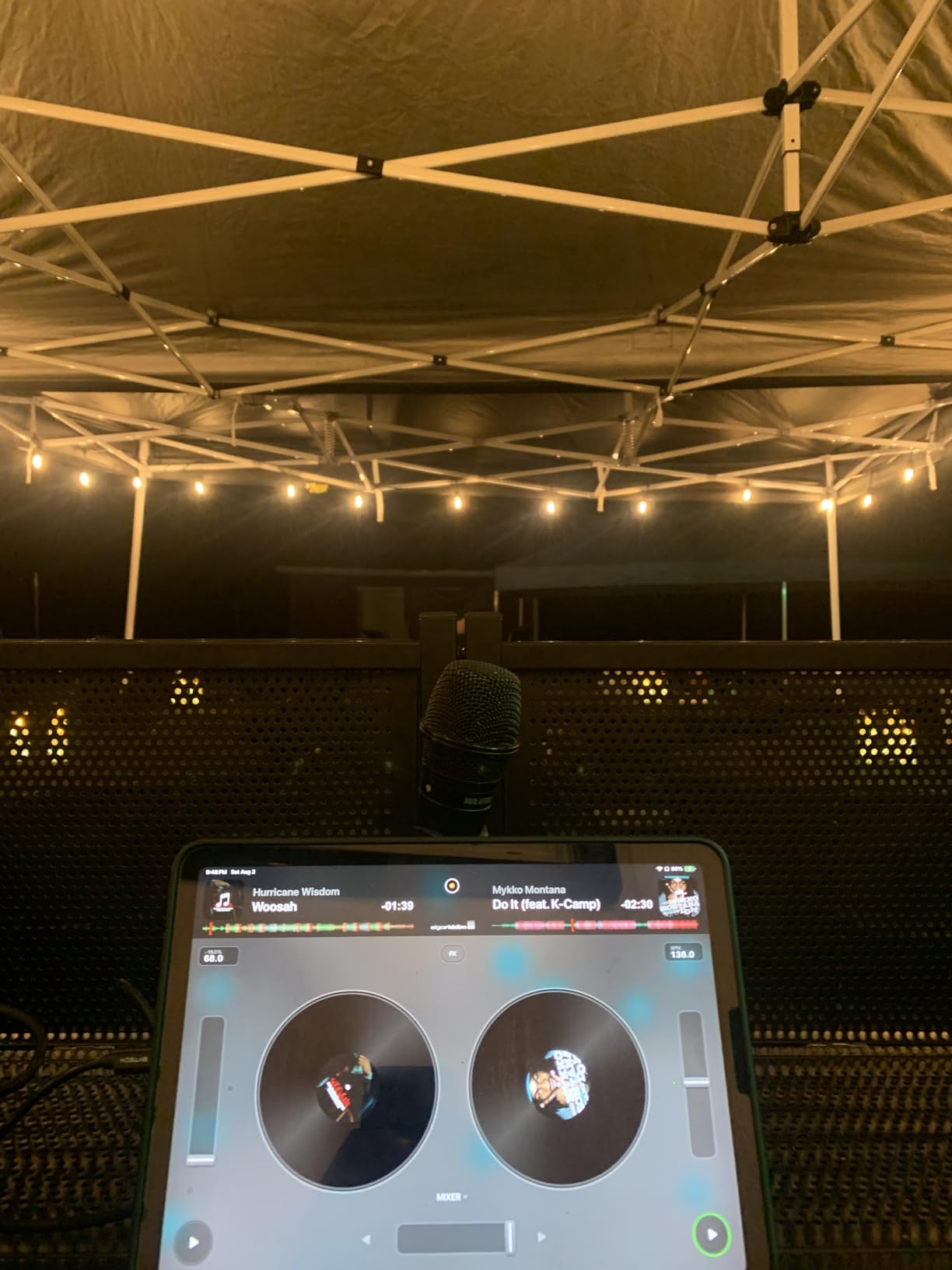
Check the surface against your smallest realistic kit
Thirty-eight and a half inches is narrower than everything else on this list, so it is really a single-controller booth. A controller plus a mixer fits. A controller plus a mixer plus a 16-inch laptop does not, unless the laptop sits on a raised tier you add separately. Measure before you order, and do not assume it is equivalent to a 40-inch top, because half an inch compounds when you are working around a mixer.
Second check is where you will actually set up. A 47-inch overall height is fine indoors but means you are working at a high angle in daylight, and tall facades on grass need a level base.
What the rating tells you
Two things. First, a published capacity is worth real money: many generic booths in this category do not state one at all, and an unstated capacity means you are guessing whether a multi-dek rig will be safe on the top. Second, a 200-pound rating on a 38.5-inch span implies a strong frame relative to its size, so it is not a marketing number attached to a weak build.
Against that, the 4.4 rating with 11 percent three-star reviews is the lowest here, and the comments are about the smaller-than-average surface and the carry bag colour varying between orders, which is a small thing that irritates people who care about presentation.
10. lunacme Double-Layer DJ Booth Table
lunacme Portable DJ Booth Table,Foldable DJ Table Stand with White & Black Scrim,Adjustable D J Facade Station Metal Frame with Cable Hole for Private Events, Clubs, Bars
40 x 20 inch table
40 x 7.87 inch upper desktop
Eight Lycra scrims
Two-year warranty
The Good
- Second desktop shelf adds a tier for a laptop or accessories
- Longest warranty on the facades here at two years
- Eight Lycra scrims project light well for clubs and bars
- Three cable holes and four adjustable screw legs
The Bad
- Heaviest booth in the roundout at roughly 42 pounds
- The 7.87 inch upper desktop is too narrow for most laptops
- Lycra gauze is see-through in bright rooms
- Higher asking price than the foldable facades
The lunacme is the pick if you want a facade and a second working plane in one frame. The main table detaches at 40 by 20 inches with three cable holes, and above it sits an additional 40 by 7.87 inch desktop. That upper shelf is deep enough for accessories, a pad controller, a mixer of a modest size, or a tablet, which takes pressure off the main surface during a long set.
Build quality is solid rather than premium. The frame is metal with a high-quality Lycra gauze facade, and four adjustable screw legs give you fine height control on uneven floors, which is more precise than the rubber footers on most of the fabric-front units here. Packed weight is about 42 pounds, the heaviest in the roundup, and it folds almost completely flat with a carry bag included.
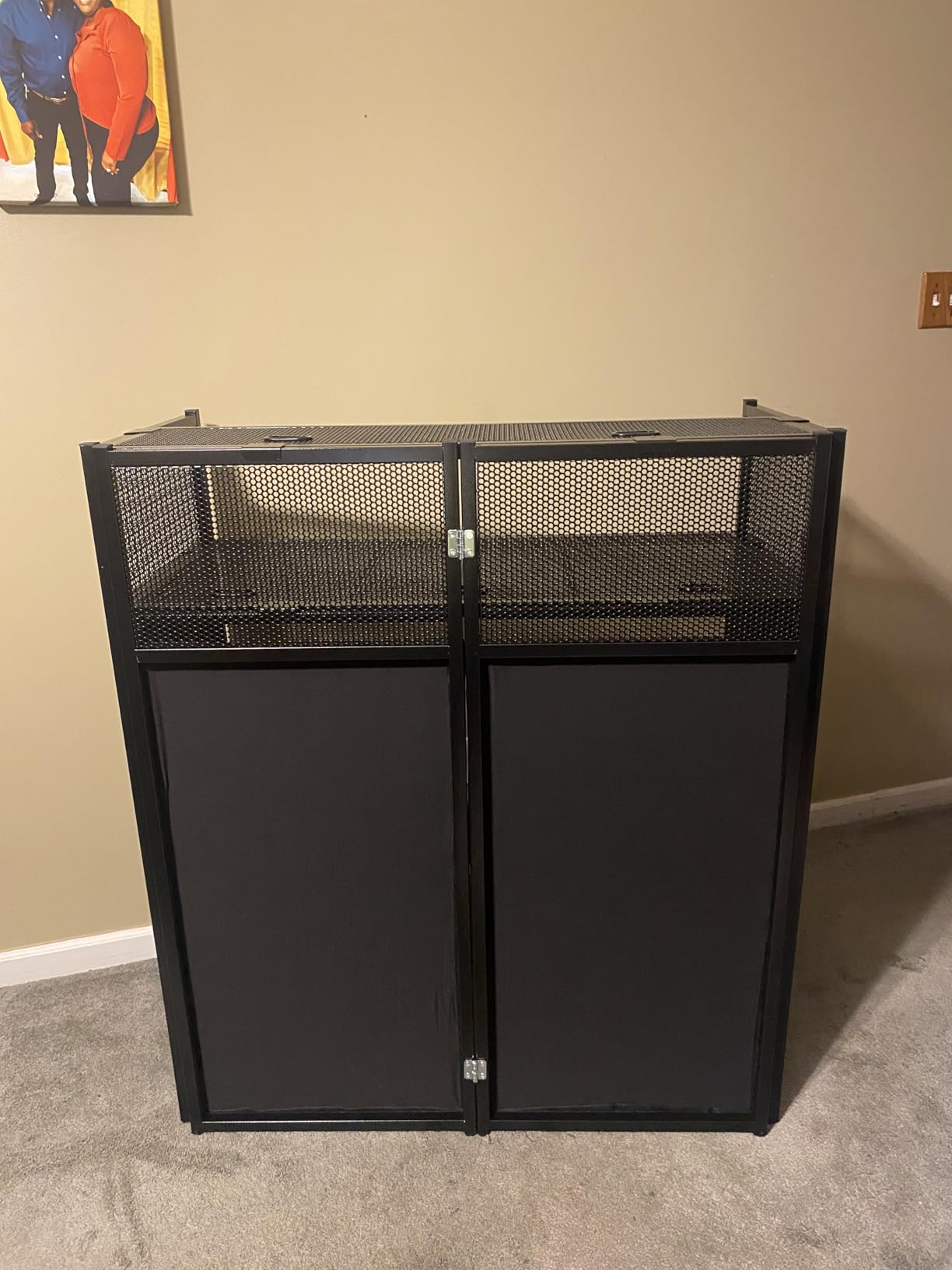
You get four black and four white gauze panels on velcro, and buyers like the way they take light in club and bar settings. Three cable holes in the main tabletop keep the wiring under control, which matters more than it sounds when the facade is backlit and every cable is silhouetted.
The warranty is the standout detail: two years from the manufacturer, which is the longest on any fabric-front booth we looked at. For a booth that gets folded and carried in a car every week, a two-year cover on the frame is a reasonable signal about how the joints are made.
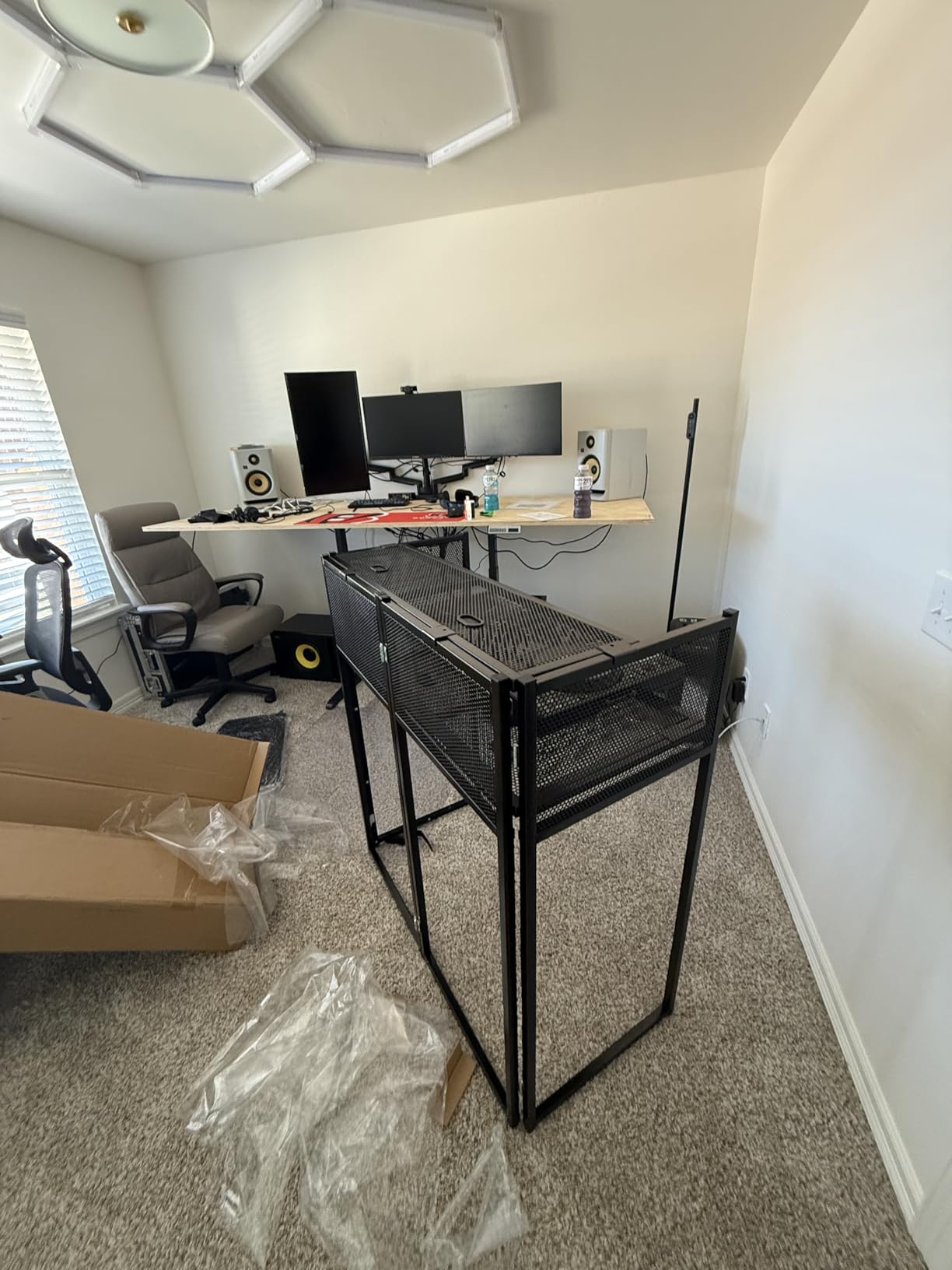
Decide what the upper shelf is for
Seven and seven-eighths of an inch of depth is the whole story here. That is enough for a small accessory tray, a pad controller, a remote, or a laptop if it is a compact one, and it is not enough for a 16-inch machine. Work out what you would genuinely place up there before you count the second layer as a feature you are paying for.
If your plan is a laptop on an upper tier, the AxcessAbles two-tier stand in pick 5 is the one to buy, because its 18 by 12.5 inch upper tier actually holds a tablet. If the shelf is for accessories, this does the job and gives you a fabric front as well.
What the extra layer and the fabric cost
At roughly 42 pounds this is the heaviest booth in the roundup, and the second desktop adds to the folded bulk. That is a real single-person load-in tax for a feature that only some working styles use. Budget accordingly, and check that it fits your vehicle once the table is detached from the frame.
On the fabric side, Lycra is the softest, most projector-friendly material and the one most likely to look good under a moving head, but it is see-through in a well-lit room and it is the first thing to pick up finger marks. Bright white Lycra also shows dirt, so plan to wash panels rather than assume they will survive the season.
How to Choose a Portable DJ Booth
Every booth on this page solves the same problem, so the differences come down to five measurable things. Work through them in order and the right product usually becomes obvious before you have spent an evening comparing photographs.
Check the folded footprint against your vehicle first
Nothing in the category is published consistently, which is why we worked the packed figures into every review above. Measure the boot opening of the car you actually use, both width and height, before you shortlist anything. A unit that folds to 26 by 6 by 49 inches will go into almost anything, while a 60-inch table is a long thin object that needs a specific kind of space.
The second half of this check is whether one person can carry it. Packed weights here run from 25 pounds to 43.5 pounds, and that 18-pound spread is the difference between a one-trip load and a two-person job. If you are loading in alone, weight matters more than any other single specification, and it is the one criterion most roundups skip.
Match the surface to the real footprint of your rig
Tape-measure the total width of your controllers, mixer and laptop as they will sit on the table, then add two inches of clearance per side. A 38.5 by 19 inch top suits a single controller and mixer. A 40 by 20 inch top adds a laptop. A 47 by 24 inch top fits a larger controller beside a 16-inch laptop, and a 60-inch top is the answer for two decks plus a mixer plus laptops.
Depth gets neglected more than width, and it is the one that catches people out. A controller in its case, a mixer and a laptop laid flat need around 24 inches of depth. Owners of the 20-inch-deep units in this roundup consistently describe the laptop area as tight, with one reporting roughly 2 inches either side of a controller still in its case.
Treat an unstated weight capacity as a warning
Several booths in this category do not publish a load rating at all, and that is not a neutral detail. Without a figure you are guessing whether a two-dek rig will be safe on the top, and a bent frame mid-set in front of a room is a far worse outcome than a booth that never gets bought. Prefer a stated capacity, and check that it is an even-distribution figure rather than a peak load.
The published figures here range from 160 pounds on the Liquid Stands, through 180 pounds on the Rockville RTBL4 and the AxcessAbles two-tier, up to 200 pounds on the Morohope. For almost any controller-based rig, 160 pounds is already more than you will ever place on the table, so the rating is less about the number and more about whether anyone stood behind it.
Time the setup against your actual load-in window
Setup times claimed by the manufacturers here range from under a minute for the RDCMKL to 10 minutes for the AxcessAbles, and our own tests landed close to both. That difference matters if a venue gives you 20 minutes to be ready, because the teardown side is where it compounds, and a booth that breaks down in under 2 minutes is what lets you play a room earlier and leave sooner.
The number of tools matters as much as the time. Anything that assembles with a single pull lever or pre-threaded hardware is a better fit for a solo operator than anything requiring a screwdriver or a hex key, and it is the difference between setting up before the guests arrive and setting up while they are watching.
Decide whether the front is doing a job
The front panel is not decoration. It conceals cable runs that would otherwise be a trip hazard and a visual problem behind a backlit surface, and it defines a working edge that discourages guests from leaning over your gear with a drink. That second point is the one pros raise most often, and it is the reason a booth is not just a table with fabric on it.
It also carries a compliance point worth knowing. Fire-retardant scrim fabric is documented on the Rockville XL, and for indoor corporate or venue events that can be an insurance question rather than a preference. Bright white fabric shows every mark, translucent Lycra is see-through in daylight, and scrim sets that arrive in random colours break branding consistency, so specify what you need rather than accepting what turns up. For related portable event kit, our picks for photo booths and mobile whiteboards cover the rest of a mobile event setup.
Frequently Asked Questions
What is the best DJ booth?
The best DJ booth for most mobile operators is the AxcessAbles ES-01, a 40 by 20 inch steel-frame facade with swappable black and white scrims, cable slots in the top, carry cases and a 10-minute tool-free setup. For a wider two-controller rig, the Rockville Rockbooth XL gives you a 47 by 24 inch detachable table and eight fire-retardant scrims. If you do not need a fabric front, the Liquid Stands MS1098 is a 160-pound-rated steel workstation with a 10-year warranty.
Do I even need a DJ booth for mobile events?
Not for every gig. Plenty of pros work from a folding table draped with linen and never hear a word about it, and if you play private parties on a small rig you may never notice the difference. Booths earn their place at weddings, corporate events and any room you do not control, where a bare table reads as unfinished and where a front panel stops guests leaning over your gear with a drink.
How big should a portable DJ booth be?
Size the surface to your rig plus two inches of clearance per side. A single controller and mixer fits a 38.5 by 19 inch top. Adding a 16-inch laptop pushes you to 40 by 20 inches. Two decks, a mixer and a laptop need about 54 by 24 inches, which means a 60-inch table or a 47-inch facade is the closest commercial fit. Depth matters as much as width, and 24 inches is the practical minimum for a full setup.
Can a portable DJ booth fit in my car?
Most fold into a bag between 26 by 6 by 49 inches, which fits a mid-size SUV or the back of a hatchback. The exceptions are wide tables: a 60-inch model is a long thin object that needs a full-length load across a larger vehicle. Check your boot opening height as well as width, since a 45-inch-tall facade will not pass through a low hatch. Always measure before you buy rather than trusting product photographs.
How long does it take to set up a portable DJ booth?
Tool-free foldable booths go up in anywhere from under a minute to about 10 minutes depending on the frame. Our own times matched the claims: the RDCMKL all-metal unit rigged in under a minute, and the AxcessAbles ES-01 took just over 10 minutes from bag to locked frame with one person and no tools. Breakdown is the faster half, often under 2 minutes, which is what decides whether you can finish a set and leave early.
What weight capacity does a DJ booth need?
For a controller, mixer and laptop setup, 160 pounds is more than enough, so the rating matters more as a build-quality signal than as a limit. What you should not accept is no figure at all, because that leaves you guessing whether a multi-dek rig is safe on the top. Note also that an evenly distributed rating is not the same as a concentrated load at the centre of a wide table where a heavy mixer sits.
Conclusion
The best DJ booths for mobile setups are not the ones with the most features, they are the ones that match your rig, your vehicle and your load-in window. The AxcessAbles ES-01 is our pick overall because it is the most complete package we could find that one person can carry, rig in about 10 minutes and fold back into proper cases.
If your rig is wide, move to the Rockville Rockbooth XL for a 47 by 24 inch table and documented fire-retardant scrims. If you would rather have a rock-solid surface than a fabric front, the Liquid Stands MS1098 gives you a 160-pound rating and a 10-year warranty. And for a multi-dek setup that needs real width, the Rockville RTBL4 at 60 inches solves the sizing problem no facade in this roundup can.
Measure your gear, measure your boot, and pick from there. The right booth is the one that is already set up when the guests walk in.