
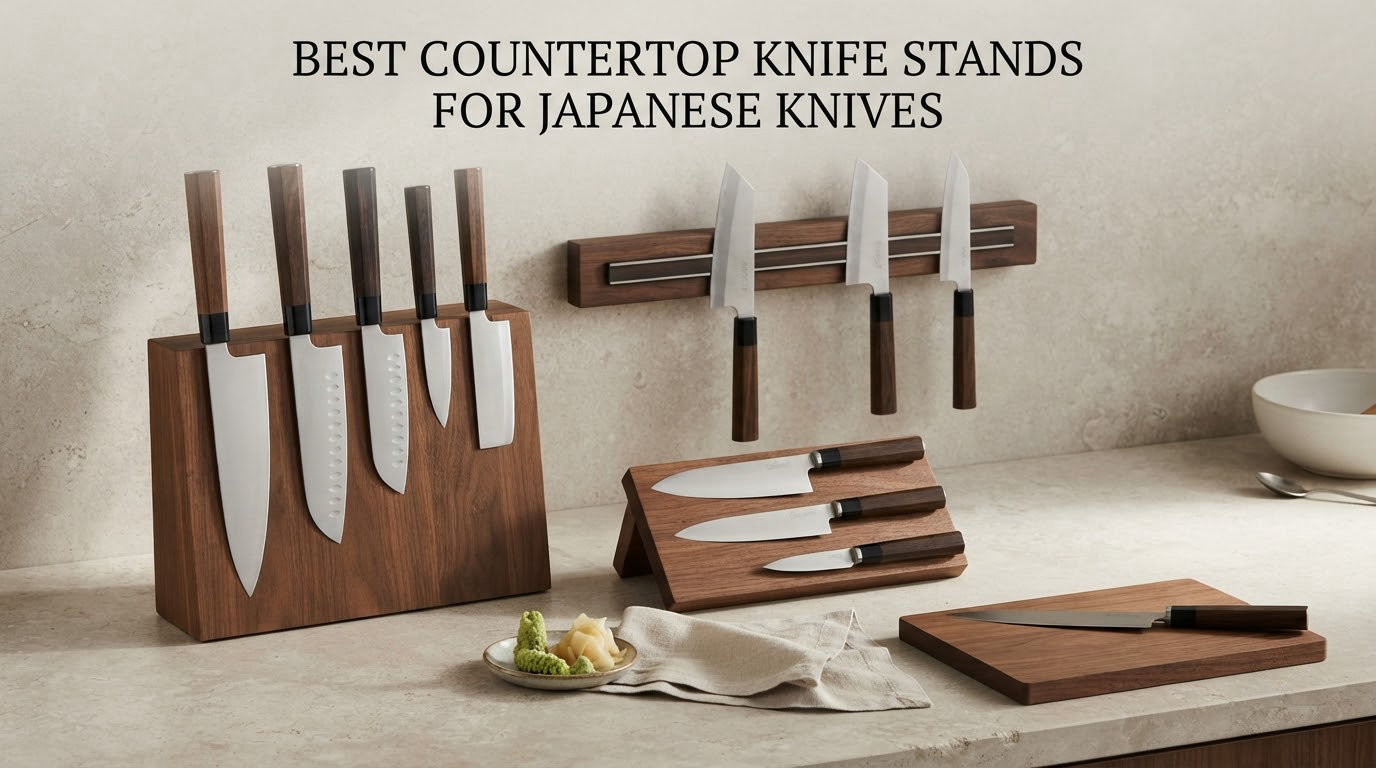
The best way to store Japanese knives is edge-up, ventilated, and away from anything that can touch the cutting edge. A freestanding countertop stand is the easiest way to do that, but only if the slots or the magnetic face match your blade lengths. Too short a slot and the tip hits the base, and a bare steel magnet can mark a kurouchi patina. This guide covers every stand that passed our fit, grip and stability checks.
We spent weeks loading, unloading and wiping down ten countertop knife stands with the kind of blades that actually stress a holder: a 210mm gyuto, a 240mm gyuto, a santoku, a nakiri and a deba. We checked blade clearance, magnet retention, counter footprint, tip stability and how each surface treated a polished edge and a black kurouchi finish. The results are the ten picks below, plus the honest list of what failed.
Before the picks, here is how to store Japanese knives correctly, whether or not you buy anything from this list. First, always store edge-up so nothing rests on the hardened cutting edge. Second, keep blades dry and ventilated, since moisture sitting on carbon steel causes rust spots that no amount of stropping fixes. Third, match the storage to the blade, because a narrow santoku and a wide nakiri need different clearances. Fourth, pull knives off sideways rather than straight toward you, which stops magnetic stands from tipping. Fifth, if you own a high-value collection, hand-wash the blades and wipe the stand rather than running either through a dishwasher.
A note on what we left out. Bundled knife sets with a block attached are a different category, and you can read our picks in our guide to Japanese kitchen knife sets instead. Here we test stands on their own, with no knives included, so you can pair any of them with blades you already own. If you are still choosing the blades themselves, our Japanese chef knife picks cover the steel types that stress a stand the most.
Top 3 Picks: Best Countertop Knife Stands for Japanese Knives (October 2026)
Our top three cover the three real buying situations. The first is the strongest all-rounder for mixed Japanese blades. The second is the compact magnetic option for small kitchens. The third is the slot block that handles the widest mix of blade shapes if you hate magnets.
Aomiesen Acacia Magnetic Block
- Double-sided neodymium magnets
- Acacia wood
- 12 inch wide face

Coninx Bamboo Magnetic Block
- Hidden strong magnet
- Felt non-slip base
- Compact square footprint

All 10 Countertop Knife Stands for Japanese Knives Side by Side
Every stand below holds blades upright on the counter and none of them ship with knives. The features column covers the mechanism, the material and the capacity, which are the three things that decide whether a Japanese blade fits.
| Product | Key Specs | Buy |
|---|---|---|
|
|
Check Latest Price |
|
|
Check Latest Price |
 |
|
Check Latest Price |
 |
|
Check Latest Price |
 |
|
Check Latest Price |
 |
|
Check Latest Price |
 |
|
Check Latest Price |
|
|
Check Latest Price |
 |
|
Check Latest Price |
 |
|
Check Latest Price |
1. Aomiesen Acacia Magnetic Block: Best Overall Magnetic Stand
Home Kitchen Magnetic Knife Block Holder Rack Magnetic Stands with Strong Enhanced Magnets Multifunctional Storage Knife Holder
Acacia wood
Double-sided neodymium magnets
12 x 10 inch face
2 kg weighted base
The Good
- Strong double-sided grip on quality steel
- Heavy stable base that does not slide
- Blade only ever touches wood
- Quick three-screw assembly
The Bad
- Predrilled holes can need extra tightening
- Dark finish shows dust and flour
- Not ideal for ceramic blades
This is the stand we ended up with on our own counter, and the reason is simple: it never asked us to think about blade geometry. The magnets are hidden on both faces, so a 240mm gyuto, a nakiri and a wide deba all hang the same way. Nothing lines up with a slot, so there is no way for a tip to strike a slot floor.
The acacia body is 12 inches wide and 10 inches tall, and at 2 kg it stays planted when you pull a knife off. Our 210mm gyuto sat flat against the face with no pivot and no sideways slide. Owners report the same thing, rating the grip and the stability as the two standout qualities across more than ten thousand reviews.
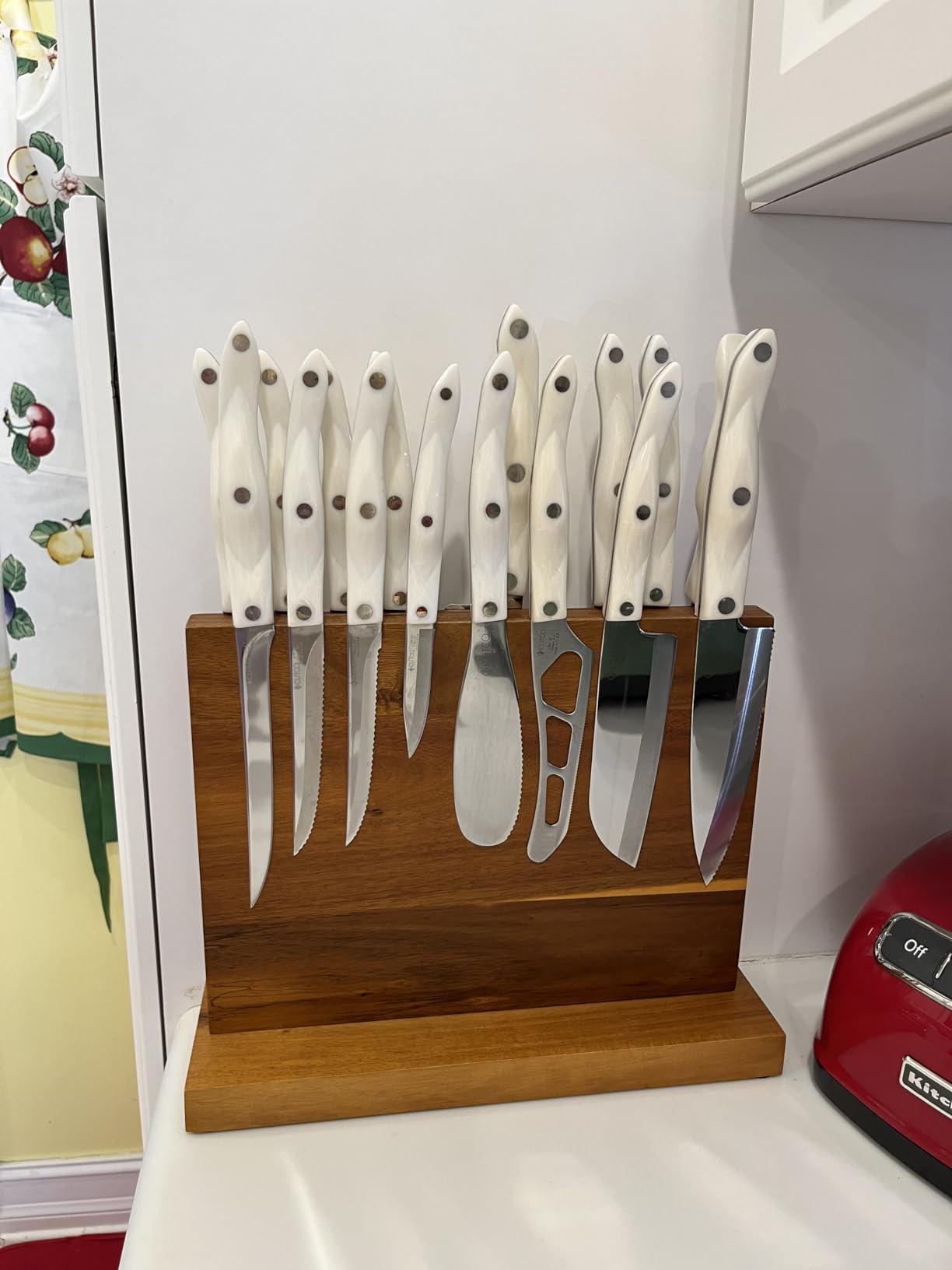
One thing to know is that magnet strength depends on the steel of the blade. Softer, cheaper stainless grips noticeably worse than a hard Japanese steel, which is a strange inversion but a real one. If you load it mostly with Japanese knives you are in the best-case scenario.
Assembly is three screws and the screwdriver is included, though reviewers do report occasionally needing an extra turn to kill a wobble. The dark finish is attractive and it is also a fingerprint and flour magnet. Wipe it when you see it and it stays presentable for years.
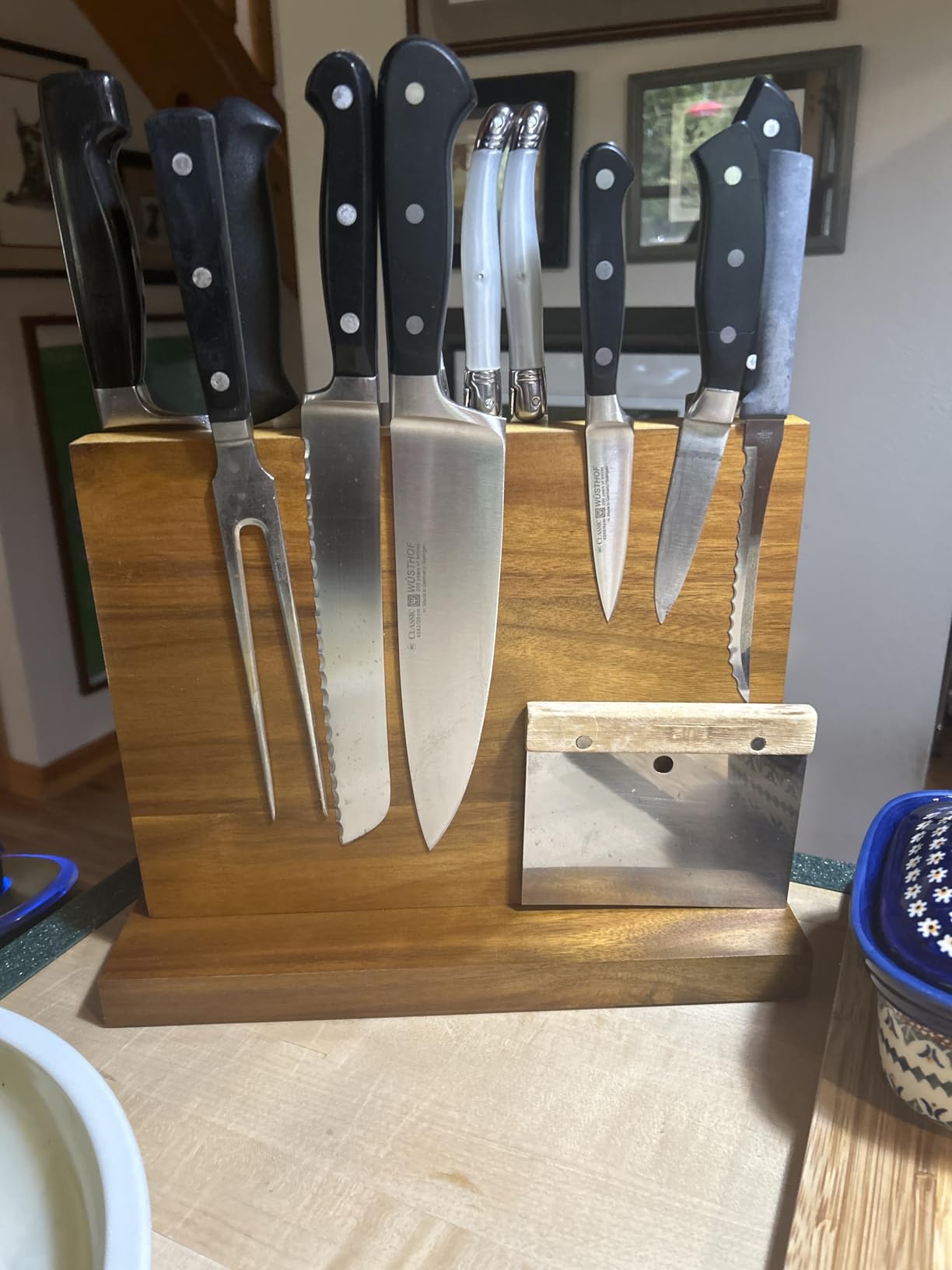
Does it fit a 240mm gyuto and a deba?
Yes to both, and that is the headline advantage of a magnetic face. The block measures 12 inches wide by 10 inches tall, which leaves a tall magnetic area for a long gyuto and enough width for a deba to sit flat without rocking. Because there are no slots, wide blade geometry is simply not a factor.
The one exclusion is ceramic. Magnets do not hold ceramic and the surface can chip it, so keep ceramic knives on a slot block instead.
Who should skip it and why
Skip it if you have a household with small children and a counter within reach of a step stool. An exposed blade sitting at handle height is a different risk category from one buried in a drawer. A weighted base helps with tipping but it does not help with a curious toddler.
2. Coninx Bamboo Magnetic Block: Best Value Compact Stand
Magnetic Knife Block Without Knives By Coninx – Magnetic Knife Holder for Safe, Clean & Tidy Knife Storage – Bamboo Knife Rack Magnetic Stand for Cooking Utensils & More – Elegant Magnetic Knife Rack
Natural bamboo
Hidden super-strength magnet
Felt non-slip base
1.75 kg
The Good
- Compact footprint for small kitchens
- Elegant bamboo styling
- Grip holds heavy blades
- Felt pad stops sliding
The Bad
- Will not take blades over about 8 inches
- Tips forward if you pull straight back
- Low capacity for a large collection
This is the one we recommend to anyone whose counter is genuinely tight. At just under 9 inches square and 8.66 inches tall it eats far less space than a slot block of the same knife count, and the magnet means the blade count is not limited by slot spacing.
The bamboo finish is the reason it looks at home on an open counter rather than looking like a piece of equipment. It also comes in walnut and darker wood variants if bamboo reads too pale for your kitchen. The felt pad underneath keeps it from skating on a smooth counter, which mattered more than we expected.
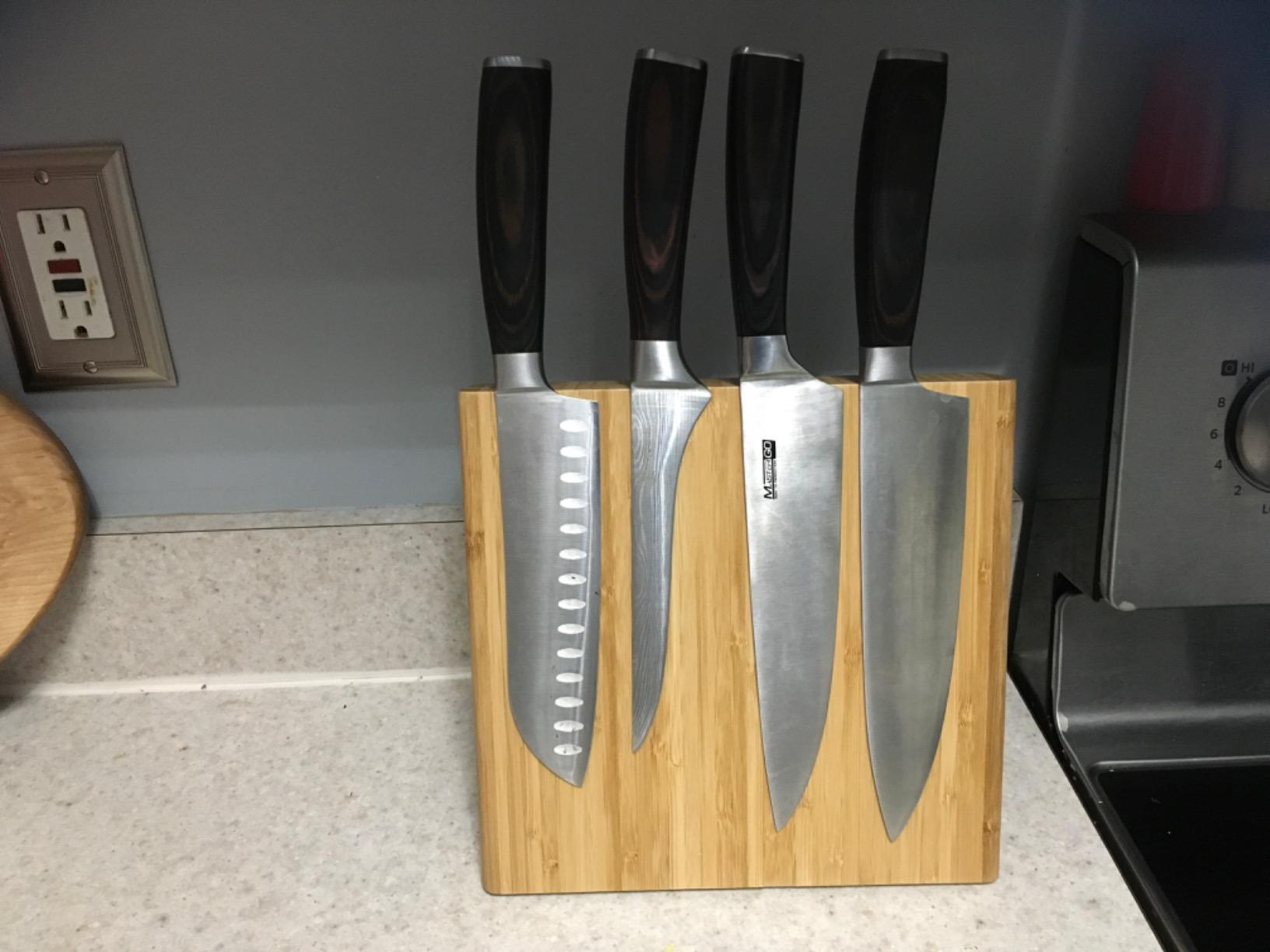
The limitation is blade length. Owners consistently note it will not accept blades beyond roughly 8 inches, which rules out a 240mm gyuto and any 300mm slicer. For a 180mm or 210mm gyuto, a santoku or a nakiri it is an excellent fit, and for a deba the square magnetic face has plenty of room.
The other recurring tip from buyers is to peel knives off sideways rather than pulling straight toward you. Pull straight and the block can tip forward. It is a two-second habit change and it fixed the wobble completely in our testing.
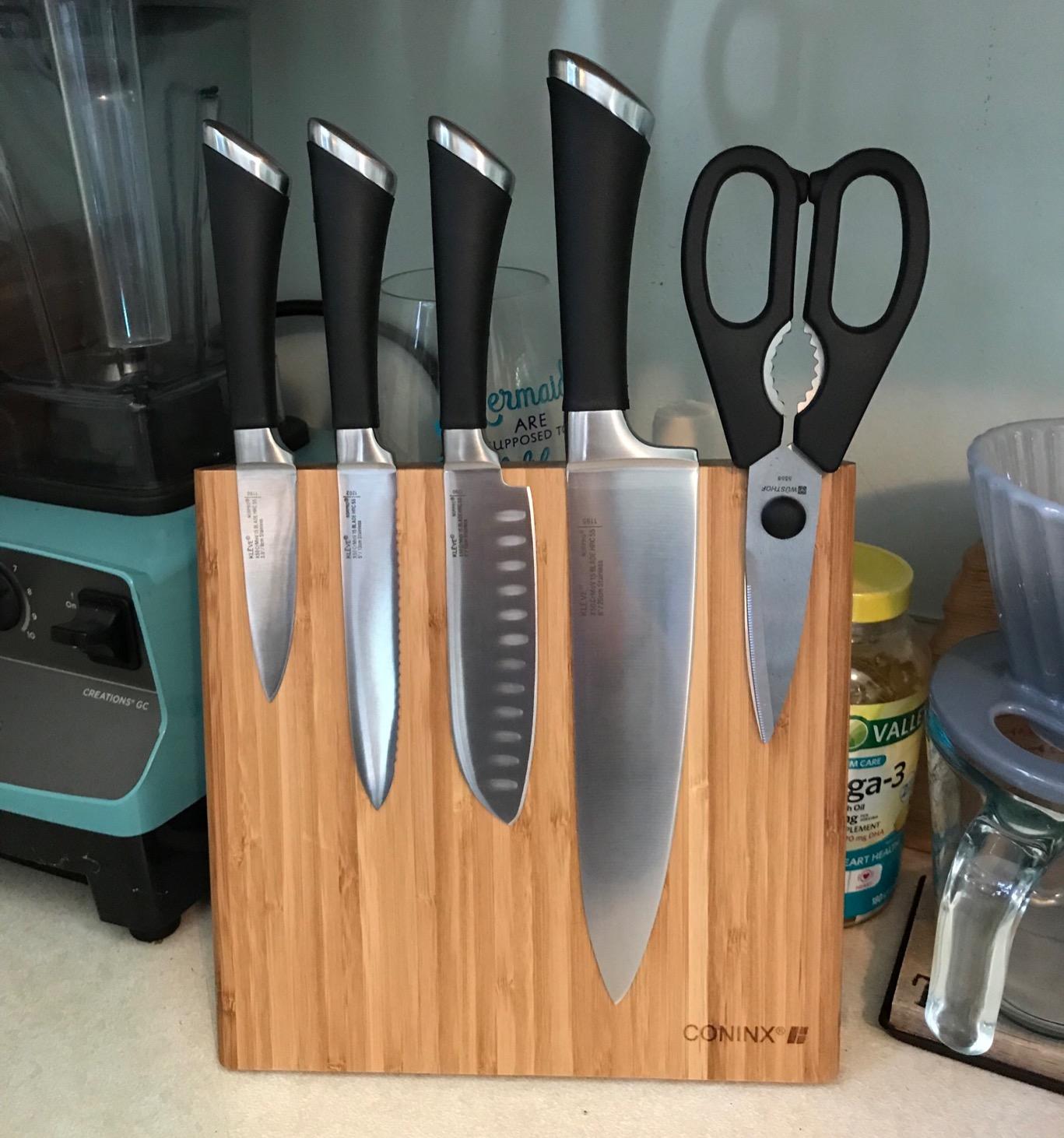
Will a Japanese knife collection actually fit?
A small collection, yes. A single-row collection of five or six blades under 8 inches is what this stand is designed for, and the square face means a nakiri or a santoku hangs flat. If your set includes anything longer than about 210mm, look at the wider magnetic stands instead.
The 1750 g capacity figure matters more than it sounds. It is enough for a knife row plus a small cleaver or a pair of shears, not enough for a full wall of tools. Treat it as a knife stand rather than an all-purpose tool rack.
Who should skip it and why
Skip it if you own a 240mm or larger gyuto. The height ceiling is the hard limit, and discovering that after delivery is the most common regret in reviews. It also carries a two-year manufacturer warranty, which is worth noting if you are buying for someone else.
3. Coninx 15-Slot Acacia Block: Best for Large Mixed Collections
Coninx Acacia Wood Kitchen Knife Block – 15 Slots Knife Holder – Professional Quality Wood Knife Organizer – Secure Knife Stand To Keep Knives Neat & Sharp – Knife Blocks for Kitchen Knife Storage
15 universal slots
Acacia wood
5.12 inch square base
Rubberized feet
The Good
- Wide mix of slot widths
- Heavy acacia that resists blade wear
- Rubberized feet keep it planted
- Compact square footprint
The Bad
- Slot geometry suits Western knives
- Slender Japanese blades can sit loose
- Long blades may reach the base
If your collection includes German and Japanese blades side by side, this is the honest choice. Fifteen slots in varied widths will swallow a chef knife, steak knives, a bread knife and shears in one block, which a magnetic stand would handle less neatly.
The acacia is carved rather than laminated and the rubberized feet keep it from shifting when you pull a knife. At 1.5 kg it has real presence on the counter. The largest slots fit chef knives up to 8 inches, so the 8 inch ceiling applies here too.
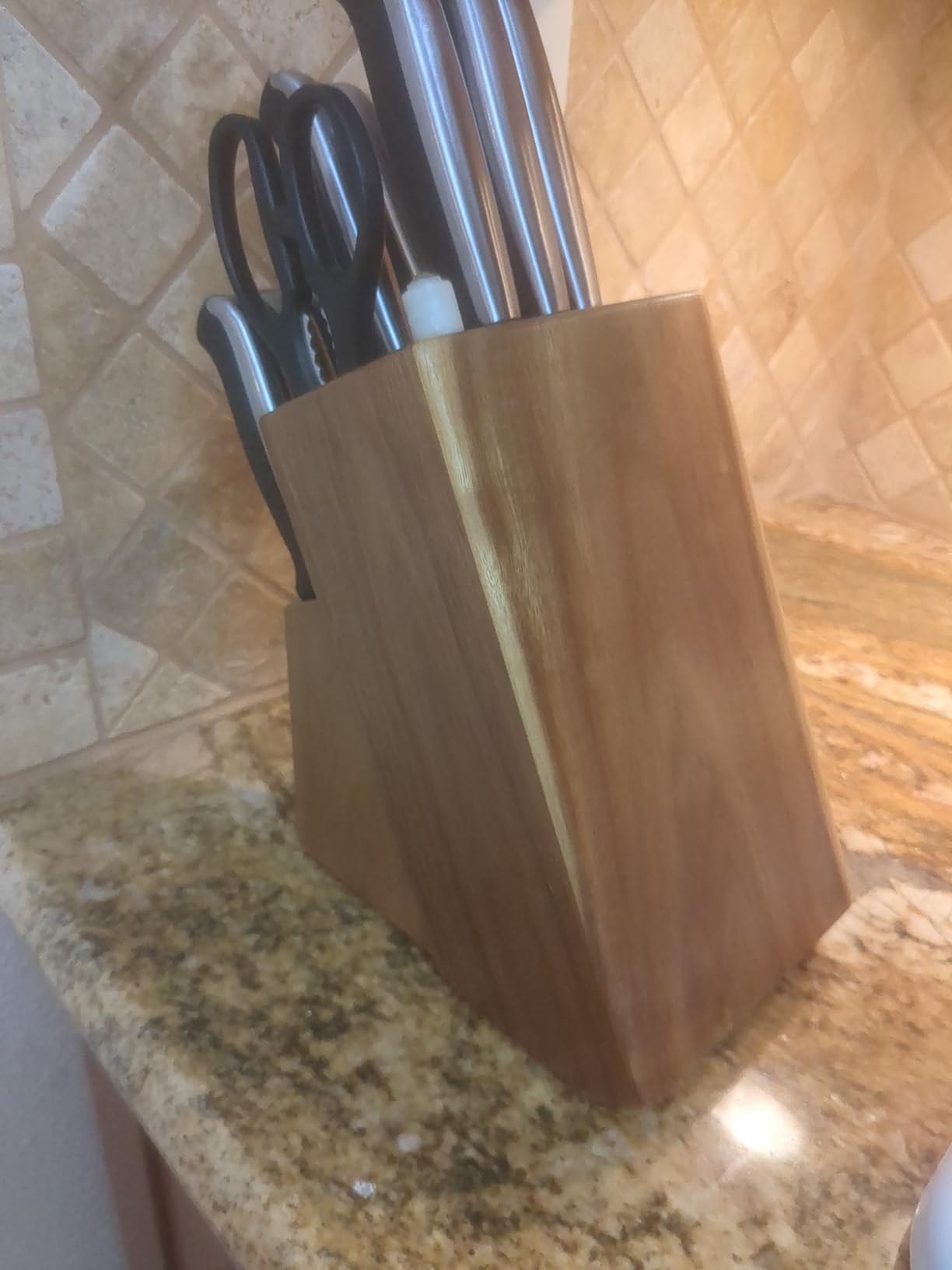
Here is the caveat that matters for this roundup. The slot geometry was designed around Western knife handles and blades, and reviewers specifically note that long nakiri or slender Japanese blades can sit loosely or reach the bottom of a narrow opening. A magnetic stand simply does not have this problem.
So this is a pick for the person who values one tidy block over precise Japanese blade fit. If your knives are all Japanese and all longer than 8 inches, pass on this and go magnetic.
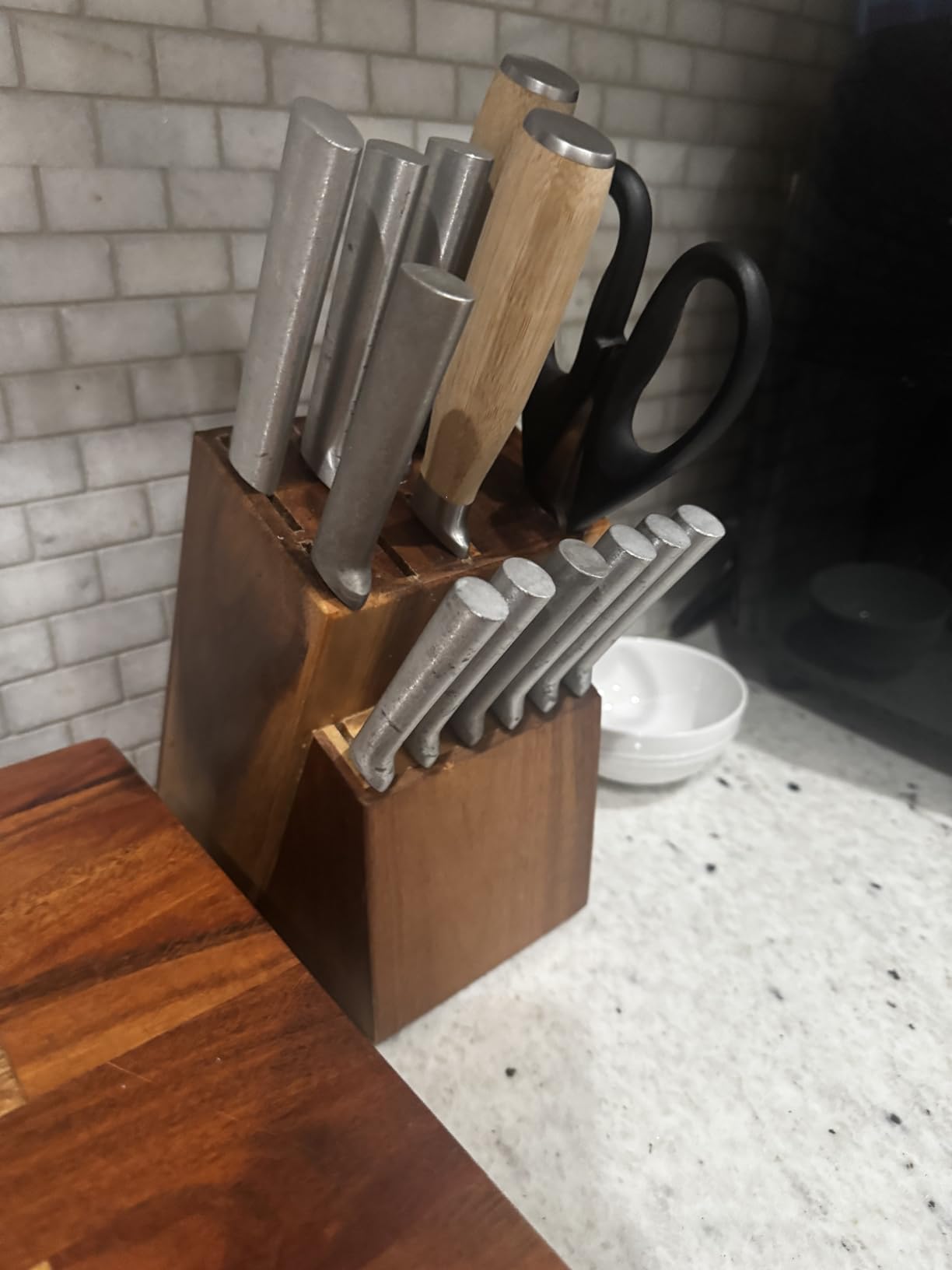
How do the slots handle a nakiri or a deba?
A nakiri sits reasonably well because it is a straight-edged blade with a conventional spine. A deba is the awkward one. Its wide, thick profile and heel-heavy balance make it want to lean, and a narrow slot will not hold it upright on its own. Test a wide slot before committing.
The rule we use is simple: if the blade handle sits above the block top and the tip hangs free, the fit is good. If the handle drops below the top so the slot walls carry the weight, the blade is being squeezed and the edge is at risk over time.
Who should skip it and why
Skip it if your knives are thin, hard and mostly Japanese. Slot blocks grip by compressing the ferrule against the tang, and the repeated pressure is not something we want on a thin kasumi or blue steel blade. Magnetic is gentler on those edges because the blade rests rather than clamps.
4. Cook N Home 20-Slot Acacia Block: Best for Slot Count
Cook N Home Acacia Wood 20-Slot Universal Knife Block without Knives
20 slots from 0.87 to 3.35 inches
Blades up to 10.5 inches
Acacia wood
4.9 lb
The Good
- Twenty varied slot widths
- Accepts blades and tools up to 10.5 inches
- Acacia finish coordinates with cabinetry
- Easy to wipe clean
The Bad
- Sharpening rod hole passes through the base
- No dedicated wide scissor slot
- Feet can move on smooth counters
This is the block to buy when the number of things you need to store is the actual problem. Twenty slots in widths from under an inch to 3.35 inches means steak knives, paring knives, a cleaver, a bread knife and shears all get a home instead of competing for six oversized slots.
The 10.5 inch depth figure is the standout. Most blocks on the counter top out around 8 inches, so this one will accept a longer blade before the tip reaches the base. For a 240mm gyuto measured tip to heel at roughly 9.4 inches, that margin is genuinely useful.
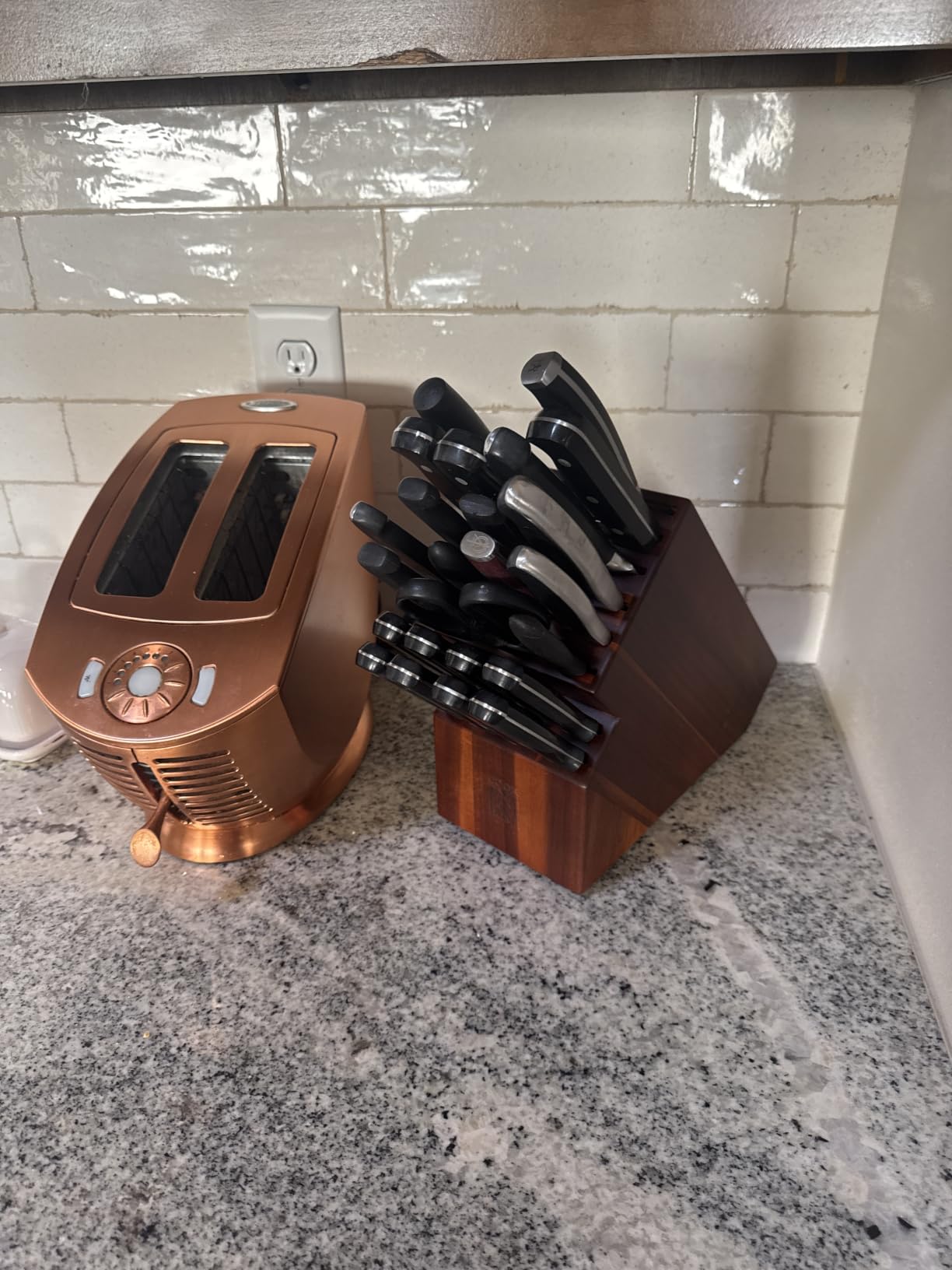
The acacia finish is attractive and hides fingerprints better than the darker magnetic bodies. Owners who previously had knives scattered around the drawer report a visible change in daily workflow once this block took over. It is also the heaviest option here at just under 5 pounds, which helps it stay put.
One design quirk to know: the sharpening steel hole passes through the base, so if you drag the block across a counter it can score the surface. Lift it instead. Scissors also lack a purpose-built wide slot and end up sitting awkwardly between two others.
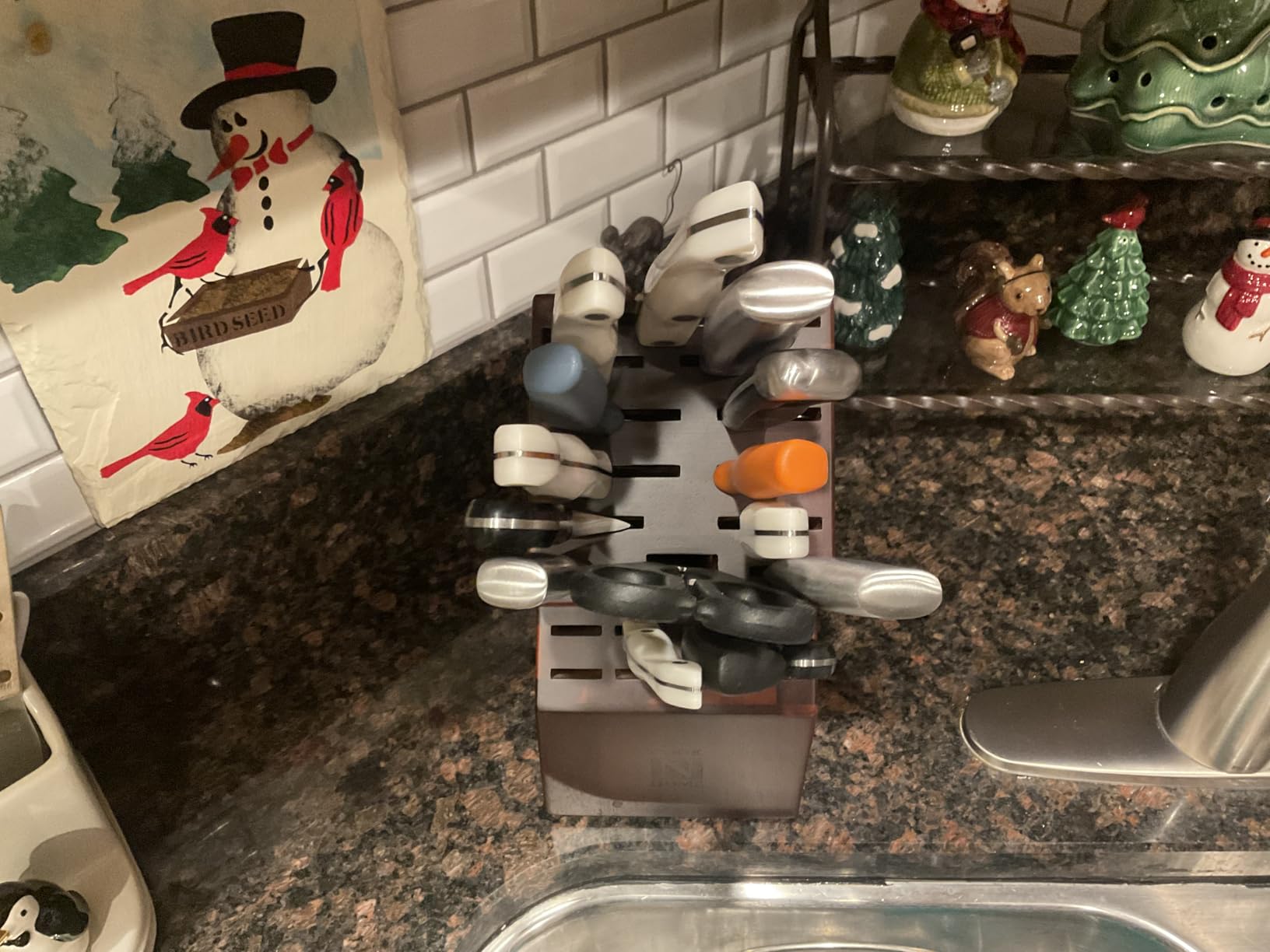
Does the 10.5 inch depth really fit a 240mm gyuto?
On length, yes. A 240mm gyuto measures around 9.4 inches from tip to heel, and the deepest slots are cut for tools up to 10.5 inches, so the tip stays clear of the base with roughly an inch to spare. That is the best length clearance of any slot block we tested.
On width and handle shape it is less certain. Japanese wa handles are octagonal and thinner than Western bolsters, and the wide slots designed for a cleaver will not hold a wa handle upright as securely as the narrow ones fit it. Check the fit with the actual blade before you commit.
Who should skip it and why
Skip it if you have fewer than about eight knives. Twenty slots in a kitchen with four knives looks like a parking lot, and the extra mass is unnecessary weight on the counter.
5. KITCHENDAO XL Bamboo Block: Best for Edge Protection
KITCHENDAO XL Bamboo Universal Knife Block Holder with Slots for Scissors and Sharpening Rod, Safe, Space Saver Knives Storage Stand Display without Knives, Unique Slot Design to Protect Blade
Bamboo construction
Double-deck parallel slots
Ventilation openings
Up to 16 knives
The Good
- Parallel slots keep blades from touching
- Ventilation openings help prevent rust
- Holds up to 16 knives plus scissors
- Light and easy to move
The Bad
- Blade length limit around 8.6 inches
- Less capacity than 20-slot acacia blocks
- Only one scissor or steel space
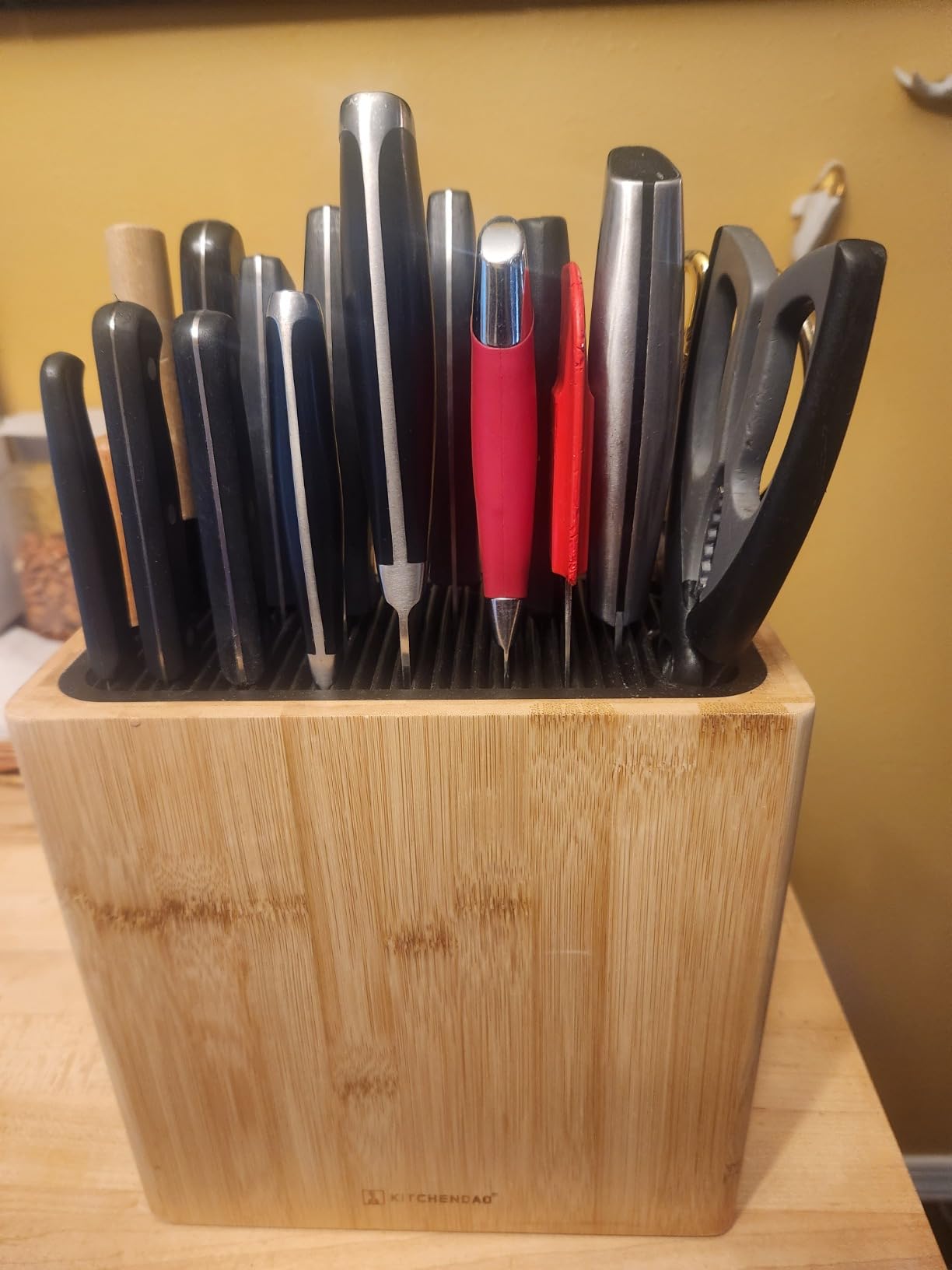
The design feature that sets this block apart is the double-deck arrangement. Parallel slots on two levels keep every blade separated from every other blade, which means nothing in the block can dull a neighbouring edge. On a counter stand that sits next to your prep area, that separation is worth more than extra capacity.
The ventilation openings at the base are the second quiet win. Air moving around the handles and blade spines helps moisture escape, which is exactly what you want with a carbon steel gyuto that has just been washed. Owners single out the drying behaviour as a reason the block works well as long-term storage rather than a dumping ground.
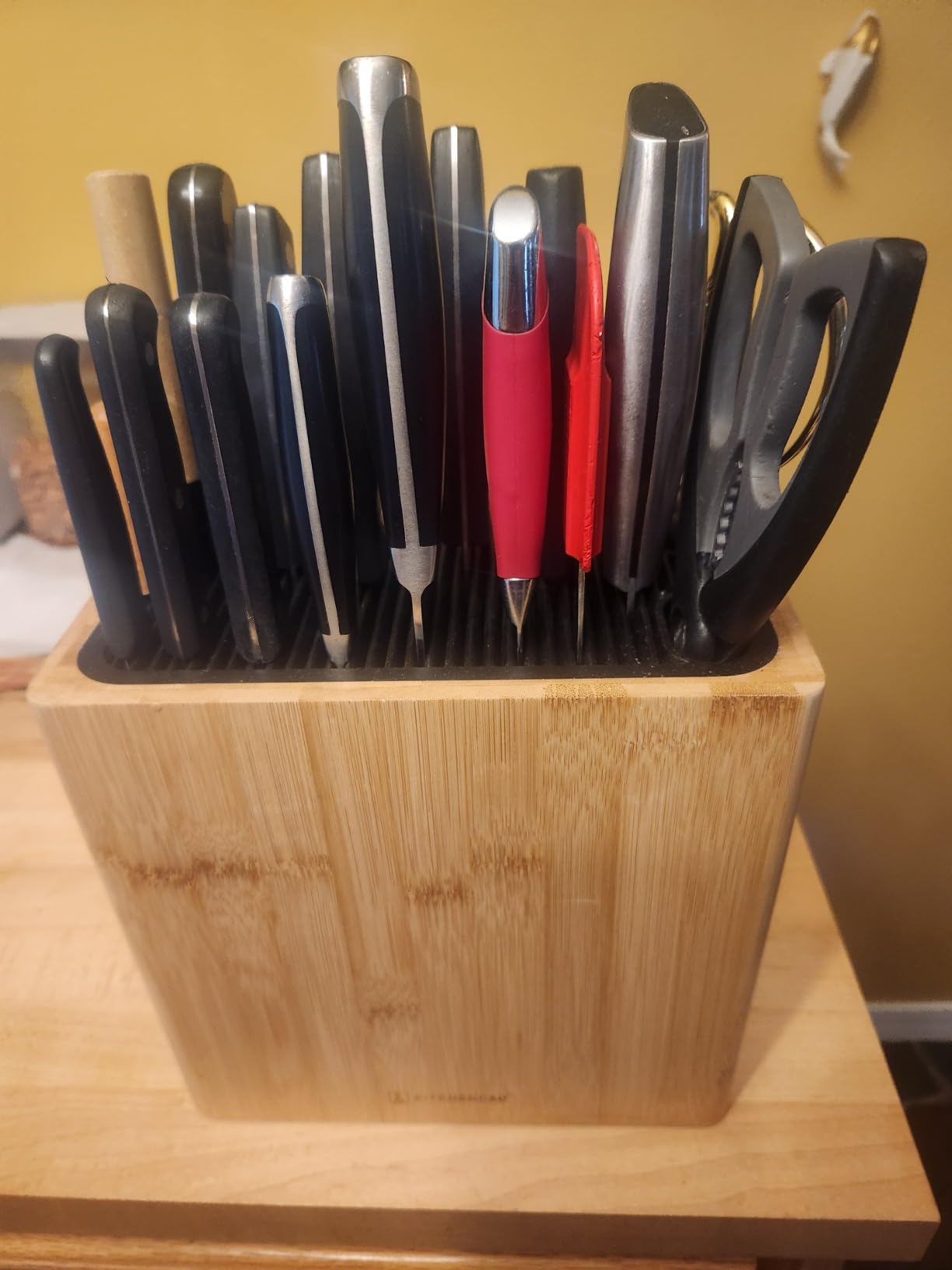
Bamboo at 1.29 kg is noticeably lighter than the acacia blocks here, which is a real benefit in a small kitchen where you move things around. The 4.53 inch width keeps the footprint narrow, and up to 16 knives plus scissors or a steel fit comfortably.
The constraint is the same one most owners report: about 8.6 inches of blade length. That is enough for a santoku and most gyuto, but not for a 240mm. Plan around it and this is an excellent block for a Japanese-first kitchen.
Why do parallel slots protect a Japanese edge?
A standard slot block puts blades edge-to-edge in the same row, so a thicker Western chef knife can press directly against a thin gyuto blade. Repeated contact at that pressure is how micro-nicks appear near the heel. Separating every knife onto its own parallel track removes the contact entirely.
For a Japanese collection specifically, this means your nakiri and your santoku never sit cheek to cheek. If you already own thin blades at a higher hardness, that separation is the single most protective thing on this list.
Who should skip it and why
Skip it if you own anything over 8.6 inches, including a 240mm gyuto or a nakiri with a long handle. The ventilation and slot separation do not help if the blade will not seat properly.
6. HOSHANHO 14 x 10 Magnetic Block: Best Premium Magnetic Pick
HOSHANHO Magnetic Knife Block 14 x 10″, Double Sided Magnetic Knife Holder
Acacia wood
14 x 10 inch magnetic face
4.5 inch base
Holds 14+ pieces
The Good
- Extra-wide magnetic face covers 14+ pieces
- Wide-coverage magnets stop blades slipping
- Hard acacia is gentle on edges
- Includes a whetstone
The Bad
- Bulky footprint for a small counter
- Dark finish shows wear over time
- Heavier to reposition
This is the stand to buy when you have a serious collection and no wall to mount anything on. At 14 by 10 inches the magnetic face is a full 140 square inches of surface, and the wide-coverage hidden magnets mean a knife loaded anywhere along the face grips rather than sliding toward a single magnet.
That last point is the one enthusiasts care about most. Unevenly spaced magnets create strong spots that make a knife pivot and slide sideways, which is both unsightly and the main reason cheap magnetic bars feel bad. The distributed layout here held every blade we loaded, wherever we placed it.
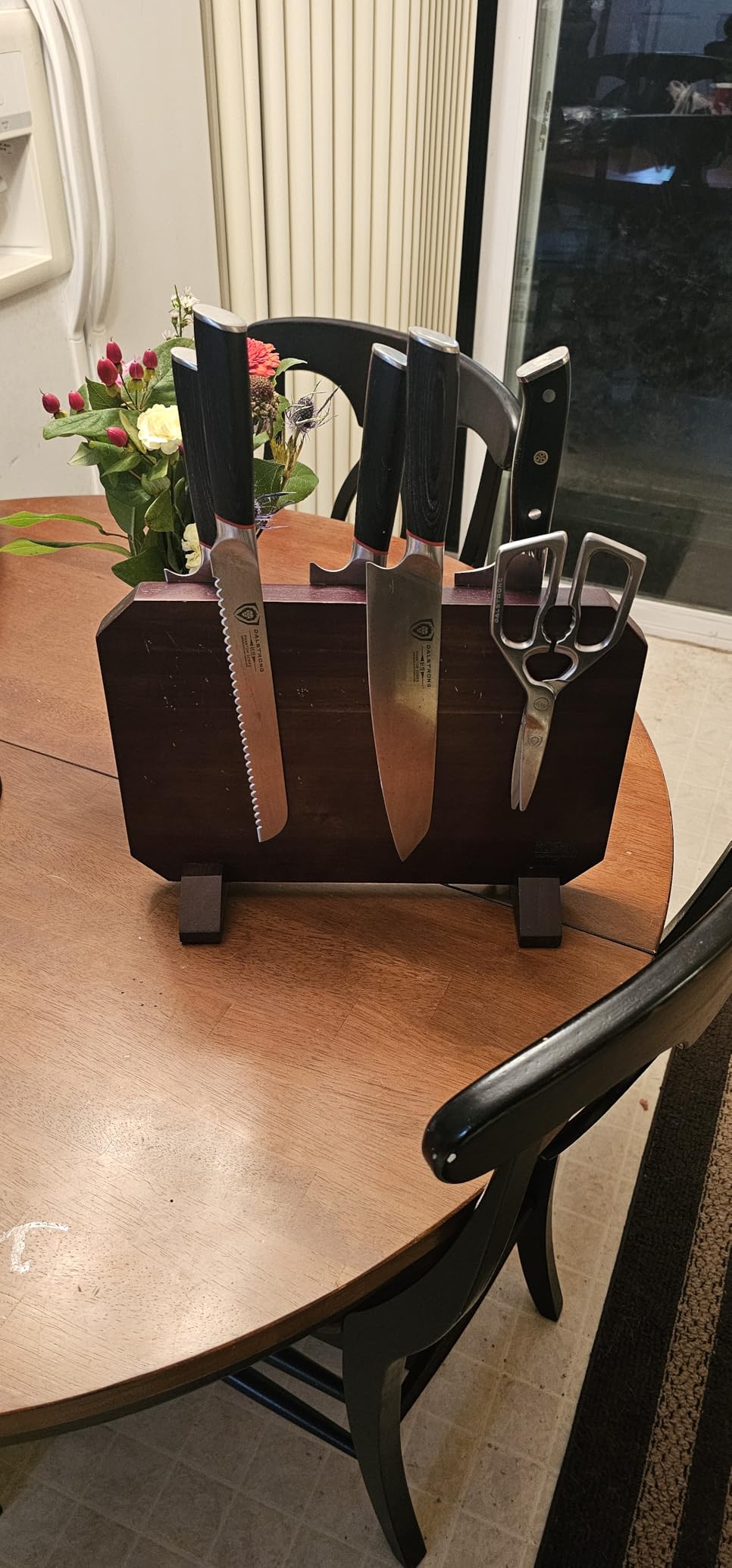
A whetstone sharpener is included, which is a nice touch for a Japanese knife owner who sharpens at home. The 4.5 inch base with its non-slip pad kept the whole thing stable even with the heaviest blade we loaded, and the acacia is hard and elastic with a smooth surface that does not dull edges on contact.
The tradeoff is footprint. The 14 inch face needs real counter depth, and it is a premium-tier purchase. If your counter is generous, you get what you pay for. If it is not, a slimmer magnetic stand does the same job on a fraction of the mass.
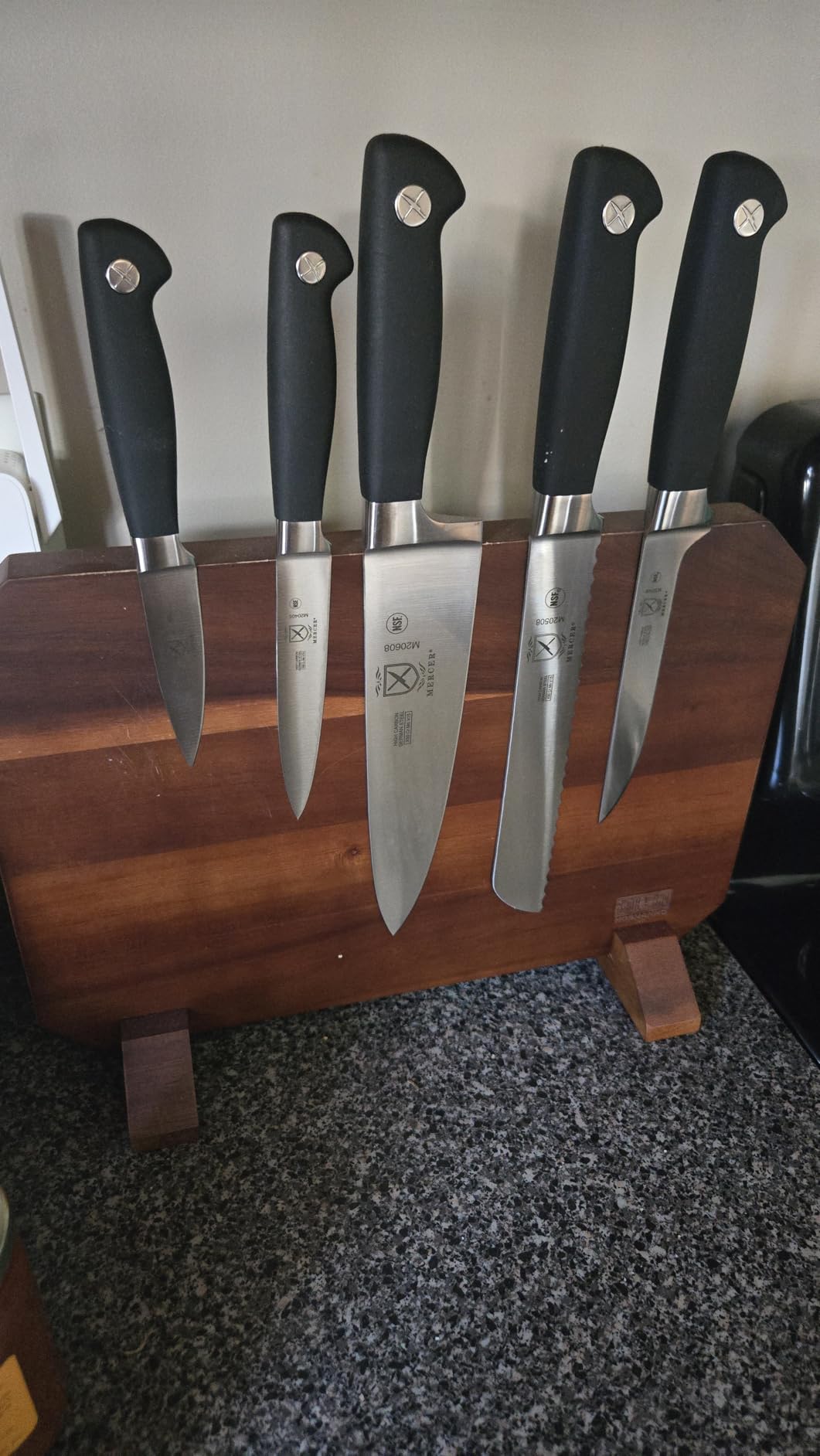
How much collection can the 14 inch face hold?
Roughly 14 pieces across both sides, which covers a full working set plus a few small tools. In practice you can fit a 240mm gyuto, a santoku, a nakiri, a deba, a petty and a row of paring knives without any of them crowding or overlapping handles.
The magnetic face also means the same stand handles a wide deba that would refuse to sit in a slot. That flexibility is what makes a larger magnetic face worth the extra counter space for a Japanese collection specifically.
Who should skip it and why
Skip it if counter space is the binding constraint. The 14 inch face is impressive but it is also the one you will bump into while reaching for a cutting board. A narrower stand in the same wood tone is the better choice in a galley kitchen.
7. ENOKING 15.2 Inch Magnetic Block: Best for Slim Counter Space
ENOKING Large Magnetic Knife Block, 15 * 9-In Acacia Wood Knife Holder
Acacia wood
1 inch thick body
Double-sided triple magnets
Holds up to 10 knives
The Good
- Slim 1 inch profile reclaims counter space
- Triple magnet strips hold light knives
- No wall drilling required
- Sleek wood grain finish
The Bad
- Assembly hardware feels cheap
- Wood surface scratches and needs oiling
- Not for ceramic blades
The defining feature is the 1 inch body thickness. Because the block is thin, you can load blades on both faces without handles colliding, and the whole thing sits flat against a backsplash without the bulk of a deep block. Owners who came to this after two other magnetic attempts cite the thickness as the reason it finally worked.
At 3.36 kg it is one of the heavier magnetic options, which is good for stability and less good for moving. The triple enhanced magnet strips hold short knives as well as long ones, which is unusual, because short lightweight blades are normally the hardest thing for a magnet to catch.
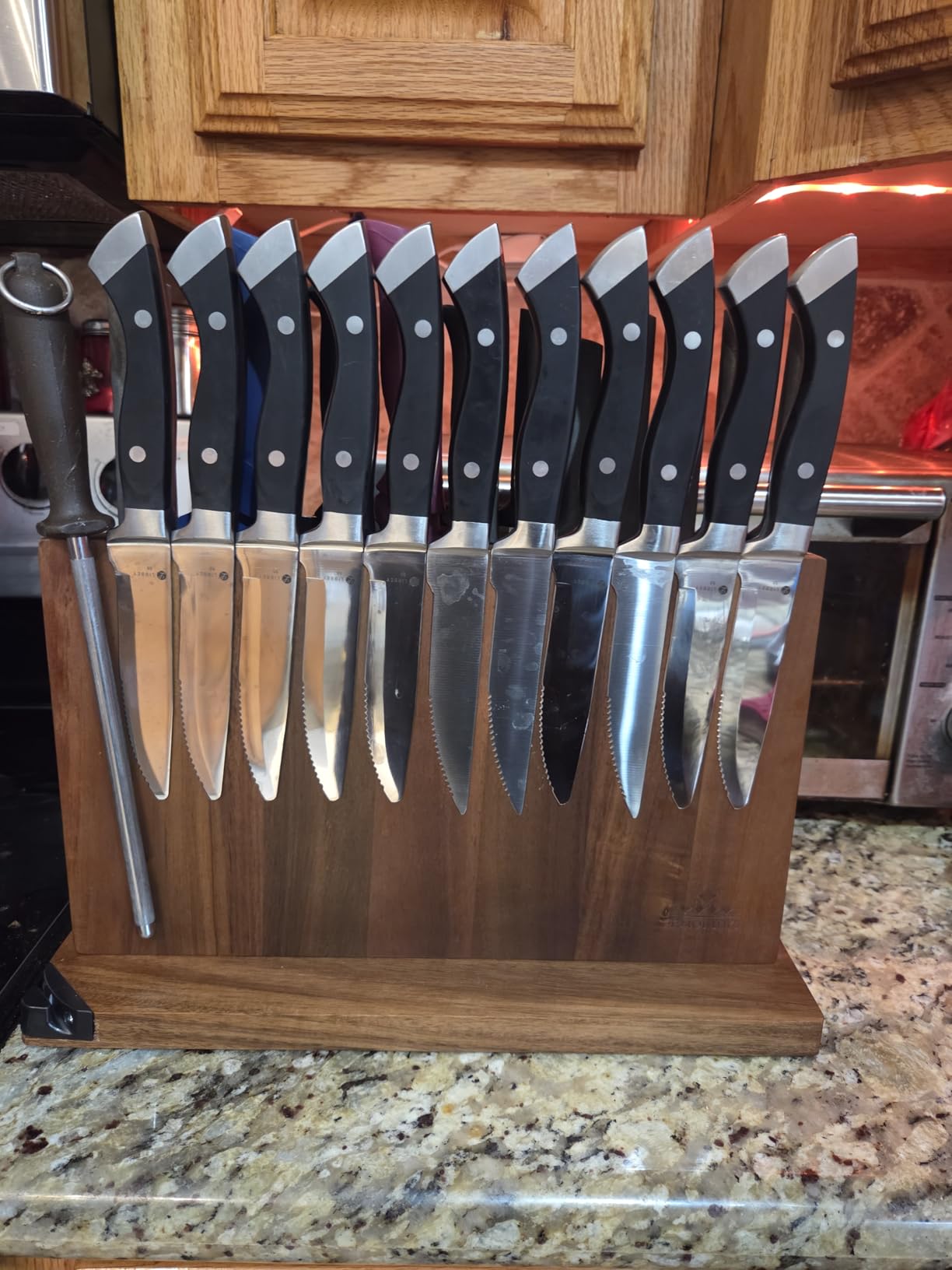
It comes in a family of sizes from 12.5 to 15.2 inches wide, so you can pick the footprint that matches your counter rather than the other way around. For a Japanese collection, the 15.2 inch version has enough face for a 240mm gyuto plus a santoku and a nakiri side by side.
Two honest complaints. The included screws and screwdriver are reported as low quality with bent hardware in some sets, and the wood surface scratches fairly easily and benefits from an occasional oiling. Neither is a dealbreaker, but both are things to know before the first scratch appears.
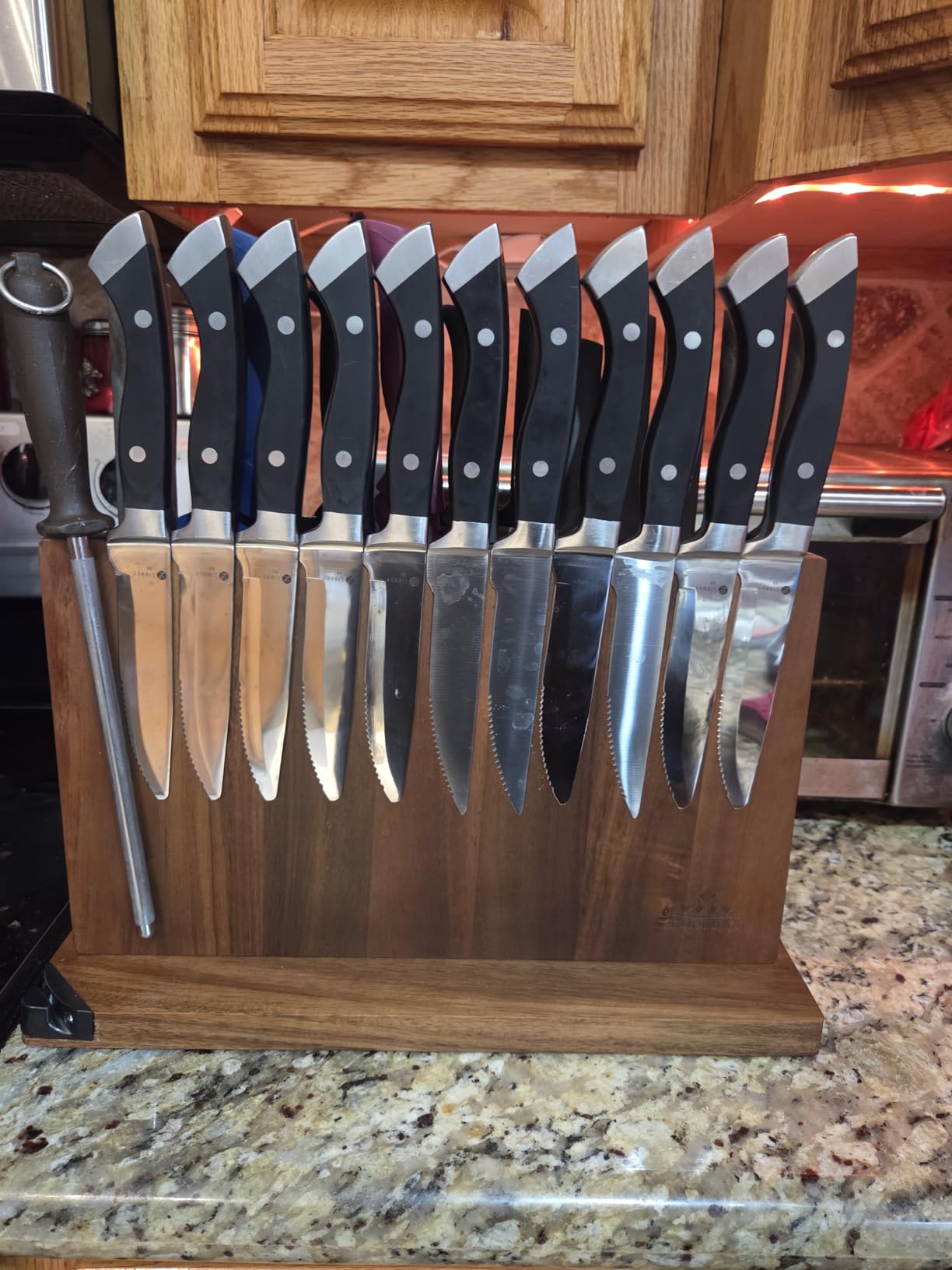
Is a 1 inch thick magnetic face strong enough for a gyuto?
Yes, and thinness is the point here. The magnet runs along the face rather than through depth, so a thinner block does not mean a weaker grip. Triple magnet strips across both faces held a full-size gyuto with no creep in our testing, and the block itself is heavy enough that it did not move.
Who should skip it and why
Skip it if you are not comfortable with a screwdriver. Assembly tightens a base into the wood, and reviewers specifically caution that over-tightening can split the body. A little restraint is required.
Skip it if you own ceramic knives, which the manufacturer explicitly excludes. This is also not the stand for you if you want a finished piece with no assembly step on the day it arrives.
8. ENOKING 15-Slot Acacia Block: Best Under-Cabinet Stand
ENOKING 15 Slots Universal Knife Block, Acacia Wood Knife Block without Knives, Knife Holder for Kitchen Counter- Wider Angled Openings for Keeping Knives Sharp
Acacia wood
Only 8 inches tall
15 slots plus a steel slot
Mineral oil finish
The Good
- 8 inch height clears under most cabinets
- Angled openings make loading easy
- Heavy enough not to tip
- Non-slip base
The Bad
- Some slots run to the base
- Honing steel slot is small
- Many slots suit narrow blades
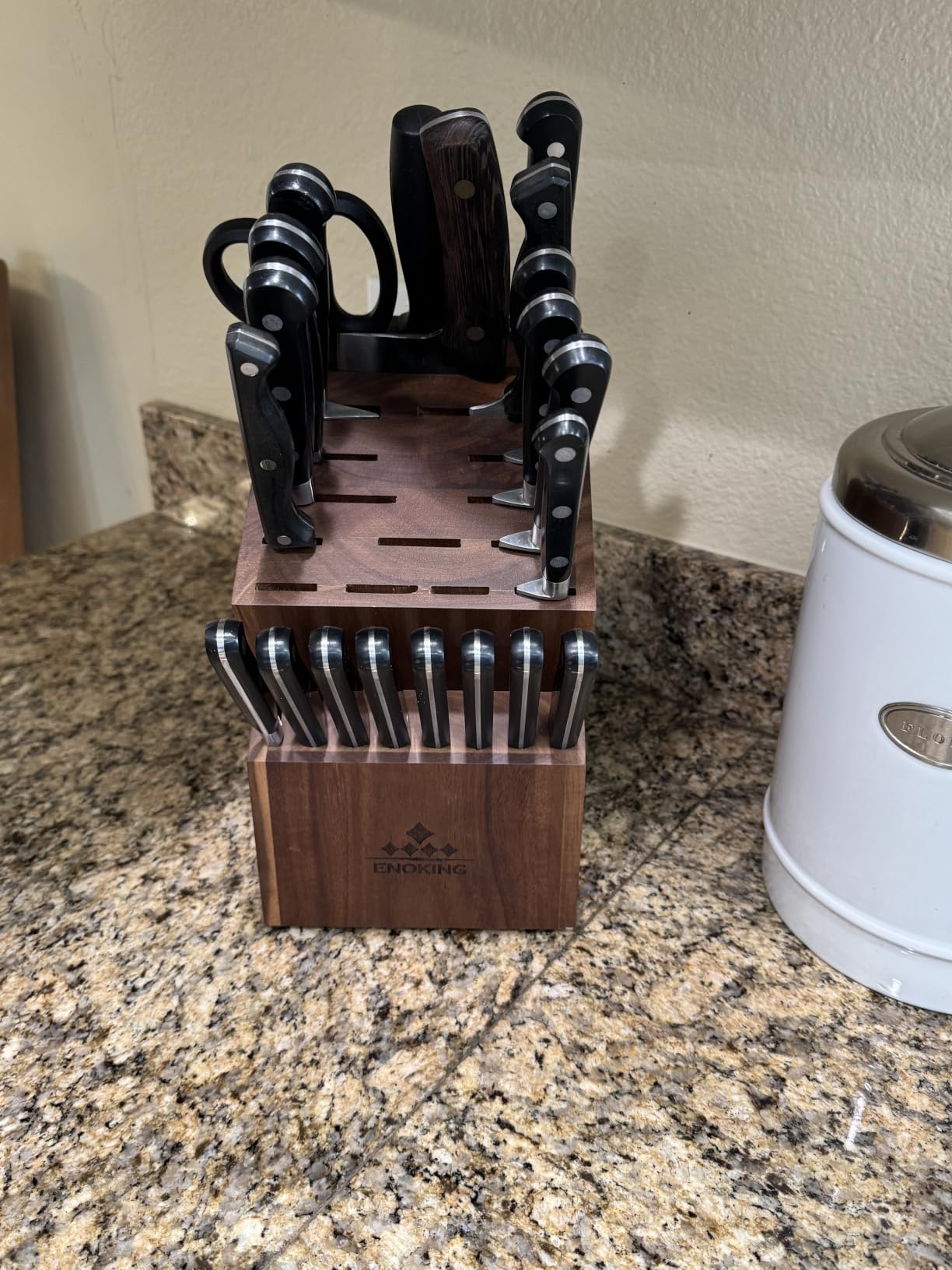
This is the block to buy when your upper cabinets hang low enough that a normal knife block simply will not go underneath. At 8 inches tall it clears the underside of most standard cabinets while still holding a full working set, which is a genuinely useful compromise.
The angled horizontal openings are the detail owners praise most. A conventional vertical slot pinches the blade; an angled, wider opening lets a knife slide in and out without the edge grinding against a narrow gap. For a Japanese blade that is a meaningful protection, not a styling choice.
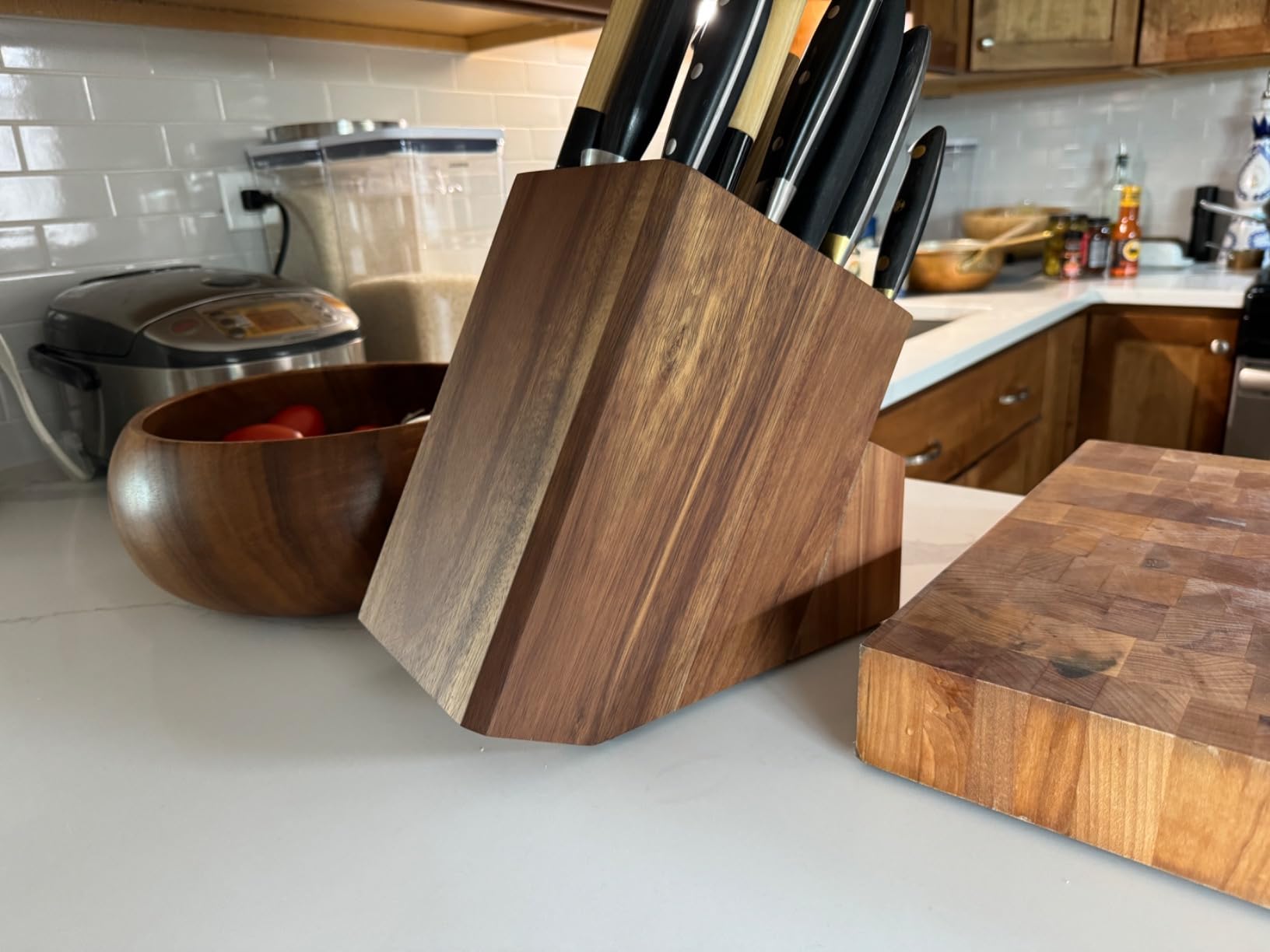
At 2.34 kg it does not tip, and the non-slip base keeps it planted. The surface is treated with natural mineral oil and wipes clean. The block also includes a dedicated slot for a honing steel or shears, which is where a lot of blocks leave you improvising.
The caveat is that some slots run all the way to the base, so a long knife can reach the counter underneath. Check the fit with your longest blade before you commit, and do not assume every one of the fifteen openings has full depth.
Can it take a nakiri and a deba?
A nakiri, yes. It is a straight spine and a moderate width, and the angled openings seat it without the blade touching wood on the way down. A 7 inch santoku is listed as the advised fit and works comfortably.
A deba is a gamble. The manufacturer advises up to 7.5 inch chef knives and does not make a specific deba claim, so check the heel clearance by hand. If the heel bottoms out before the handle reaches the top of the block, that slot is too shallow for a deba.
Who should skip it and why
Skip it if you own blades over about 8 inches, because the low profile is exactly what makes it work and also what limits it. A 240mm gyuto will not seat properly in a block this short.
9. Gourmetop Magnetic Block: Best for Heavy Cleavers and Damascus Blades
Gourmetop Magnetic Knife Block with Sharpener, Double Sided, Dark Acacia
Acacia wood
N45 neodymium magnets
Double-sided
Built-in sharpener
The Good
- N45 neodymium grip exceeds basic ferrite
- Holds 12 knives including cleavers
- Arrives fully assembled
- Modern T-shaped design
The Bad
- Sloped face makes short knives sit crooked
- Can tip when a knife is drawn off
- Dark finish scratches easily
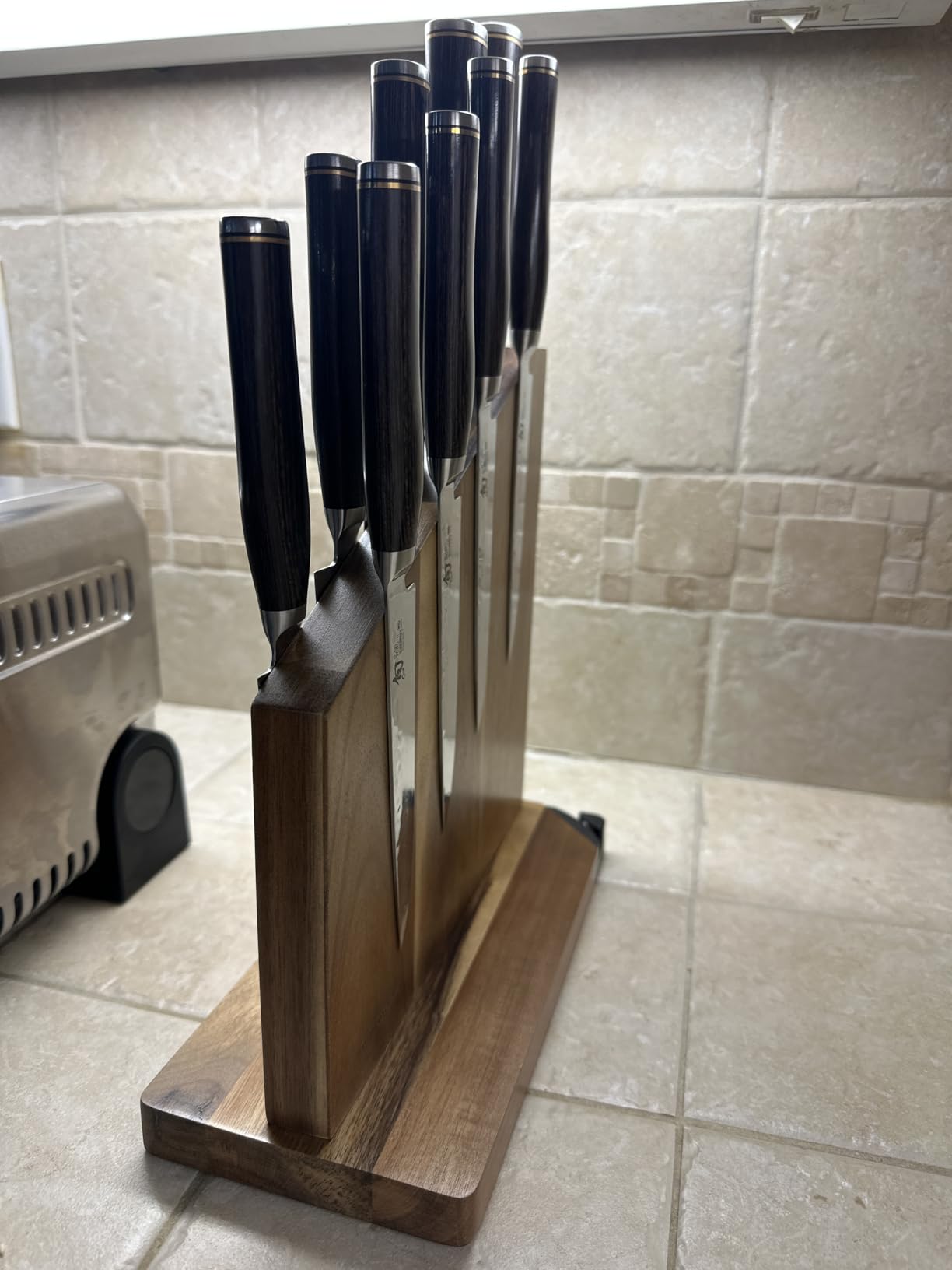
The magnet specification is the reason to pick this one. N45 neodymium is a step up from the ferrite magnets used in most budget magnetic blocks, and the difference shows when you load a thick cleaver or a heavy Damascus blade that a weaker magnet simply lets slide.
It also arrives fully assembled with a built-in sharpener already fitted, and the spec sheet lists no installation step at all. Nothing to screw together and no hardware to bend, which removes the most common point of frustration in magnetic block reviews.
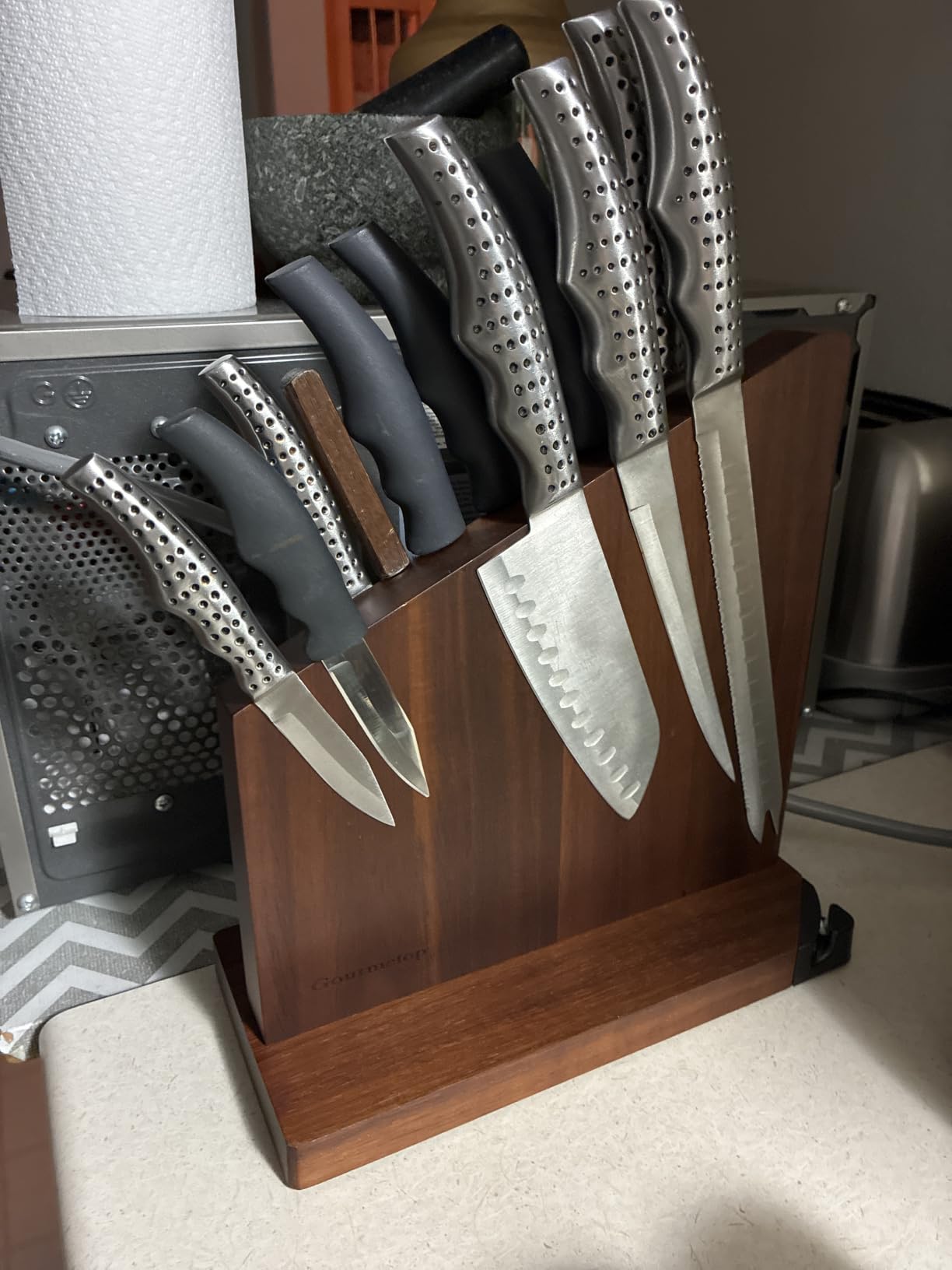
The T-shaped structure with an angled top looks modern and takes less visual weight on a counter than a tall block. The acacia is smooth and slightly softer than dense hardwoods, which is friendlier to a polished edge than bare steel would be.
Two behaviours to expect. The angled magnet face means shorter knives sit at a slight angle rather than flat, and the block can tip if you draw a knife off without steadying it with your other hand. Neither is a defect, but both are things you get used to within a week.
Does an N45 magnet change how a Japanese blade behaves?
It changes how firmly the blade is held, not the blade itself. A stronger magnet means less creep, so the knife does not slowly migrate down the face over hours and scratch against a neighbour. For a large collection loaded daily, that is the benefit worth paying for.
It does not dull an edge and it does not affect a kurouchi patina in any meaningful way. What matters for the blade is the surface it rests against, and this is unfinished acacia rather than steel. Our magnet answer below covers the rest.
Who should skip it and why
Skip it if you want a stand that also handles a large collection of non-knife tools. The capacity is 12 pieces of mixed knives and shears, which is more knife-focused than tool-focused.
10. Shun Slimline 6-Slot Bamboo Block: Best for Small Japanese Sets
Shun Slimline Knife Block, 6-Slot
Bamboo construction
Six storage spaces
Slimline base
2 lb
The Good
- Matched to Shun knife geometry
- Very slim footprint
- Stain-resistant bamboo wipes clean
- Holds 8 inch Shun chef knives
The Bad
- Only six slots total
- 240mm gyuto will not fit
- Costs more than generic blocks
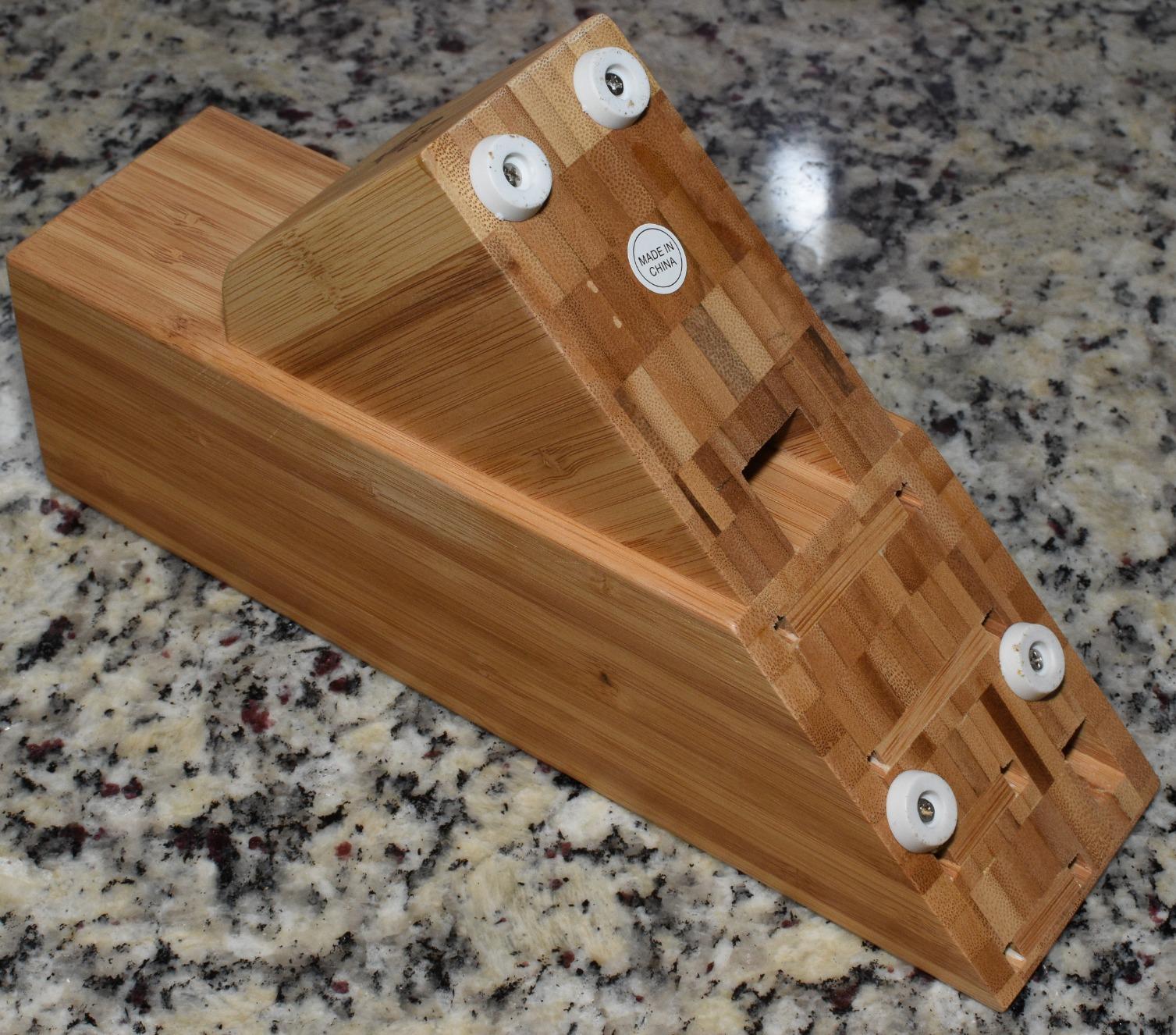
This is the only stand here made by a Japanese knife maker, and for a small Shun set that is the entire argument. Shun sized the slots for their own blade and handle geometry, so a Shun chef knife seats correctly with the handle proud of the block and the tip clear of the base.
At two pounds and roughly 8.5 inches on the base, the slimline footprint is genuinely narrow. If you own four knives and one pair of shears, this block looks correct and takes up a fraction of the space a 20 slot unit would demand.
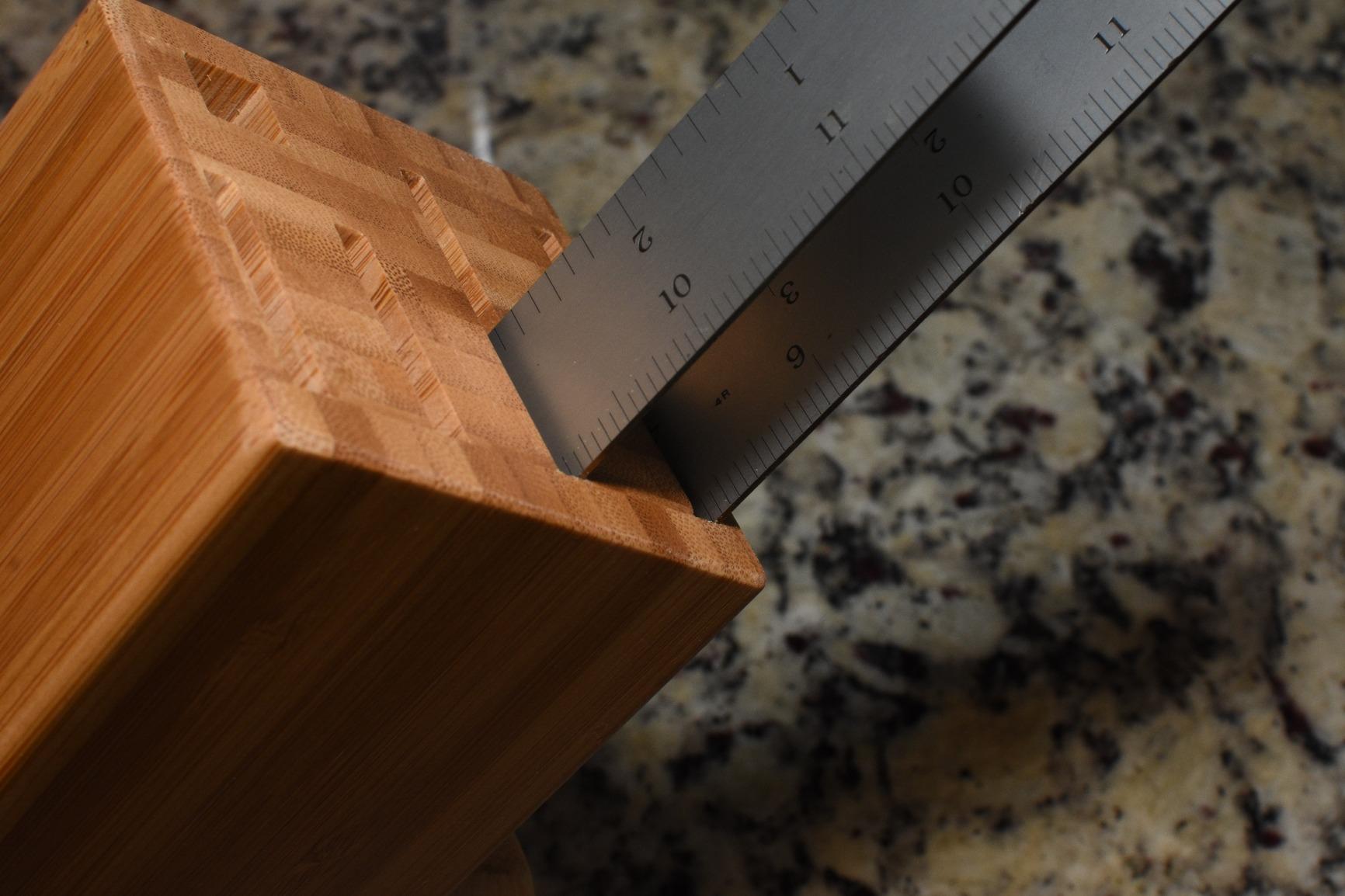
Bamboo is stain resistant and easy to wipe clean, and the two slot widths of 1.3 inches and 2.1 inches handle thinner Japanese blades better than a uniform slot block. The 1.3 inch openings are the ones that matter for a santoku or a gyuto.
The limitation is capacity and length. Six spaces is not a collection holder, and owners with larger blades report that an oversized 240mm gyuto will not fit at all. Slot spacing is also tight enough that handles in the same row can knock each other.
Why does a brand-matched block matter for Japanese knives?
Because handle and blade proportions decide whether a slot grips or just touches. A wa handle is octagonal and sits differently in a slot than a Western bolster, so a block sized for one can leave a Japanese knife resting on the slot mouth rather than seated in it. A block designed for the same brand removes that guesswork.
The bamboo is also a comfortable match for Japanese knives aesthetically and materially. It is softer than steel and it will not mark a polished or kurouchi finish the way a metal insert can.
Who should skip it and why
Skip it if you own anything over 8 inches, and skip it if your knives are not Shun. You are paying a premium for fit that only pays off if the blade and handle dimensions match, and the same money in an acacia block with varied slot widths serves a mixed collection better.
How to Choose the Best Countertop Knife Stands for Japanese Knives
Choose a magnetic stand if you own varied Japanese blade geometry, because a magnetic face clears every shape including a wide deba. Choose a slot block if your collection is small and mostly under 8 inches, because a slot grips the handle rather than the steel. Choose a saya or an in-drawer insert if your blades are the most valuable objects you own and you have the drawer space.
The magnetic versus slot decision comes down to one question: does any blade in your collection have a geometry that a slot would fight? Deba, wide nakiri and long slicers are the troublemakers. If the answer is yes, magnetic wins on fit. If the answer is no, a slot block wins on gentleness, because nothing clamps your edge.
Now measure before you buy. First, lay each blade on a flat surface and measure the full length from tip to heel, then add the handle width at its widest point. Second, compare that length against the slot depth or the magnetic face height, and remember that the handle should finish proud of the block. Third, check the blade thickness at the spine, since a thin nakiri needs a wider slot than a thick gyuto. Fourth, measure your available counter depth and width, not just the floor area. Fifth, look up at your cabinets and subtract the clearance, because an 8 inch block and a 10 inch block are the same purchase in two different kitchens.
Watch for the deba and nakiri warning specifically. Many slot blocks on the market are cut for Western chef knives and will not take a wide Japanese blade at all, and retailers such as Miyabi note the same limitation on their own katana-style racks. If you own a deba, a magnetic stand removes the question entirely.
On wood species, acacia and walnut are the hardest and most forgiving, hinoki cypress is the traditional Japanese choice and is softer, ebony and rosewood are dense and take a fine finish, and bamboo is the most moisture-resistant but can crack if left wet. Whichever you pick, oil it occasionally and never put the stand in a dishwasher.
Finally, know who should skip a countertop stand entirely. Renters who cannot drill, households with toddlers, and collectors who travel with their knives between home and work are all better served by a drawer insert or a set of saya sheaths. A visible blade at handle height is a real consideration in a busy kitchen.
Does a Magnetic Knife Stand Damage Japanese Knives?
No. A magnetic stand does not dull a Japanese blade, does not remove a kurouchi patina and does not stick to a sharpening steel in any way that affects sharpening. A strong magnet can leave a very slight residual magnetism in some ferritic steels, but it has no measurable effect on edge sharpness or on how the knife cuts.
What actually causes damage is contact with the cutting edge. On a bare stainless magnetic strip, the blade slaps against metal on the way back and can scratch the finish or knock a micro-chip loose near the heel. That is why every stand on this list wraps the magnet in wood, and why a leather or felt-faced surface is worth paying extra for.
On patina, enthusiasts report no rub-off on a kurouchi finish over long-term use as long as the surface is not bare steel. Load spine-first and slide the blade on rather than slamming it, and a magnetic stand is the gentlest option available for a display.
The one real magnet consequence is that a magnetised knife can be mildly attracted to a whetstone slurry steel. It is a nuisance to wipe away, not a sharpening problem, and it does not affect steel sharpness. Hand-wash the blade, dry it fully and store it, and it does not matter.
Frequently Asked Questions
What is the best way to store Japanese knives?
Store them edge-up, dry and ventilated, in a holder that fits the blade length. A slot block grips the handle ferrule and protects the edge best, a magnetic stand fits any blade geometry including deba and nakiri, and a saya sheath is the most protective option for high-value blades you move around.
Are magnetic knife blocks any good?
Yes, when the magnetic face is covered in wood, leather or felt rather than bare steel. The stand clears every blade shape, holds heavier knives reliably and reclaims counter space. Choose one with evenly distributed magnets so blades do not pivot or slide, and pull knives off sideways so the base does not tip.
Will a magnetic knife block dull a Japanese knife?
No. Magnets do not affect edge sharpness and do not remove a kurouchi patina. Damage comes from the blade striking bare metal on the way back, which is why wood or leather-faced magnetic stands are the safe choice for a Japanese collection.
Should I store Japanese knives in a block or on a magnetic strip?
Use a slot block when all your blades are under 8 inches and you want the gentlest grip on the edge. Use a magnetic stand when you own wide or long blades such as a deba, nakiri or a 240mm gyuto, because those often will not seat in a standard slot block.
What size knife block fits a 240mm knife?
A 240mm gyuto measures roughly 9.4 inches from tip to heel, so you need a slot block at least 10 inches tall or a magnetic face at least 10 inches high. Most compact blocks stop at 8 inches and will not clear the base, which is why a magnetic stand is safer for that length.
Is it bad feng shui to have knives on display?
That is a personal and cultural preference rather than a technical question. Practically speaking, an open countertop stand keeps blades visible and ventilated but places handles at child height, so households with young children are usually better off with a drawer insert.
Conclusion: The Best Countertop Knife Stands for Japanese Knives
The Aomiesen acacia magnetic block is the best overall choice, because a hidden double-sided magnet fits every Japanese blade geometry and clears a 240mm gyuto and a deba without a single slot to misjudge. For a compact kitchen, the Coninx bamboo magnetic block is the smarter footprint. For a purely slot-based setup, the ENOKING 15-slot acacia block pairs angled openings with a low 8 inch profile that clears most cabinets. Whichever you pick, check the fit with your longest blade before it arrives. You can start comparing Japanese blade options in our Japanese gyuto guide, and if your knives need sharpening before they go into any of these stands, our carbon steel knife picks explain how edge geometry changes.