
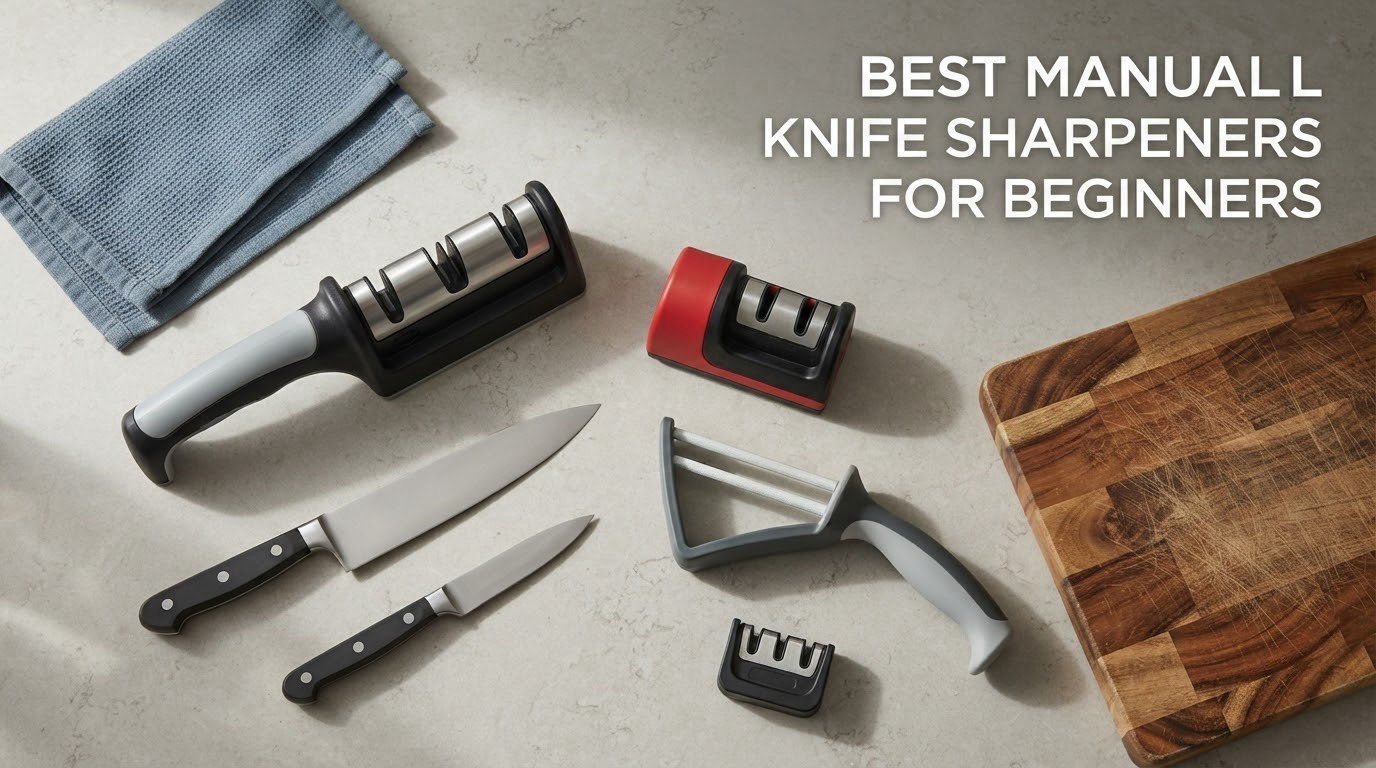
Most dull knives do not need replacing. They need about ten minutes with a tool that costs less than a nice dinner, and almost nobody wants to admit they have never done it. If you have been putting off the whole topic, the search for the best manual knife sharpeners for beginners ends earlier than most guides make it sound: you are choosing between a few clearly different tool families, and only one of them will match how much patience you actually have.
We spent weeks putting twelve hand-powered sharpeners through the same routine, on the same tired chef’s knife, a serrated bread knife and a pocket knife, looking for the ones a first-timer can pick up on day one and still be using a year later. This list is manual only. We did not include electric, cordless or rolling sharpeners, because the moment you plug one in or roll a blade through it, the technique question disappears and you are shopping for a different product. We also excluded honing steels, which realign an edge but do not remove metal, so they cannot be a beginner’s first sharpening tool.
What follows is the honest version: the easiest tool, the best value, the best first stone, the best adjustable system, and the specific limits of each. Some of these tools are quick fixes that leave steel behind every time you use them. Others set a repeatable angle and last for years. Knowing which is which before you buy matters more than any rating number.
Top 3 Picks for the Best Manual Knife Sharpeners for Beginners in 2026
For most beginners the pull-through style of tool wins, because it sets the edge angle for you. Our best overall pick is the KitchenIQ Edge Grip, our best all-in-one guided option is the Work Sharp Guided Field Sharpener, and our best first step into real stones is the Sharp Pebble 1000/6000 combination whetstone. Every tool here runs without electricity, and none of them needs oil.

KitchenIQ Edge Grip 2-Stage
- Carbide stage then ceramic stage
- Edge Grip V notch
- Handles straight and serrated knives

Work Sharp Guided Field
- Guided 20-25 degree angle
- Five abrasives in one body
- Leather strop and hook groove

Sharp Pebble 1000/6000
- 1000 grit repair and 6000 grit polish
- Angle guide included
- Non-slip bamboo base
If you want the full reasoning rather than the summary, keep reading. If you just want the shelf, the three cards above are the shortlist and the table further down covers all twelve.
How We Picked and Tested
Every product here was put through the same three jobs: put a dull edge back on an inexpensive high-carbon chef’s knife, run a serrated bread knife through the stage designed for it, and see how a beginner reacts to the instructions without help. We tracked how much steel came off, whether the tool was still working after a month of intermittent use, and whether the instructions made sense on the first read.
Four things decided the rankings. First, angle guidance, because guessing 15-20 degrees freehand is the number one reason beginners quit. Second, how much steel the tool removes per session, since a slot sharpener and a stone are not the same trade. Third, blade compatibility, including serrated knives and single-bevel geometry. Fourth, upkeep, which is where oil stones and soaking stones separate from everything else.
Every rating and review count quoted below comes straight from the retail listing at the time of writing and changes over time. We do not test with a lab, and we do not claim to. If a tool is wrong for your knives, we say so.
The 12 Best Manual Knife Sharpeners for Beginners at a Glance
All twelve tools below are hand-powered. Nothing on this list needs a plug, and every one can be used on a kitchen counter with a dish towel under it.
| Product | Key Specs | Buy |
|---|---|---|
|
|
Check Latest Price |
 |
|
Check Latest Price |
 |
|
Check Latest Price |
|
|
Check Latest Price |
 |
|
Check Latest Price |
 |
|
Check Latest Price |
|
|
Check Latest Price |
 |
|
Check Latest Price |
 |
|
Check Latest Price |
 |
|
Check Latest Price |
 |
|
Check Latest Price |
 |
|
Check Latest Price |
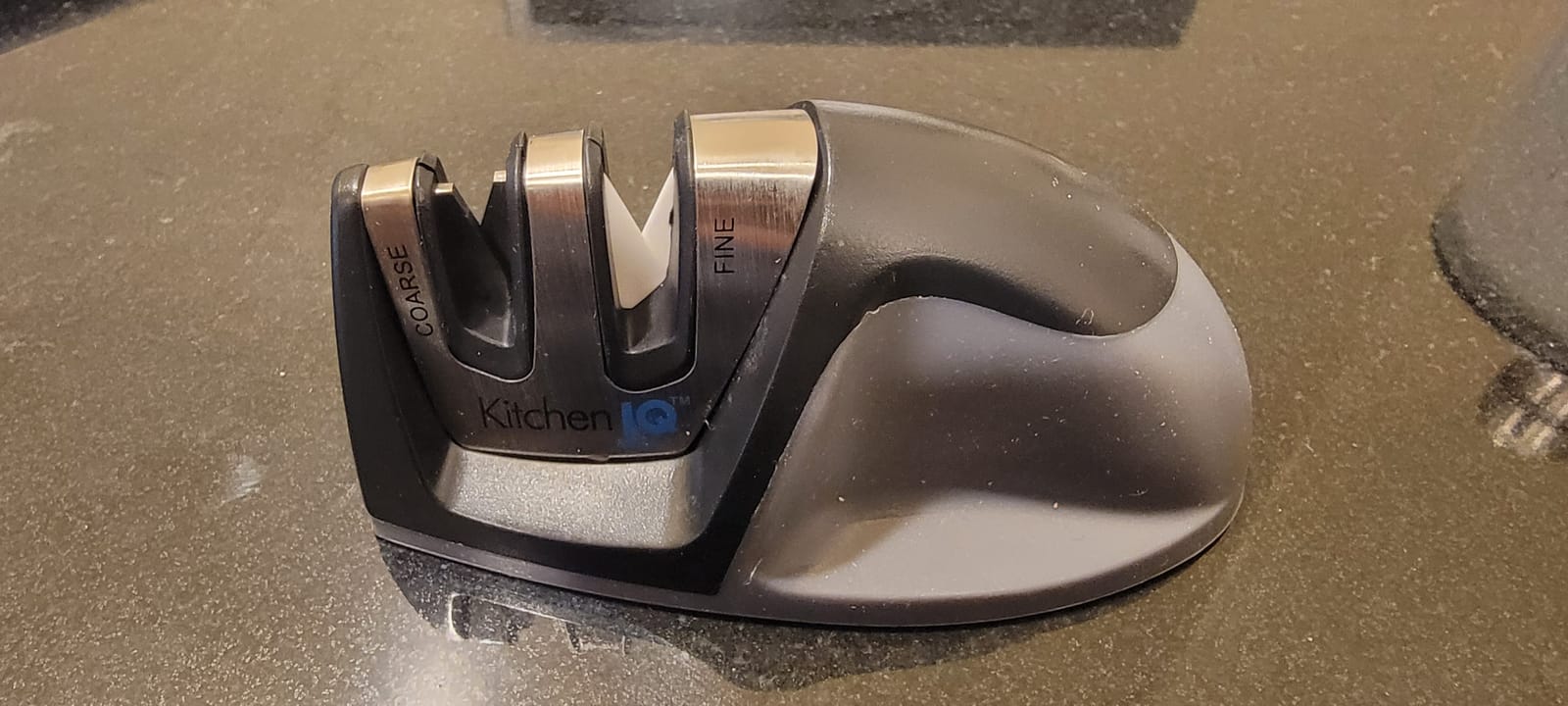
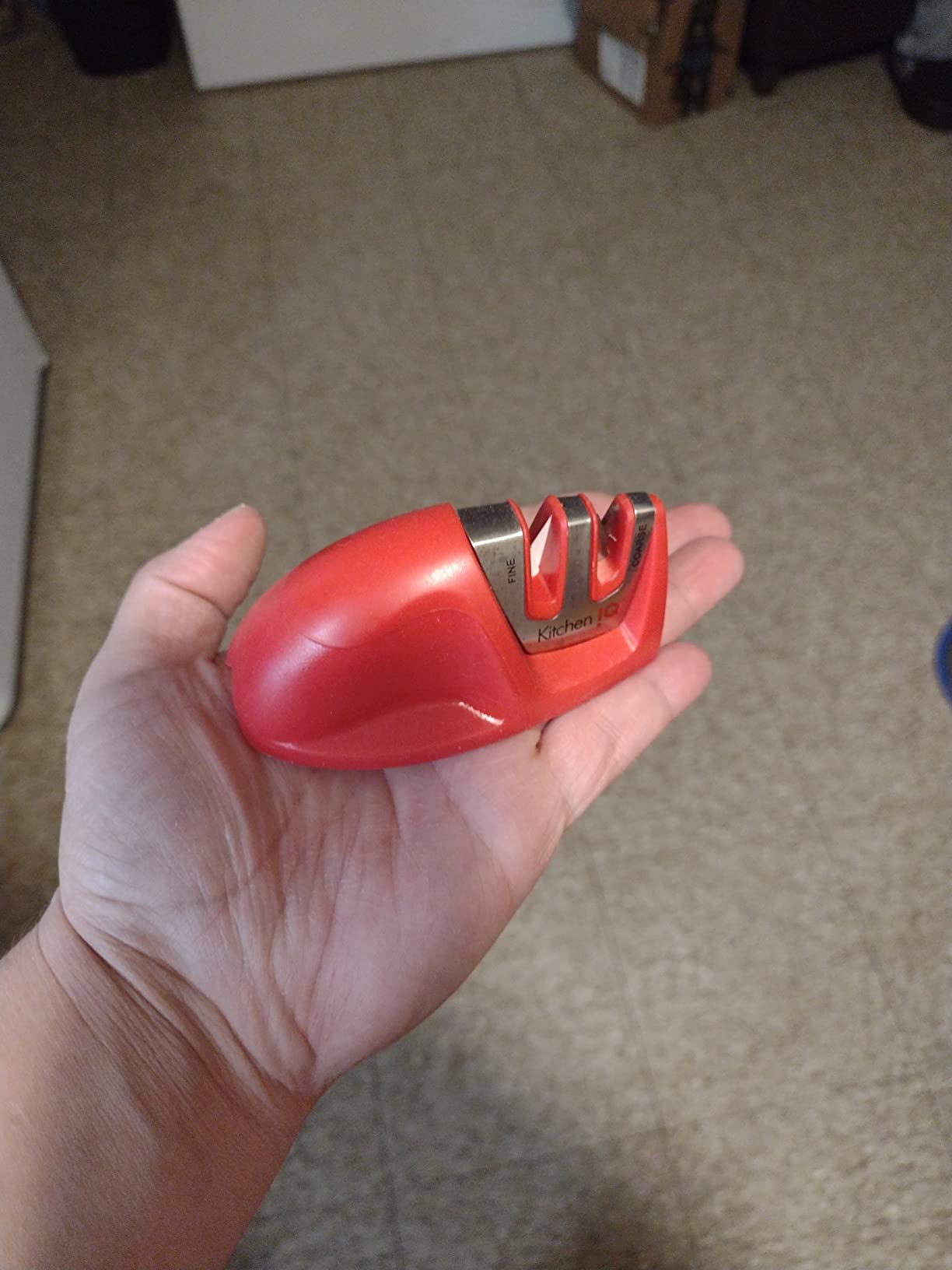
1. KitchenIQ Edge Grip 2-Stage Sharpener – Best Overall for First-Timers
KitchenIQ 50009 Edge Grip 2-Stage Knife Sharpener, Black, Coarse & Fine Sharpeners, Compact for Easy Storage, Stable Non-Slip Base, Soft Grip Rubber Handle, Straight & Serrated Knives
Carbide coarse and ceramic fine stages
Edge Grip V notch
14.2 g
1 year warranty
The Good
- No technique or angle knowledge needed
- Compact enough for a utensil drawer
- Non-slip base stays put on the counter
- Handles straight and serrated knives
The Bad
- Fine slot wears out and the whole unit gets replaced
- Edges fade faster than a stone-produced edge
- One fixed angle only
- Countertop use rather than handheld
This is the tool most people should buy first, and it has the most owner feedback of anything on this list at 97k reviews and a 4.4 rating. You set the knife into the V-shaped Edge Grip notch, pull it through the carbide stage two or three times, then through the ceramic stage the same number of times. There is no angle to think about, because the notch holds the blade at a set height for you.
That is the whole trick. A beginner who has never held a whetstone can get a working edge in about a minute, and the tool weighs 14.2 grams, so it lives in a drawer rather than on a shelf. The non-slip base means you can put a damp towel under it and it stays put, which matters more than it sounds.
It also does something most slot sharpeners skip: the Edge Grip works at the counter edge, which is where a dull chef’s knife actually loses its bite. Straight and serrated blades both go through it, which is why this is our top recommendation for a mixed knife drawer rather than a single-knife owner.
Here is the trade. Every stroke through carbide takes a little steel with it, and the fixed angle means the edge comes out the same every time whether the knife wants that angle or not. Reviewers report the fine slot wearing out and needing a replacement unit after a couple of years of regular use. If you own a Japanese single-bevel knife, this is the wrong tool for it, and you should read our guide to sharpeners for Japanese knives instead.
What this sharpener is good for
A dull chef’s knife that has been sitting in a block for a year. A knife that slips rather than cuts. A cook who wants a drawer tool that works in under a minute and never has to think about technique. It is also the safest pick in the group for anyone sharpening with one hand while holding an ingredient in the other.
When to skip it
Skip it if you want an edge that lasts a week of heavy prep rather than a day. Skip it if you own thin, single-bevel or specialty edges, because a fixed slot angle will not respect their geometry. And skip it if you already own a decent stone setup, because this is a tool you graduate out of rather than one you grow into.
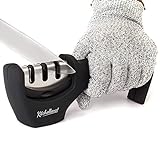
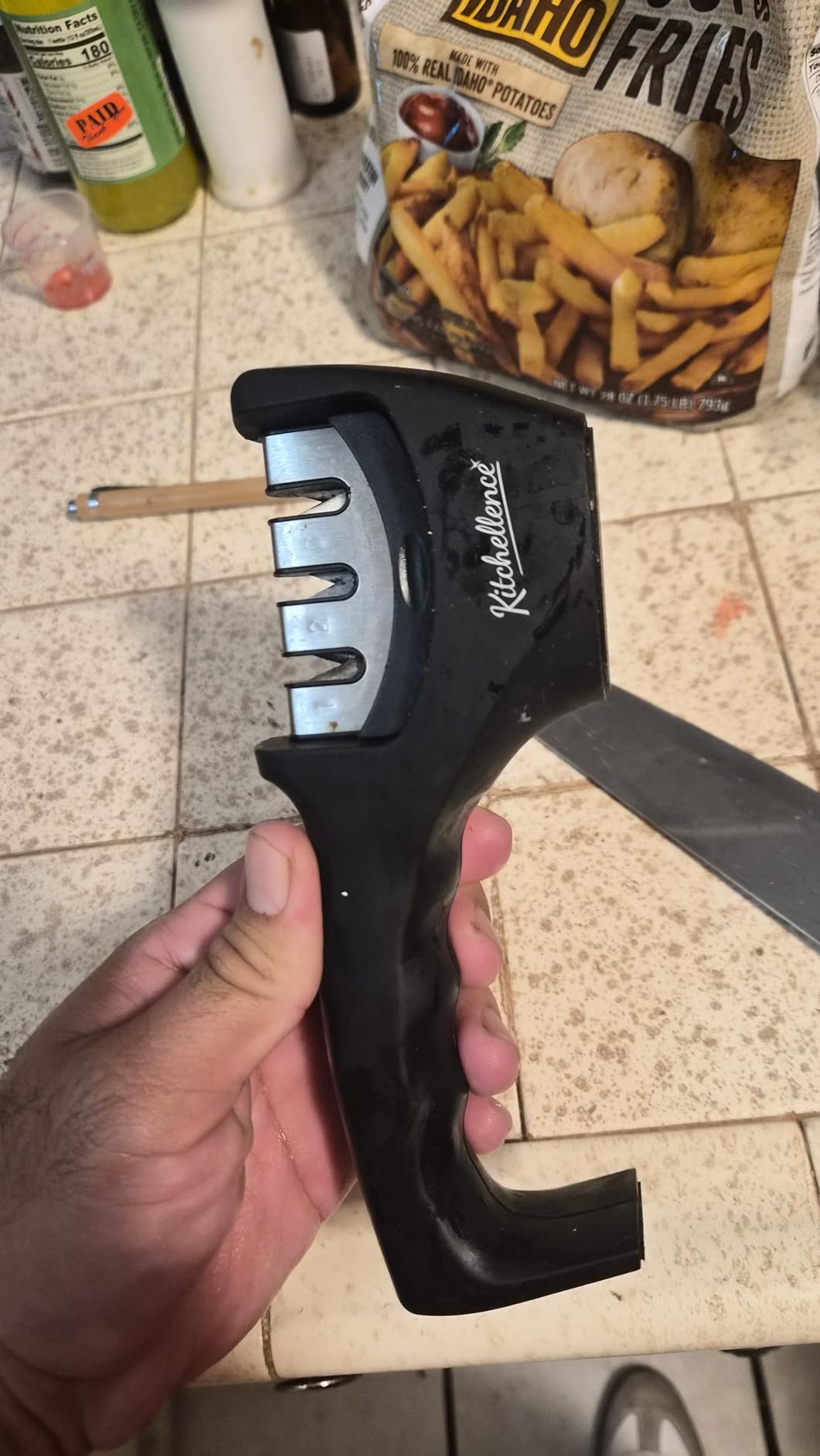
2. KITCHELLENCE 4-in-1 3-Stage Sharpener – Best for Three-Stage Control
4-in-1 Kitchen Knife Accessories: 3-Stage Knife Sharpener Helps Repair, Restore, Polish Blades and Cut-Resistant Glove (Black)
Diamond rod plus coarse and fine slots
Includes cut-resistant glove
180 g
The Good
- Three distinct stages give finer control than two slots
- Restores a dull knife in seconds
- Sturdy ABS body
- Works comfortably with either hand
The Bad
- Printed slot order and angle guidance are often wrong
- Glove was missing from some shipments
- Edges are adequate rather than fine
- Included glove is awkward to use
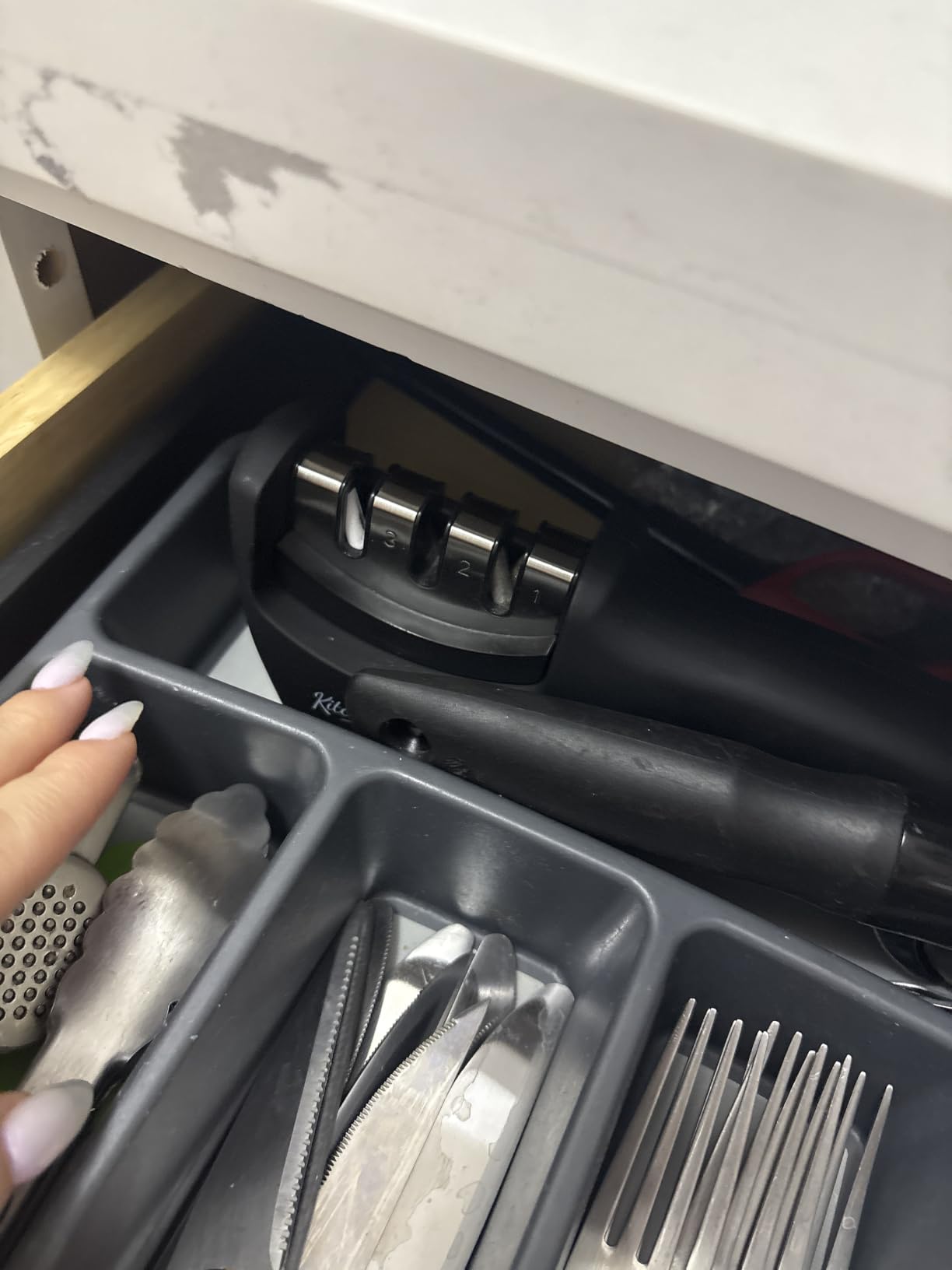
This is the middle ground between a two-slot slot sharpener and a real stone system, and at 39k reviews with a 4.5 rating it is one of the most proven designs in the category. You get a diamond rod for repair, a coarse slot to rebuild the V shape, and a fine slot to polish and take the burr down. Three stages means you can back off when you are being too hard on the edge.
The handle is genuinely ambidextrous, which is rarer than it should be. The 180 gram body feels substantial in the hand, noticeably more so than the KitchenIQ, and that weight is what stops the blade from skating sideways when you pull. Instructions tell you to pull in one direction rather than back and forth, which is the correct advice and takes about a week to build into habit.
The honest caveat is in the reviews: the manufacturer’s own guidance on which slot to use and at what angle is frequently wrong, and experienced users write long posts explaining how to deviate from it. A few shipments also arrived without the cut-resistant glove. If you buy this, plan on two minutes of figuring it out rather than reading the card, and do not count on the glove being in the box.
The edge it produces is functional rather than refined. It cuts properly and holds for a few days on a home knife, then wants doing again. That is the honest ceiling of any slot system and this one is no exception.
Who should buy this one
Anyone who found a two-slot unit too blunt and wants more control without moving to stones. The three stages let you repair a genuinely damaged edge first, then refine it, which is useful for an inherited knife set that has been in a drawer since someone else’s kitchen.
Who should look elsewhere
If the printed instructions being wrong would end your sharpening habit before it starts, choose a tool with a clearer manual. It also makes a poor gift, because the glove marketing sets an expectation the tool does not really meet. For long-term edge quality, a whetstone section further down will serve you better.
3. AccuSharp Original Manual Sharpener – Best for Safe Ten-Second Sharpening
AccuSharp Knife Sharpener, Ergonomic Comfortable Handle, Compact & Easy to Use, Restore and Hone Straight & Serrated Knives, White
Reversible diamond-honed carbide blades
Full finger guard
Dishwasher safe
1.6 oz
The Good
- Sharpens most blades in around ten seconds
- Reversible carbide blades last years
- Finger guard keeps hands clear of the blade
- Works for chef
- paring
- serrated
- filet and cleaver
The Bad
- Fixed angle limits edge control against a stone
- Not ideal for Japanese single-bevel or specialty edges
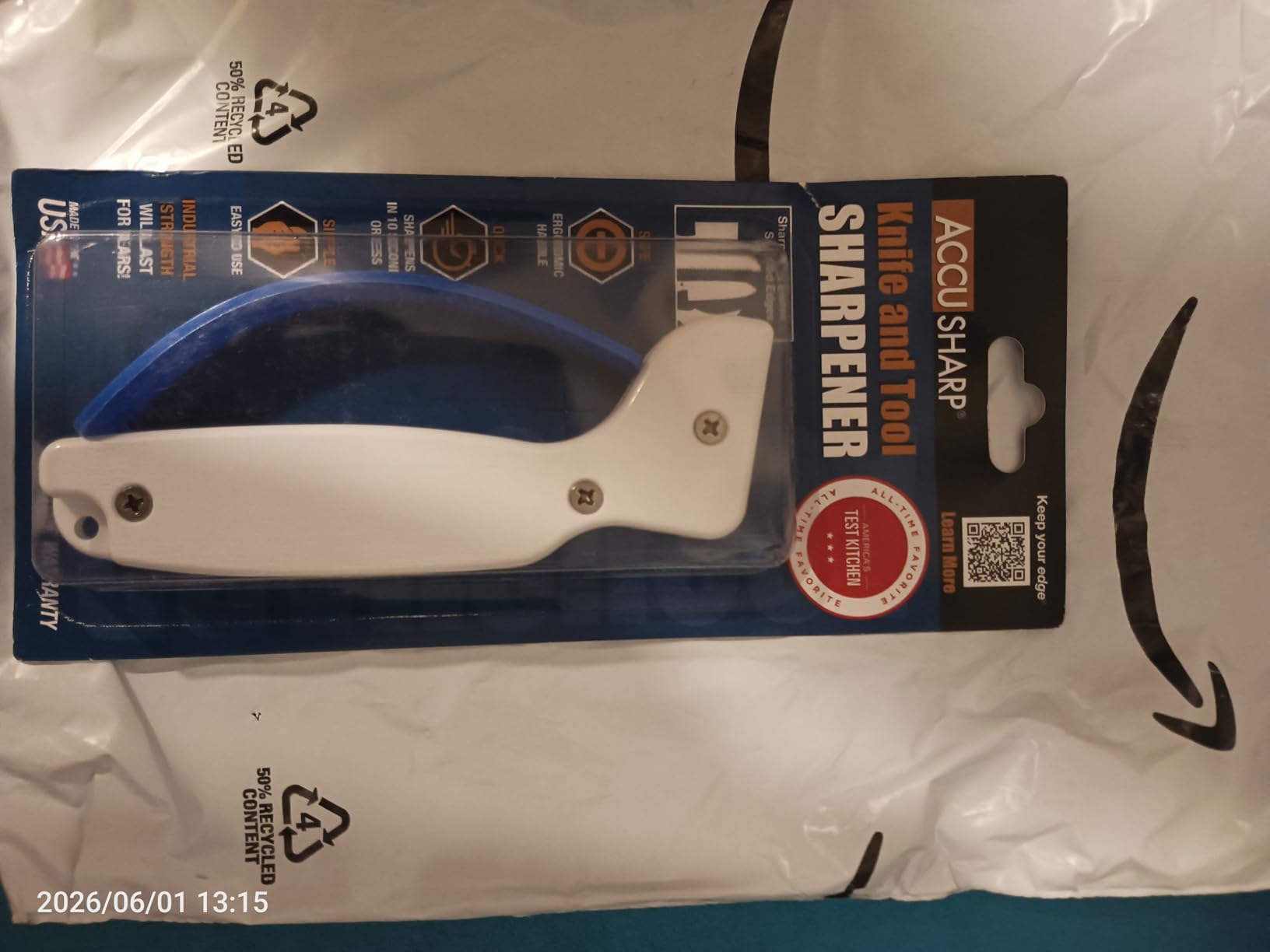
The AccuSharp has been on the market long enough that its design has stopped changing, and that is the compliment. It is rated 4.7 across more than 28k reviews, it ranks first in its retail category, and the mechanism is the same one that has worked since the beginning: two crossed carbide plates in a slot set at a fixed angle, drawn through a few times.
What makes it the safest tool here is the full-length finger guard. The hand never comes near the blade face because the handle is closed all the way down, which is a real consideration if you are new to sharpening and slightly nervous about a four-inch moment with a chef’s knife. It is also dishwasher safe, which removes the cleanup argument entirely.
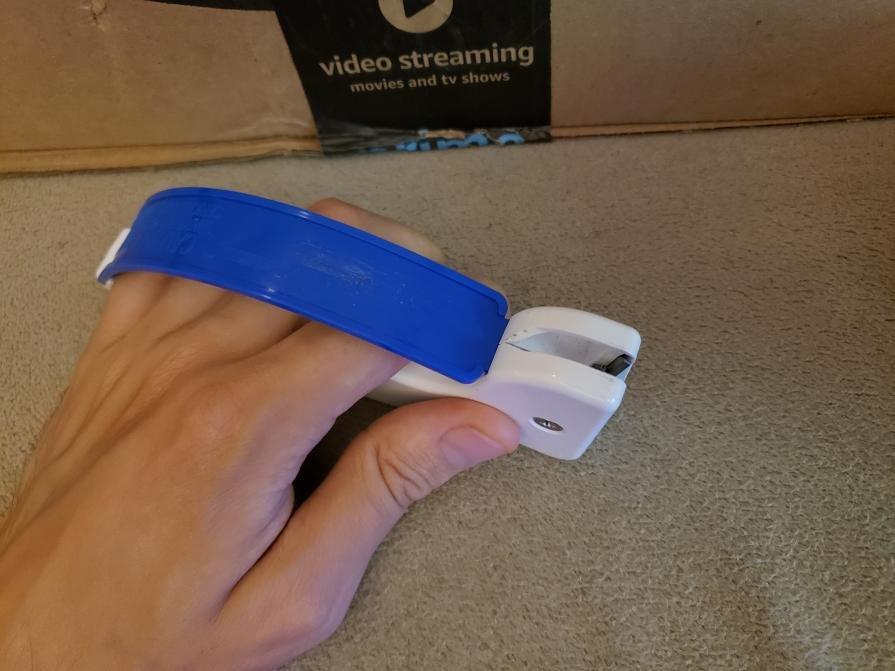
The carbide plates are reversible, so when one side dulls you turn them over and get a second life before replacing anything. Owners report years between replacements, which changes the long maths compared with slot units that use ceramic inserts you cannot turn over.
The limits are the same limits. The angle is whatever the tool was moulded to, and it will not reprofile a badly damaged edge or respect a thin single-bevel geometry. Ten seconds is genuinely all it takes on a normal dull edge, and that speed is why people keep one of these in a drawer even after they buy something better.
What works well here
Chef’s knives, paring knives, fillet knives and cleavers going dull through normal use. It handles serrated knives in the sense that it will not destroy them, and the guard plus the fast cycle make it a good first tool to own while you learn what sharpening even involves.
Where it falls short
Single-bevel Japanese knives, tanto blades, and any edge thinner or thicker than the factory angle. It also will not save a knife with a real chip in the bevel. For a wider view of the tools that do handle those edges, see our Japanese knife sharpener roundup.
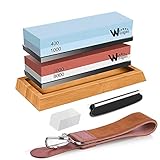
4. Sharp Pebble 1000/6000 Whetstone – Best First Sharpening Stone
Sharp Pebble Whetstone Knife Sharpener – 1000/6000 Grit Sharpening Stone
1000 grit repair and 6000 grit polish
Angle guide and bamboo base
2.1 lb
Water only
The Good
- Angle guide makes a consistent bevel reachable for a first-timer
- Non-slip bamboo base holds the stone steady
- 1000 and 6000 grit covers most home kitchen work
- Also handles scissors
- chisels and razors
The Bad
- Freehand work still takes practice even with the guide
- No flattening stone included
- Identical stones sold by other brands for less
- Angle guide not explained in the packaging
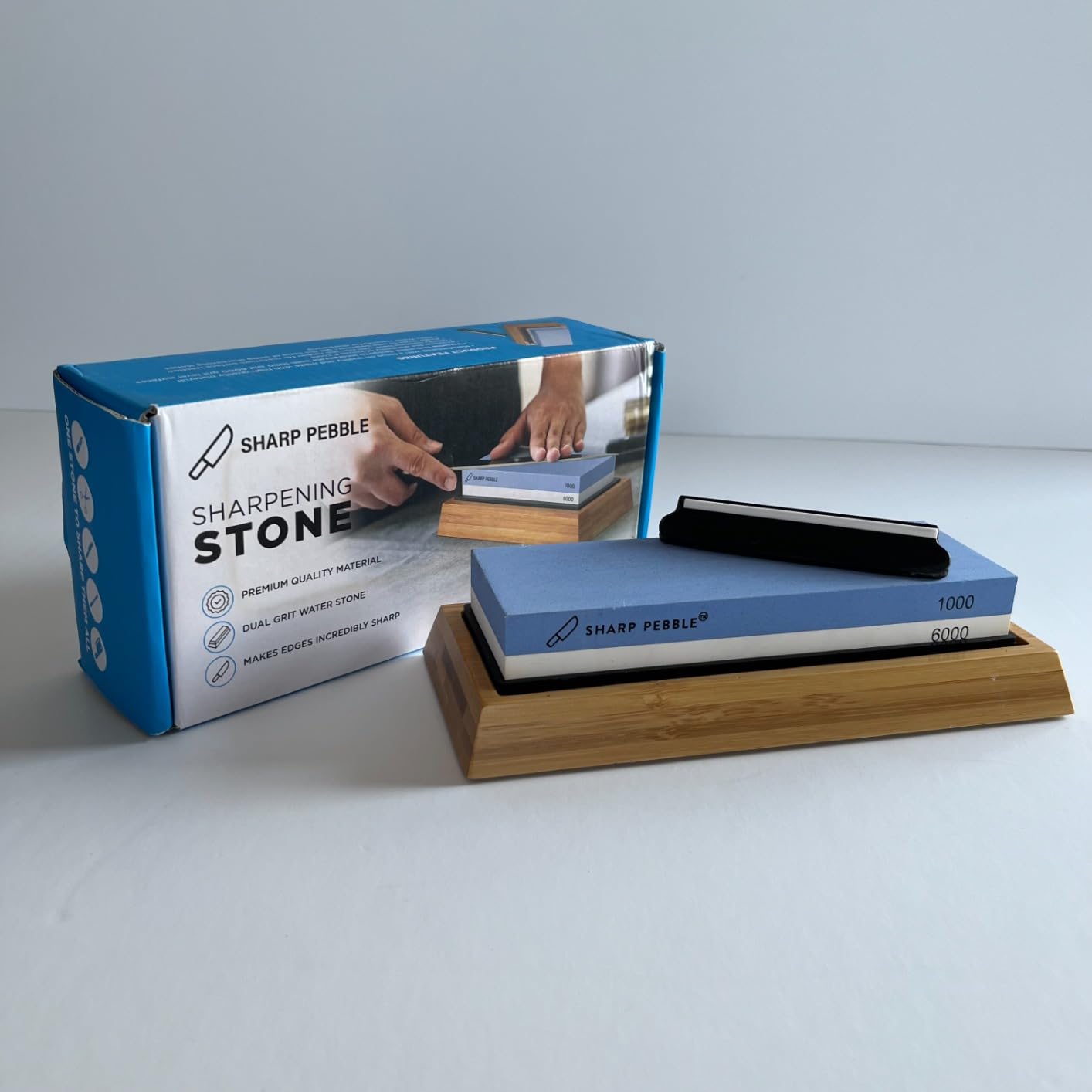
This is where most people should end up, and 25k reviews at 4.6 make it one of the most trusted entry points into stone sharpening. A 1000 grit side resets a dull edge and a 6000 grit side refines it into something that genuinely holds. Nothing on the slot sharpeners above can produce that result, because they cannot change grit halfway through a session.
Two details make it work for beginners specifically. The angle guide is a plastic wedge that rests on the stone and holds the blade at a repeatable height, which is the single thing that stops first-timers from producing a wedge-shaped edge instead of a bevel. The bamboo base keeps the stone from sliding on a wet counter, which is the other thing that ends a first session.
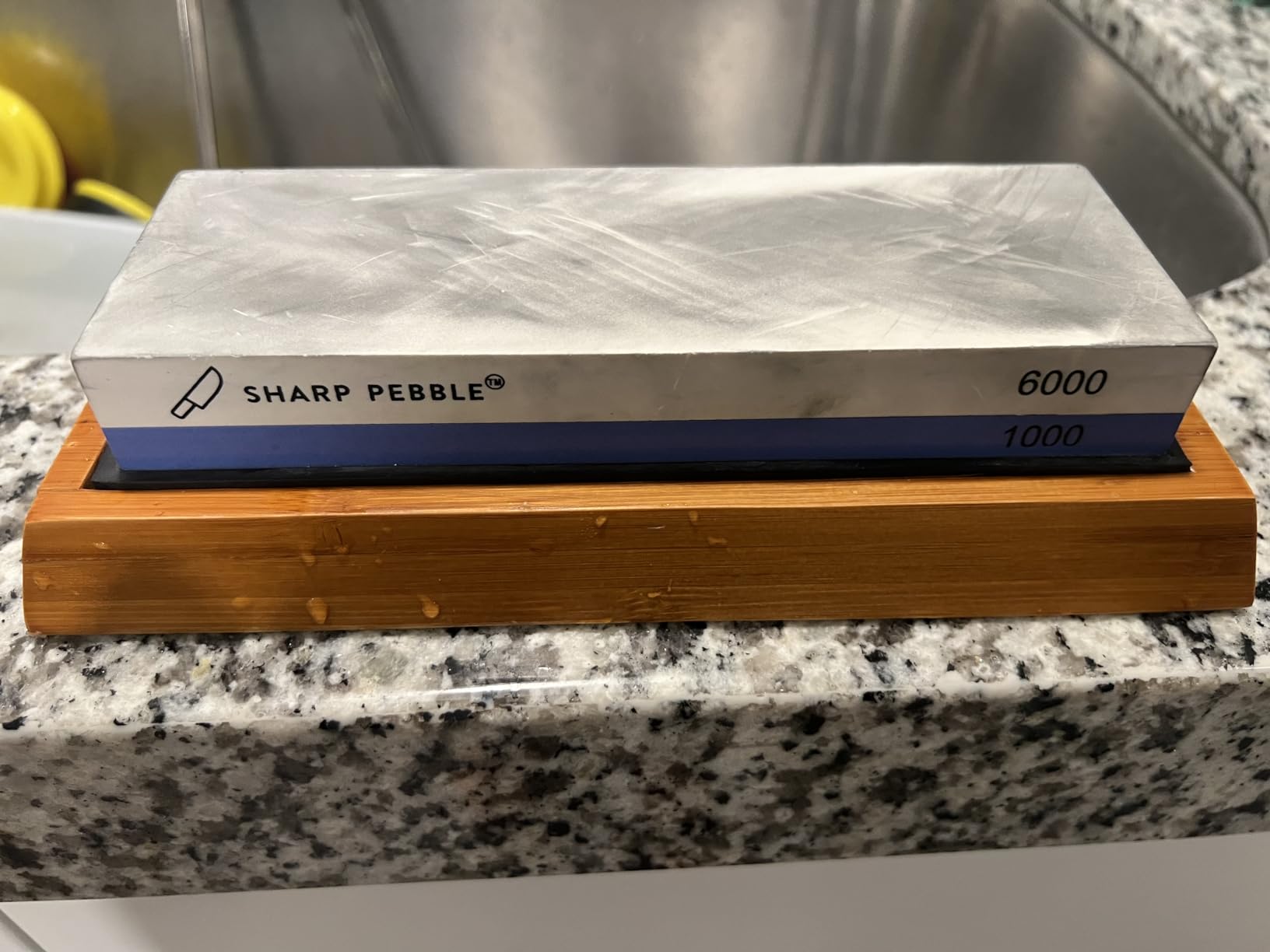
It is water-based, so you spray or pour water on the surface and start. No oil, no soaking ritual, no cleanup beyond rinsing. The 1000 grit side is a repair and daily-sharpening grit, and 6000 is a finishing grit, so this single stone handles both a neglected knife and an edge that just needs refreshing.
Reviewers are honest that a learning curve remains even with the guide, and that identical stones are sometimes listed by other brands for less. The packaging also does not explain how to use the angle guide well. If you are starting from nothing, read the five-step method further down before your first session, because knowing what a burr feels like changes the whole process.
Why this is the right first stone
Two-sided, one stone, one method. There is no grit ladder to learn and no oil to remember. It will sharpen a high-carbon chef’s knife and it will refine a hardened stainless blade, and the included guide does most of the geometric work for you while your hands are still learning.
When it is not enough
A badly chipped or bent blade, where a 400 grit side would be needed first. It is also the wrong first stone for a single-bevel Japanese knife, because the flat back of those blades has its own geometry. And without a flattening stone included, you will eventually need one to keep the surface true.
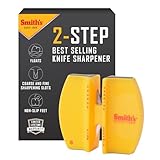
5. Smith’s CCKS 2-Step Sharpener – Best for Travel and Outdoor Knives
Smith’s CCKS 2-Step Knife Sharpener – Yellow – 2-Step Preset Coarse & Fine Slots – Outdoor Handheld Knife Sharpener – Fishing, Hunting, Fillet, Pocket Knives – Compact Plastic Portable Keychain Tool
Coarse carbide and crossed ceramic slots
Preset angles
Under 2 oz
Floats in water
The Good
- Small and light enough for a pocket or tackle box
- Preset angles make results repeatable
- Lanyard hole for keychain or backpack
- Under two ounces and wipes clean
The Bad
- Fixed angle limits control and cannot reprofile damage
- Small size is awkward on a large chef's knife
At under two ounces with a lanyard hole, this is the sharpener for the knife that lives on your belt rather than in a block. Reviewers rate it 4.5 across close to 17k reviews, and the pattern of feedback is consistent: people value it for portability over anything else, and it does that job extremely well.
The mechanism is deliberately simple. Crossed tungsten carbide blades cut an edge back, crossed ceramic rods then refine it, both at preset angles. Reviewers report three or four strokes through the coarse slot is enough to bring a dull edge back, which is a realistic expectation for a fillet or pocket knife that just needs taking back to working order.
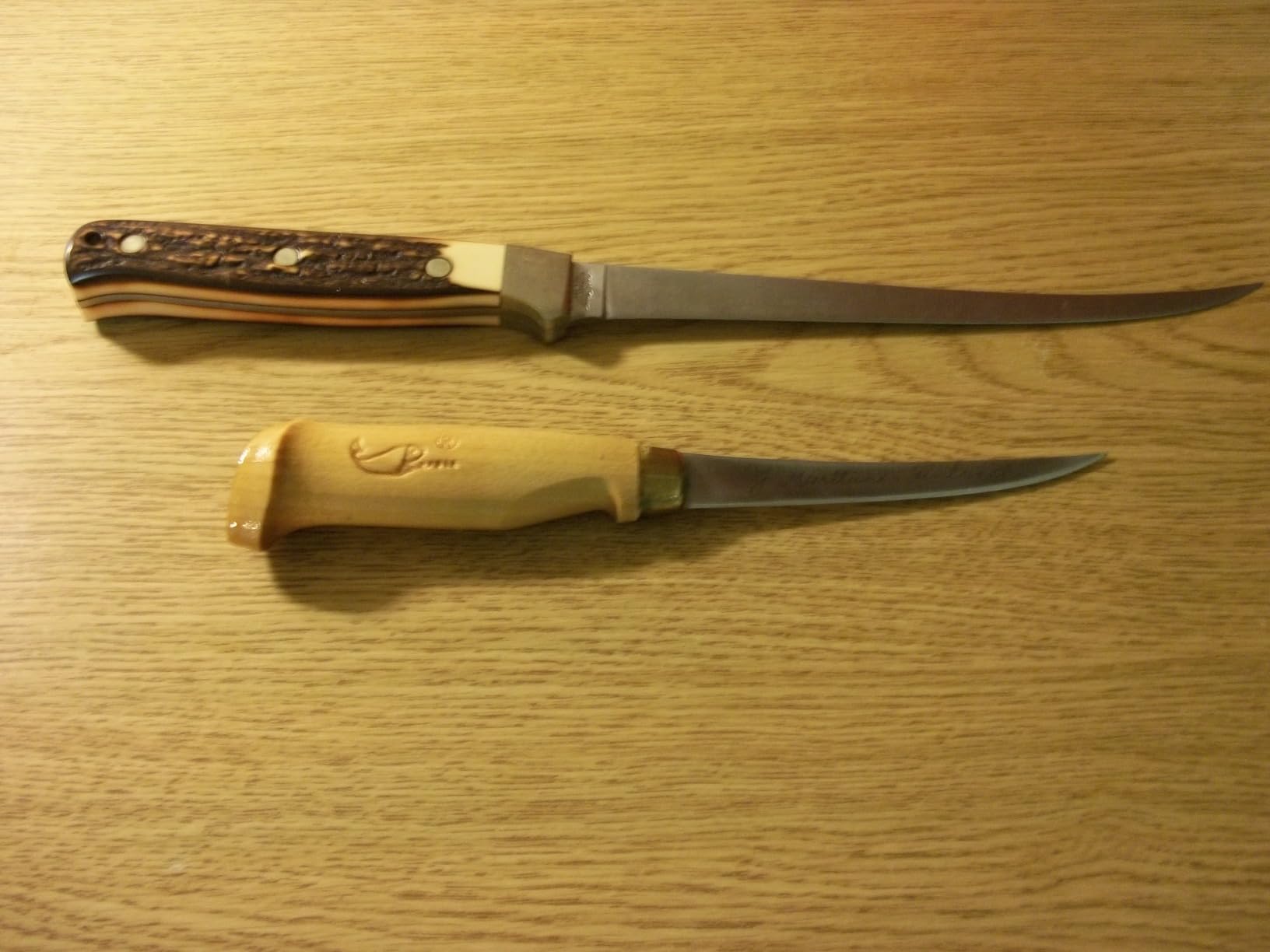
It floats, it wipes clean with a damp cloth, and it needs no water, no oil and no setup. That combination is why it is the first recommendation for anyone who owns hunting, fishing or camp knives rather than a full kitchen set, and it pairs well as a backup alongside whatever you use at home.
The limitation is size. On a large chef’s knife the short slot is awkward and the handle sits close to the blade, so it is not the tool you want for a twelve-inch blade. It also shares the fixed-angle ceiling, meaning it cannot rebuild a badly damaged edge.
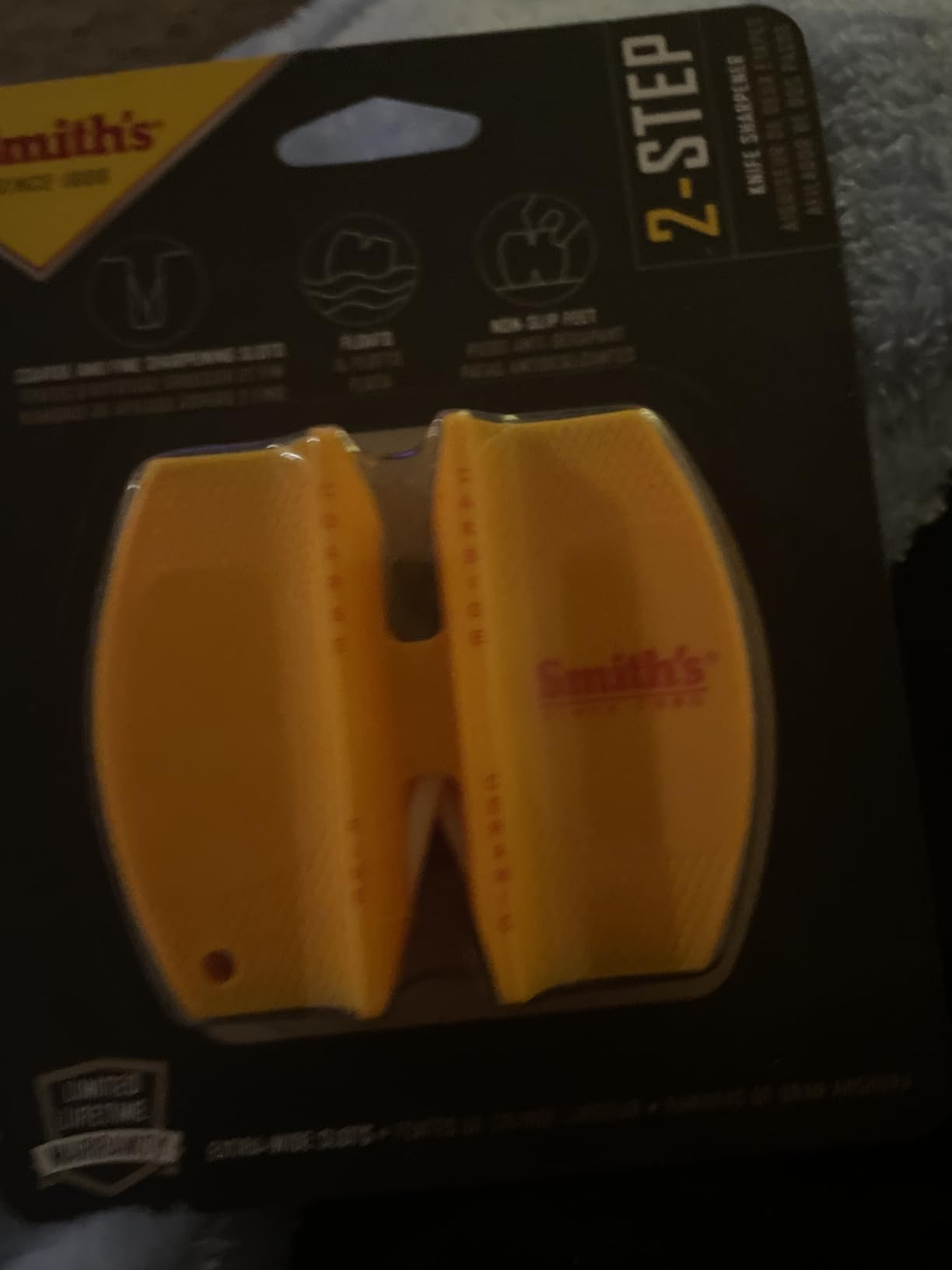
Where it earns its place
A keychain, a tackle box, a backpack and a glove box. It also makes sense as a gift for someone who is not ready to commit to a stone setup but wants a working edge on the go. Four strokes and a wipe is a routine that survives contact with real life.
Where it does not
Large kitchen knives and any edge that has been allowed to genuinely dull. It will not reprofile, and its fixed angle suits outdoor knives far better than it suits a thin single-bevel blade. If your knives all live in a kitchen, the KitchenIQ at number one is the better spend.
6. Lansky Deluxe 5-Stone System – Best for the Full Grit Range
Lansky Deluxe Knife Sharpening System: 5-Stone Ceramic Knife Sharpener Kit with Honing Oil – LKCLX
Extra-coarse to extra-fine, five stones
Knife clamp and honing oil
1.1 lb
The Good
- Covers edge repair through mirror polish
- Knife clamp makes the angle repeatable
- Finger-grooved holders keep fingers off the stones
- Oil and case included for storage
The Bad
- Oil-based stones need oil and more upkeep
- Bulkier and costlier than a two-stage pull-through
- Practice knife replica adds little for kitchen-only use
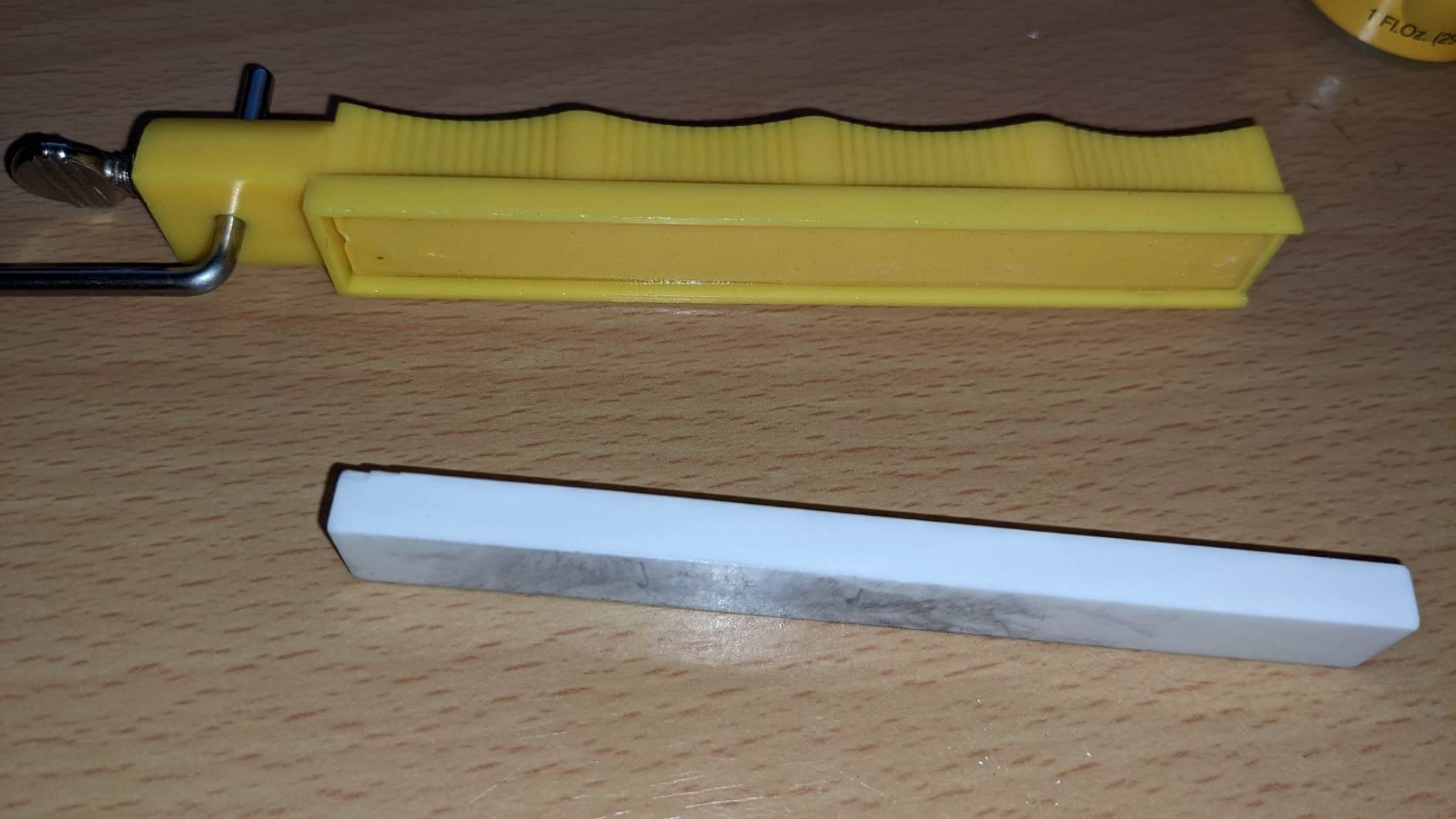
The Lansky Deluxe is the traditional answer, and 14k reviews at 4.5 reflect a system people keep for years rather than a gadget they try once. Five color-coded stones run from extra-coarse to extra-fine, so you have a repair grit, a shaping grit, a sharpening grit and two finishing grits in one case. Nothing else in this list covers that range with one purchase.
The knife clamp is the beginner-friendly part. You lock the blade in, and the clamp geometry sets the angle, so the same repeatable bevel comes out whether you are concentrating or not. That directly addresses the complaint enthusiasts raise about cheap rod systems, where guides that are meant to help end up getting in the way after half an hour.
Forum discussion is consistently kind to this system. Owners report buying one years ago and never upgrading, which is the strongest durability signal you can get for a sharpening setup, and it is named repeatedly in the same conversations where people debate guided systems.
The cost of that range is maintenance. These are oil stones, not water stones, so every session means applying honing oil, working the stone, and cleaning the slurry off afterwards. It is a wetter, stickier, slower routine than a ceramic-bonded waterstone, and the case is genuinely bulky compared with a single stone on a tray.
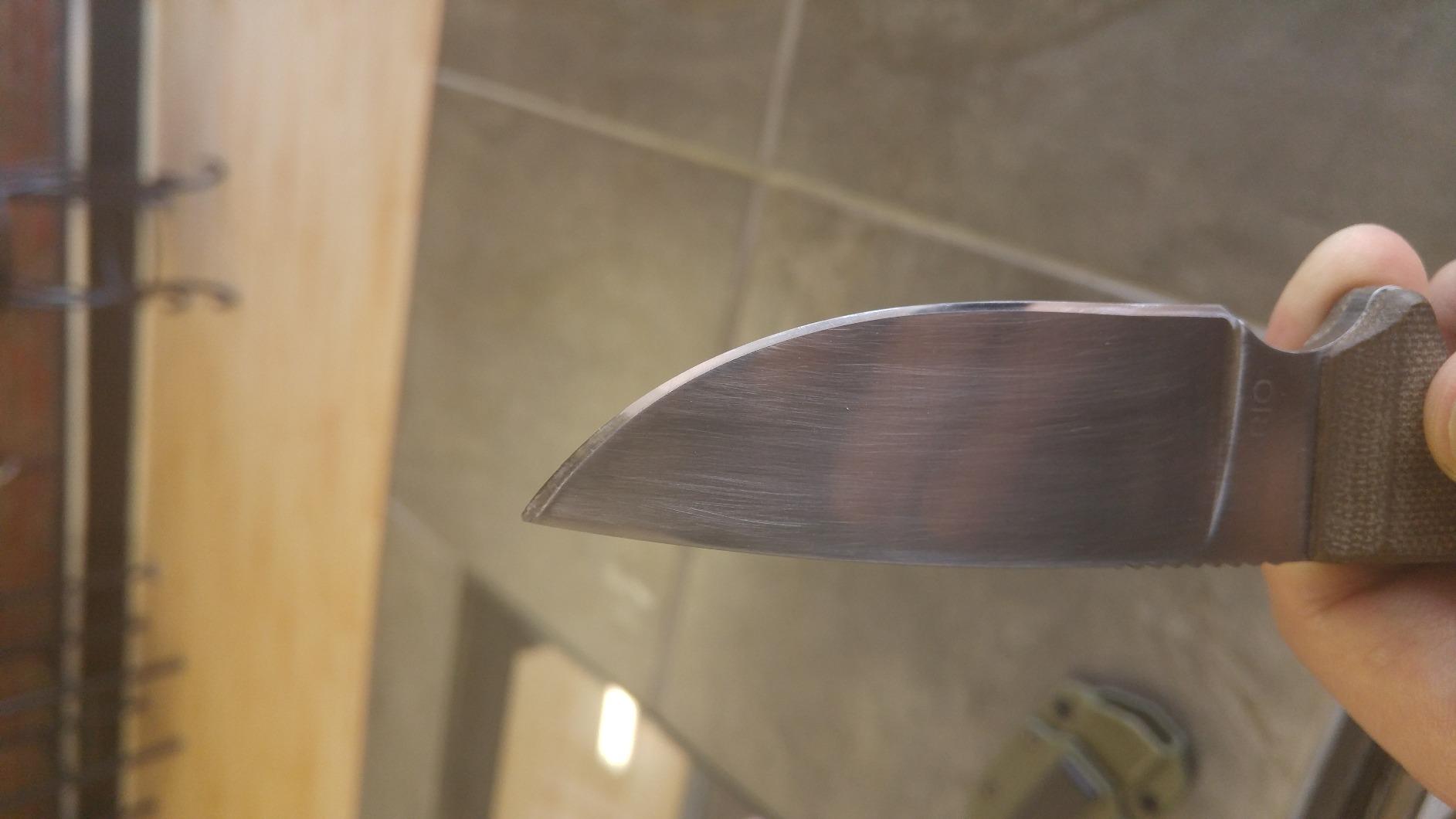
Who this suits
Someone who wants to sharpen kitchen, hunting and pocket knives on the same system and is willing to make oil part of the routine. The five grits let you remove a chip, shape the edge, sharpen it and polish it without buying anything else. The finger-grooved holders are a nice touch for beginners worried about proximity to the stone.
Who should pass
If you want a ten-minute setup you pull out occasionally, five stones is more than you will use. The included practice knife replica is of limited value if you only care about kitchen blades. A water-based combination stone gives most of the same results with less fuss, and we cover that trade in the buying guide.
7. Work Sharp Guided Field Sharpener – Best All-in-One Guided Tool
Work Sharp Guided Field Sharpener, Compact Travel Knife Sharpener Tool
Five abrasives at a guided 20-25 degree angle
Diamond plates, strop and rod
135 g
The Good
- Highest rated in this group with 85 percent five-star reviews
- Guided angle removes guesswork for first-timers
- Five abrasive surfaces in one body
- No tools or assembly required
The Bad
- Guided angle cannot be adjusted for very thin or thick edges
- Larger than a pocket pull-through for travel
- Abrasives wear down under heavy long-term use
This is the highest-rated tool on the list at 4.8, with roughly 85 percent five-star reviews, and it is the one enthusiasts point beginners toward when they want guided sharpening that does not require oil or water. Everything lives in one body: two removable diamond plates, a rotating ceramic rod that switches between coarse and fine, a leather strop, and a groove for fish hooks.
The guides hold the blade at 20-25 degrees throughout, which is squarely in the range a European or American kitchen knife wants. There is nothing to assemble, no consumables and no cleanup. You open it, you work the edge, you close it. For a person who wants the benefit of a guided system without the ritual of stones, it is genuinely hard to argue with.
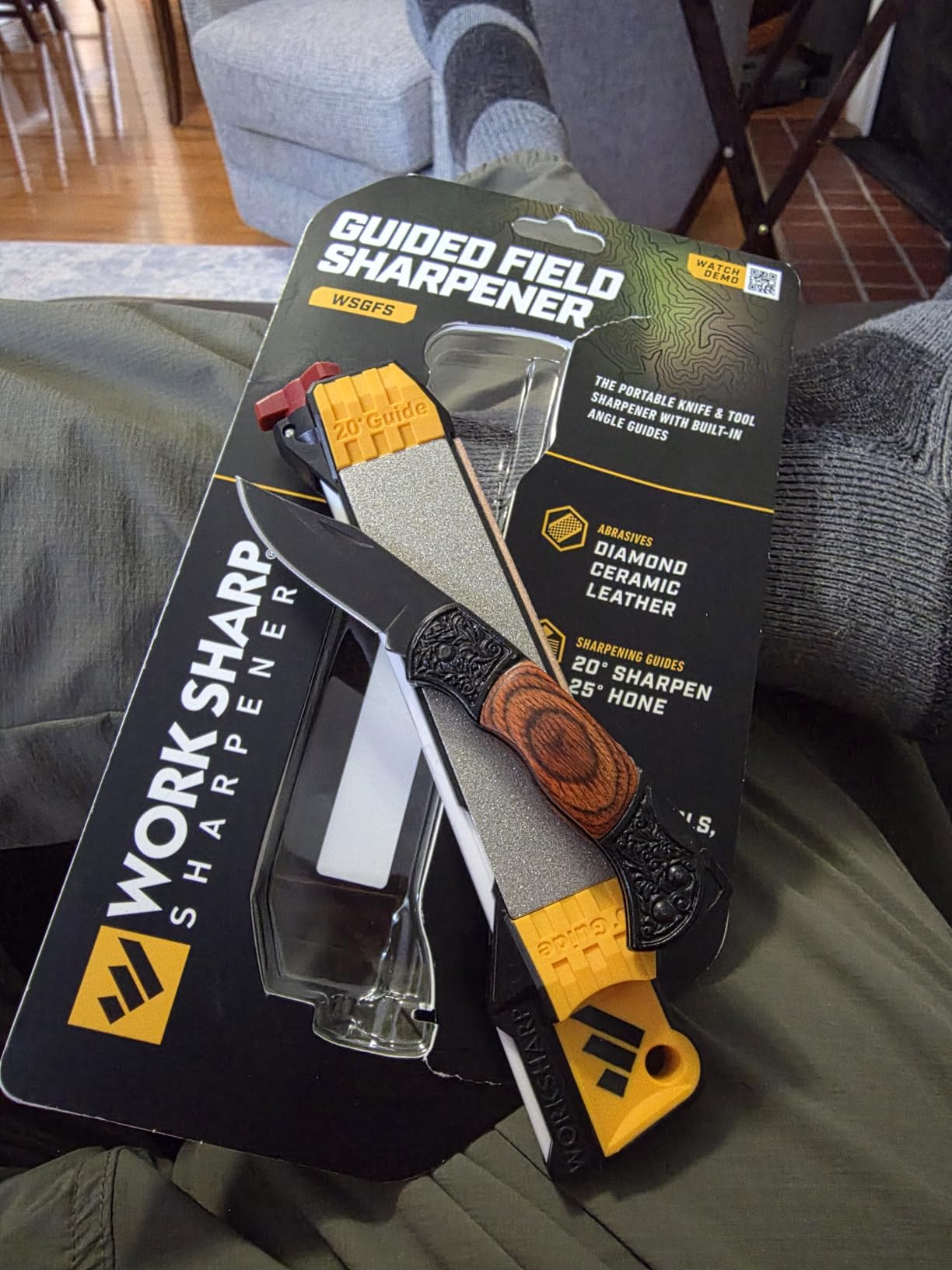
It is also the tool we would put in a drawer next to a knife block, because it is fast on a knife that just needs taking back to working order. The rotating rod is genuinely useful because a loose honing rod is the companion piece most households never buy but should.
The constraint is the same one the forum consensus raises about fixed-angle tools: 20-25 degrees is right for a lot of knives and wrong for others. A thin single-bevel Japanese edge wants a different angle, and this tool cannot be dialled to it. At 135 grams it is also noticeably bigger than a pocket sharpener if you are travelling.
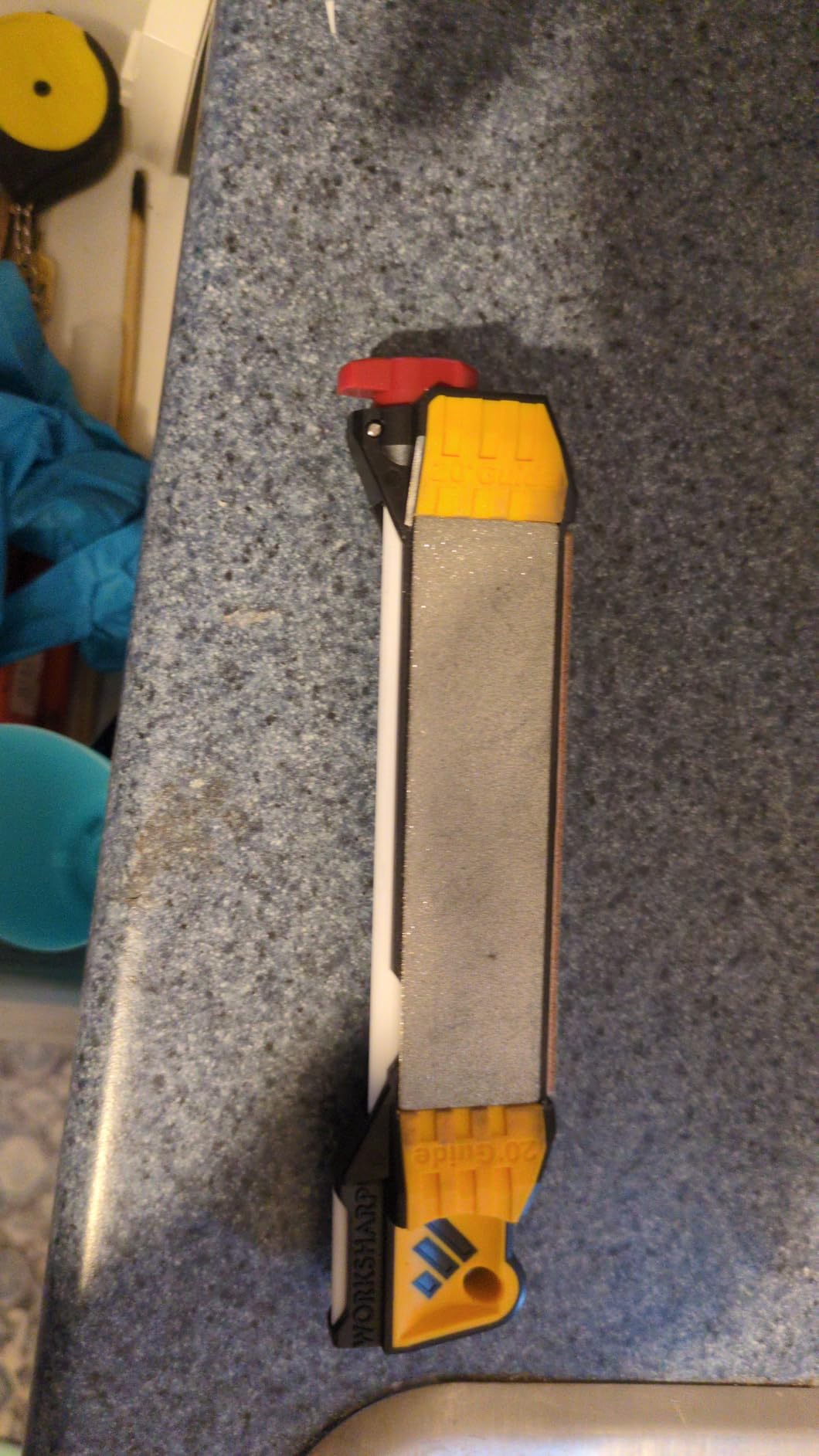
Best used for
Everyday kitchen knives that have gone dull through months of use, plus pocket and EDC knives on the same rotation. The combination of diamond plates for fast material removal and a strop for finishing means one tool covers both a proper sharpening and a quick refinement.
Best avoided for
Very thin or very thick edges where the fixed angle will not match, and any knife with a chip deep enough to need reshaping. It is also not the place to start if what you actually want to learn is whetstone technique, because the guide removes the practice.
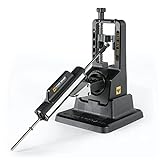
8. Work Sharp Precision Adjust – Best for Adjustable Edge Angles
Work Sharp Precision Adjust Knife Sharpener Kit – Fixed Angle Sharpening System for Kitchen & Pocket Knives – Professional Guided Knife Sharpening Tool
15-30 degrees in 1-degree steps
320 and 600 grit diamond with ceramic
215 g
The Good
- Angle can be dialled in and repeated for consistent results
- Guided clamp removes guesswork for first-time users
- Benchtop base and v-block keep the knife steady
- Works on serrated knives and can reprofile old blades
The Bad
- Highest cost in this group and a larger footprint
- Adjustable chassis takes setup and practice to work well
If the thing holding you back is not patience but control, this is the tool. The chassis adjusts from 15 to 30 degrees in one-degree steps, which is the difference between a sharpener that guesses and one that lets you decide. A thinner edge at 15 degrees slices and rolls more easily; a 20-degree edge is the durable default for most kitchen knives.
The sharpening media are a tri-abrasive rod combining 320 and 600 grit diamond with a fine ceramic section, so you can go from coarse repair to fine finish in one stroke path. The v-block clamp and benchtop base do the stabilizing work, which is what separates a repeatable result from a hopeful one. It also handles serrated knives and can reprofile an older blade that has been dull for years.
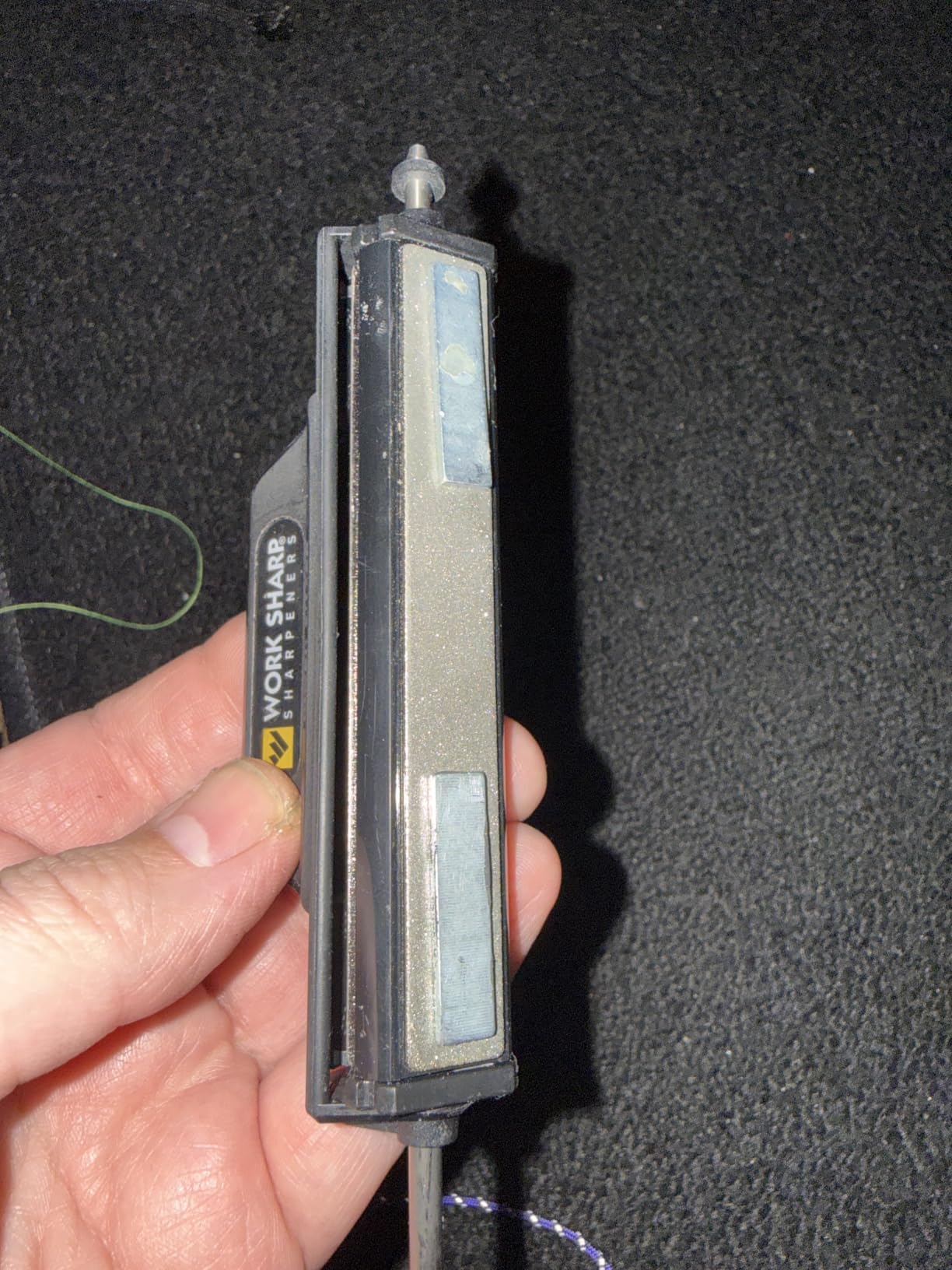
It is rated 4.5 across more than 11k reviews, and reviewers consistently describe it as the step up from a field sharpener for someone who wants a repeatable, dialable result without committing to freehand stone work. That middle position, between a slot sharpener and a full whetstone, is exactly where it sits.
The cost is size and setup. At 215 grams with a benchtop base it has the largest footprint of the handheld guided options, and the adjustable chassis takes a few sessions before you stop fiddling with it. Treat it as a bench item rather than a drawer item.
Why a beginner might want it
It answers the question a fixed-angle tool cannot: what angle should this knife be? If you own a mix of thin Japanese steel, hardened European stainless and a serrated bread knife, being able to change the number is the difference between a good edge and a great one on each of them.
Why a beginner might not
There is a simpler way to learn. A single combination stone with an angle guide teaches you the geometry that a chassis does for you, and the stone costs a fraction of this and travels better. If your budget is tight or your counter space is small, this is more machine than you need yet.
9. Intelitopia Complete Stone Set – Best All-In-One Kit
Intelitopia Complete Knife Sharpening Stone Set – Dual Grit Whetstone 400/1000 3000/8000 Knife Sharpener with Leather Strop, Flattening Stone, Bamboo Base, 3 Non-slip Rubber Bases & Angle Guide
400/1000 and 3000/8000 stones
Flattening stone and cowhide strop
5 lb
The Good
- Everything needed is in one box including a flattening stone
- Wide grit range handles nicks through mirror finishes
- Leather strop removes burrs and finishes the edge
- Angle guide makes the kit approachable for a first-timer
The Bad
- Stones must be kept wet or they grind unevenly
- Advertised non-slip base is not especially grippy
- Stones are lighter and rougher than Japanese stones
- Leather strop is thinner than described
The Intelitopia kit is the value answer to the Lansky, and it ships the accessory people most often forget to buy. You get two double-sided stones covering 400/1000 and 3000/8000, a coarse flattening stone, a genuine cowhide leather strop, an angle guide, a bamboo base with three rubber holders and an instruction manual.
That flattening stone matters more than the marketing suggests. Whetstones wear concave in the middle over time, and once they dish out, a straight stroke produces a curved bevel and a wonky edge. Having a flattening stone in the box from day one means you are not six months in before finding out why your edges started going strange.
Reviewers rate it 4.5 across more than 7k reviews and treat it as the best-value complete beginner kit. The four grit levels let you start at 400 for a genuine repair, move to 1000 to shape, then to 3000 and 8000 to finish, which covers the whole journey from a battered inherited knife to a polished edge.
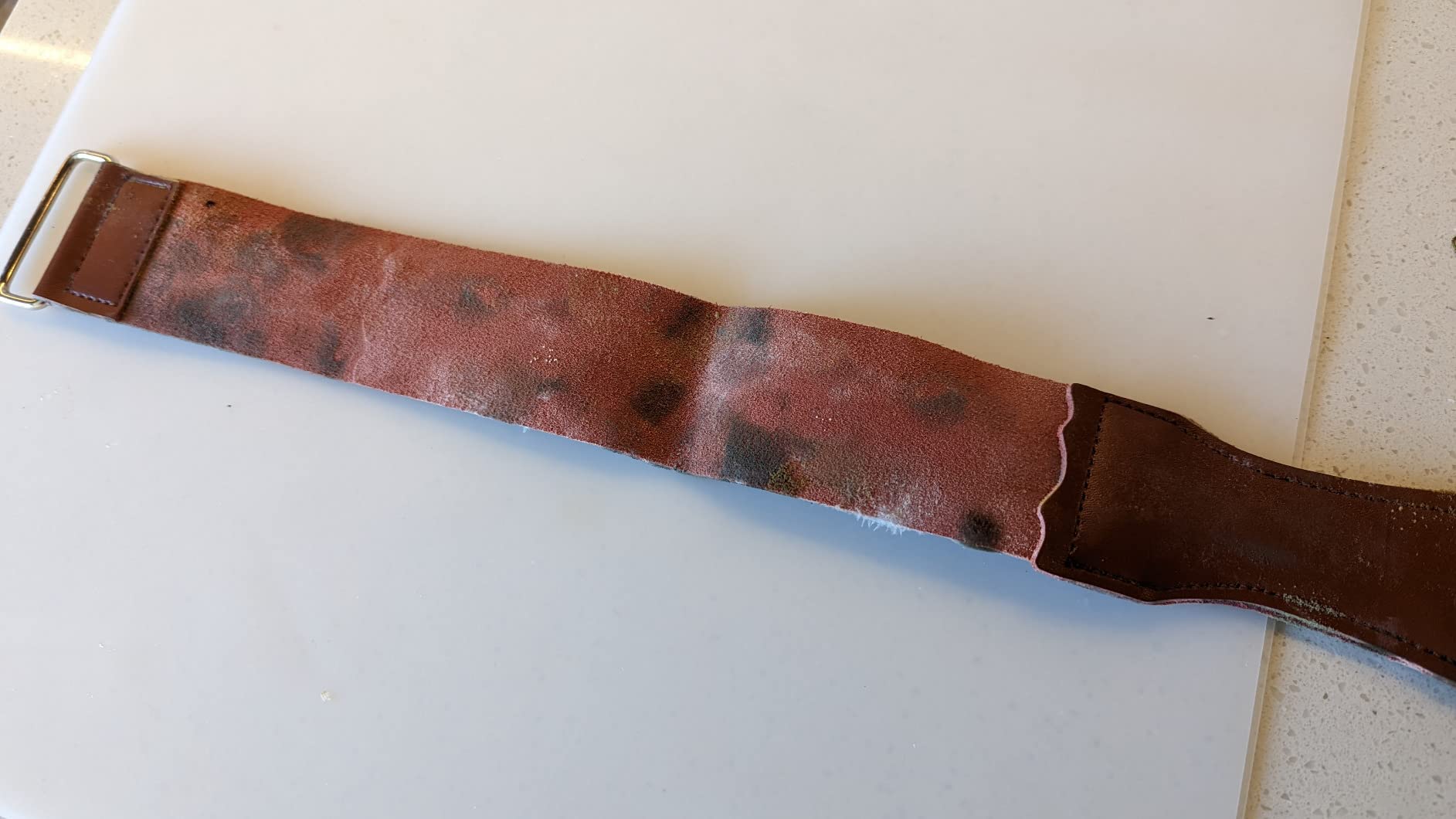
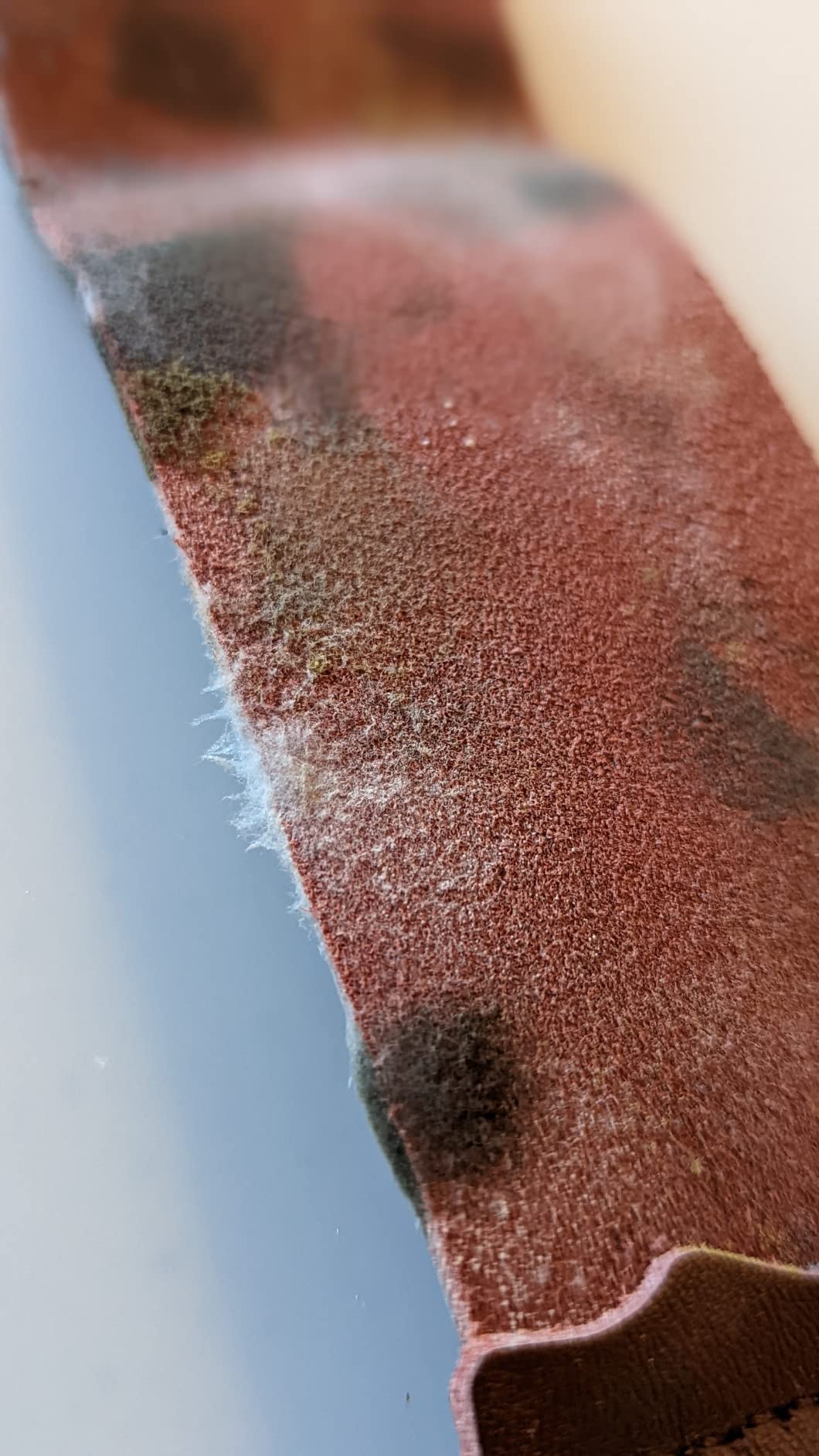
The strop is the part that finishes the job properly. Once a burr is formed, stropping on leather straightens and polishes it away, and that is what turns a sharp edge into one that feels dangerous in a good way. Reviewers are candid that the included strop is thinner than the description implies, so treat it as a learning tool rather than a long-term one.
Who this works for
A beginner who wants a complete setup in one purchase rather than buying a stone now and a flattening stone later when something goes wrong. It suits a mixed household with several knife types, and the strop makes it a good match for anyone who will also want to maintain scissors or a chisel.
Who should look at a single stone instead
Anyone with limited space or a low tolerance for setup. The kit weighs 5 pounds, needs constant rewetting during use, and the bundled base is not particularly grippy, so you will be managing more hardware than the Sharp Pebble at number four asks for. The rougher stones also need more frequent flattening.
10. Wucgea 8-in-1 Whetstone Kit – Best Starter Stone Set
Wucgea Knife Sharpening Stone Kit – 400/1000 3000/8000 Grit Japanese Whetstone Set with Non-Slip Rubber Base, Angle Guide, Flattening Stone and Leather Strop
400/1000 and 3000/8000 corundum stones
Flattening stone, strop and guide
Soak 5-10 min
The Good
- Eight accessories in one kit for well under the cost of premium stones
- Angle guide lowers the barrier for a first whetstone session
- Water-only wet sharpening with no oil needed
- Handles kitchen
- hunting
- pocket knives
- scissors and chisels
The Bad
- Stones need soaking and rewetting during use
- Corundum wears faster than bonded Japanese stones
The Wucgea kit exists to answer one question: can you learn whetstone sharpening without a big commitment. At 4.6 across nearly 5k reviews it is rated well above where budget kits usually land, and the answer is yes, if you accept that the stones wear faster and the routine is wetter.
Inside the box you get two double-sided white corundum stones at 400/1000 and 3000/8000, a flattening stone, a leather strop with polishing compound, an angle guide, and a non-slip rubber base. That is the same accessory list as a premium kit, on softer stones, at the entry price tier.
The instructions say to soak the stones 5 to 10 minutes in water before use, and to keep them wet throughout a session. Water-only means no oil and no sticky cleanup, which is a genuine advantage over an oil-based system if you sharpen in a kitchen and not a workshop.
What works well here
Learning the mechanics cheaply. The angle guide plus a flattening stone means you can practise proper technique without risking a good knife, and the broad grit range covers a kitchen knife, a hunting blade, scissors and a chisel from one kit.
Where you will notice the difference
Corundum is a softer abrasive than bonded Japanese stone, so the edges come off faster and the surface dishes out sooner. That means more frequent flattening and a slightly less refined finish at the fine end. Treat this as a training set you will eventually outgrow rather than a forever system.
11. KEENBEST 400/1000 Whetstone – Best Simple Two-Sided Stone
KEENBEST 400 1000 Premium Material Whetstone Sharpening Stone Set 2 Side Kitchen Knife Sharpener Stone Wet Stones for Sharping Knives Kit Non-slip Rubber Base
Two-sided 400 and 1000 grit stone
Soak 10-15 min, water only
16 oz
The Good
- Cheapest genuine whetstone in this group
- No oil needed
- just water
- 400 and 1000 sides cover routine kitchen sharpening
- Non-slip base keeps the stone steady
The Bad
- Only two grit levels so no polishing or mirror stage
- Soft white corundum wears and dishes faster
- Freehand use means the bevel angle is judged by eye
This is the lowest-cost way to find out whether you enjoy stone sharpening before committing to a kit. It is rated 4.7 across close to 4.6k reviews, which is a strong showing, and it does exactly one thing: a two-sided white corundum stone with a 400 grit face for daily sharpening and a 1000 grit face for smoothing.
Those two grits cover the range most home kitchens need. 400 will take a neglected edge back to shape, 1000 produces a working edge that holds for weeks on a well-used chef’s knife. Soak it 10 to 15 minutes, keep it wet while you work, and you have a complete routine with a non-slip rubber base holding it steady.
Why it is worth considering
It is the cheapest way to try a real stone, and 400/1000 is a legitimate pairing rather than a compromise. There is no oil, no assembly and no accessories to lose. For a first session on an inexpensive knife, it does the job.
Why it is not the last one you buy
There is no fine grit, so you cannot polish, and no angle guide, so the bevel angle is entirely on your eye. The soft corundum dishes out faster than harder stones, which is the same complaint reviewers raise on the Wucgea set. Expect to add a fine stone and a flattening stone later.
12. Orange Ninja 4-Stage Sharpener – Best for Serrated Knives
Orange Ninja Serrated & Kitchen Knife Sharpener – 4-Stage Sharpening Tool
Coarse carbide, medium diamond, fine and serrated slots
ABS body
10.88 oz
The Good
- Only option in this group with a dedicated serrated knife slot
- Four stages give more control than a two-slot model
- Comfortable for either hand
- Sturdy ABS body with carbide and steel components
The Bad
- Lowest rated in this group with more one and two star reviews
- Edges need refreshing more often than stone sharpening
- Coarse slot can thin the edge if overused
This earns its place for a specific reason: it is the only tool here with a dedicated serrated knife slot, and a bread knife is in most kitchens. A serrated blade has a set of teeth at a fixed geometry, and running it through a straight-edge slot gradually softens them. The dedicated slot shapes the teeth instead of rounding them off.
The other three stages are a coarse carbide repair slot, a medium diamond rod and a fine polishing stage, so it handles straight blades properly as well. The instructions specify pulling in one direction rather than back and forth, which is the same good advice the KITCHELLENCE gives.
What it is good at
Bread knives, serrated utility knives and any household blade set where the serrated member has gone soft. The four stages also give a first-timer slightly more control than a two-slot design without moving up to stones.
What to know before you buy
It carries the lowest rating in this roundup at 4.3, and the reviews reflect that with more critical feedback about edges that dull quickly and occasional uneven results. Overusing the coarse slot thins the edge faster than you would expect. If serrated knives are your only sharpening problem, it solves it; if you want a general-purpose tool, any of the three-stage options above is the safer buy.
Pull-Through vs Guided vs Stone: Which Type Should You Buy?
Start with the question that actually decides it: how much do you want to think about angle and grit. A pull-through slot decides everything for you and takes under a minute. A guided system decides the angle for you but lets you change the abrasive. A whetstone asks you to hold the geometry yourself and rewards you with the best edge and the slowest learning curve.
If you have never sharpened a knife and want results this week, buy a slot sharpener. The KitchenIQ at number one is the one we would pick, with the AccuSharp as the safer-handling alternative. You are giving up edge longevity and edge refinement, and getting a tool that cannot fail through misuse.
If you want to be able to change the angle or the abrasive, buy a guided system. The Work Sharp Precision Adjust covers 15 to 30 degrees and a serrated blade, while the Work Sharp Guided Field Sharpener fixes 20-25 degrees and does it with no consumables. The Lansky Deluxe covers the grit range instead, five stones from extra-coarse to extra-fine, at the cost of an oil routine.
If you want the best edge and you will practise, buy a whetstone. Start with a single two-sided stone like the Sharp Pebble 1000/6000, which has an angle guide to help you, rather than a five-piece kit. Add a flattening stone later, and treat a strop as the finishing step rather than an optional extra.
Two things to know before you buy anything. Angles matter: a 15 degree edge cuts beautifully and rolls quickly, a 20 degree edge is the durable everyday choice, and a 25 degree edge is tougher but heavier to push through food. And prep time matters: water-based stones need a soak or a spray, oil-based stones need oil and a wipe-down, and slot systems need nothing at all.
For a kitchen where sharpening is one step in a longer routine rather than the routine itself, a guided system is usually the sweet spot. For a knife set you are proud of, the stone is where the improvement is. Our high quality knife set guide is worth a look if you are still deciding which blades you want to maintain.
How to Sharpen a Knife Manually in 5 Steps
Whichever tool you bought, the sequence is the same. Work on a dry, stable surface, put a damp towel under everything, and take your time on the first session rather than trying to be fast.
1. Clean the blade. Wipe it dry and check the edge under a light. Any food residue or a dull grey smudge on the bevel will not sharpen; it just scratches the abrasive unevenly.
2. Find your angle. A 20 degree bevel is the right default for most kitchen knives, which is roughly a 45 degree back-of-blade angle once you account for the width. If your tool has an angle guide or a clamp, use it. If you are freehand, fold a sheet of paper in half, then in half again, and lay the blade on the fold; the crease gives you a repeatable 45 degree reference to work from.
3. Work the coarse grit until a burr forms. Use even strokes, heel to tip, at a steady pace. You are looking for a wire edge, a fine line of metal folding over onto the opposite side of the blade. Slide a fingernail up the far side of the edge and you will feel it. On a slot sharpener this is two or three pulls; on stone it is patience.
4. Change grit and remove the burr. Once the burr is consistent along the whole edge, move to the finer grit. You are now refining the edge rather than shaping it, and the goal is to knock the burr off and smooth the bevel. A leather strop is the traditional finishing step and the reason an edge feels cleaner than it looks.
5. Test it on paper. Take a sheet of printer paper in one hand and hang it. Slice down and away from yourself with the sharpened side. A properly finished edge cuts into the paper cleanly and quietly with no sawing. If it snags, you still have a wire edge or an uneven bevel. If you cannot feel a burr at all, your angle was probably too shallow on one side.
Test on an inexpensive knife first. Nobody learns freehand sharpening on a blade they care about, and a beginner’s first attempt genuinely does remove more steel than a careful one would.
5 Beginner Sharpening Mistakes to Avoid
1. Sharpening when you meant to hone. Sharpening removes metal and creates a new edge. Honing realigns an existing edge that has rolled over. If your knife cuts but not well, a honing rod or the ceramic rod on a guided sharpener is the right tool, and reaching for a coarse grit is how beginners destroy a good edge in one session.
2. Skipping the grit order. A burr is the milestone, not a number of strokes. Moving to a fine grit before a consistent burr exists leaves a jagged edge underneath a nice-looking finish, and it will not hold. Fix it at the end by going back a grit.
3. Inconsistent angle. This is the one that causes real damage, and it is the most common beginner complaint in forum threads. A 20 degree angle on one half of the blade and a 15 degree on the other produces a blunt point in the middle. Angle guides, clamps and the paper-fold method all exist to solve exactly this.
4. Ignoring stone flattening. A stone that has dished out will not produce a straight bevel no matter how careful you are. If your edges have started looking odd after a few months, flatten the stone before changing anything else. This is why the kits that include a flattening stone are worth the extra money.
5. Using the wrong tool for the blade. A slot sharpener on a single-bevel Japanese knife, or a straight-edge slot on a serrated bread knife, will grind away geometry the blade is supposed to keep. Check the tool’s compatibility list before you start, and never run a ceramic blade through a diamond abrasive.
None of these are technique problems. They are expectation problems, and knowing them in advance saves you the two sessions it takes to learn them the expensive way.
Buying Guide: How to Choose a Manual Knife Sharpener
Budget under the price of a good dinner. Two-stage slot sharpeners and simple two-sided stones live here. Buy a slot sharpener if you want zero learning, a two-sided stone if you want to start learning properly. Neither will be your last purchase, and that is fine.
Mid-range for a proper one-time setup. This is where the guided systems and two-sided combination stones sit. A guided system with an adjustable chassis is the best value if you own mixed knife types; a 1000/6000 stone with an angle guide is the best value if you own one or two good kitchen knives.
Higher spend for a full system. Five-stone kits with a clamp, and complete sets with a flattening stone, a strop and multiple grit levels, live here. You pay for range and for accessories you would otherwise buy separately, and in exchange you commit to a routine.
Check four compatibility points before you pay. Whether it handles serrated knives, if you have a dedicated slot for them or if it will round the teeth. Whether it suits a single-bevel Japanese edge, which most slot and fixed-angle tools do not. Whether the abrasives need water, oil or nothing, since that sets the upkeep. And whether a consumable needs replacing, because a ceramic insert that wears out is a different long-term cost from a diamond plate that does not.
One more thing worth knowing: an electric or rolling sharpener solves a different problem. If you want to understand what an edge is and how geometry affects it, manual is the only way there. If you just want a slightly better edge in ten seconds with no thought, the electric sharpener roundup covers that category properly, though it is outside what we tested here.
Finally, buy a strop or a honing rod alongside whatever you choose. Sharpening sets the edge, honing maintains it between sessions, and skipping the second part is why people think their sharpener is not working.
Frequently Asked Questions
What is the easiest knife sharpener to use for beginners?
A two-stage pull-through sharpener is the easiest, because it sets the blade angle for you and takes under a minute per knife. The KitchenIQ Edge Grip and the AccuSharp are the two we would start with, both rated above 4.4 across tens of thousands of reviews. The trade is that they remove more steel per session than a stone and produce an edge that needs refreshing sooner.
Is a knife sharpener better than a whetstone?
Neither is better, they do different jobs. A slot or guided sharpener is faster and removes less skill from the process, which makes it right for maintaining an already decent edge. A whetstone removes less metal overall, gives you control over grit and angle, and produces an edge that holds noticeably longer. Most cooks end up with both, using the stone periodically and a guided tool between sessions.
What is the best whetstone grit to start with for kitchen knives?
Start at 1000 grit. It is fine enough to leave a good edge intact and coarse enough to repair a dull one, so one side handles both routine maintenance and an edge that has been neglected. Drop to 400 only when you are reshaping a damaged or chipped edge, and move to 3000 or 6000 grit to refine and polish after a burr has formed.
Do all whetstones need to be soaked in water before use?
No. Water stones are used wet and many are splash-and-go, meaning you spray or pour water on the surface and start immediately. Traditional soaking stones are submerged for 10 to 15 minutes so the binder is fully saturated. Oil stones are the opposite case, needing honing oil rather than water. Check the stone type before you wet it, because using the wrong liquid on a stone can glaze it.
What is the best sharpening stone for a beginner?
A two-sided combination stone with an angle guide is the most beginner-friendly option, because the guide holds a repeatable bevel while you are still learning. The Sharp Pebble 1000/6000 pairing is the clearest example in this roundup, rated 4.6 across more than 25k reviews. Add a flattening stone within a few months, since stones wear concave in the middle and a concave surface cannot produce a straight edge.
Are manual knife sharpeners any good?
Yes, provided you pick one that matches the job. A manual sharpener can restore an edge that a dull knife has lost, and a stone removes less steel than an aggressive slot tool while producing a longer-lasting result. What no manual tool can do is fix a deeply chipped or bent blade, restore thin single-bevel geometry, or sharpen ceramic blades with a diamond abrasive. Expect a good edge, not a factory mirror finish.
Can a manual sharpener fix a chipped knife?
Small nicks on a straight European or American edge can usually be removed, provided the tool has a coarse side below 1000 grit or a 400 grit stone side. Deep chips, a bent tip or a blade with missing steel are a different problem and often need a 200 or 400 grit stone plus real practice. Serrated teeth can be reshaped only by a tool with a dedicated serrated slot, which is why the Orange Ninja at number twelve exists.
The Best Manual Knife Sharpeners for Beginners: Final Verdict
The best manual knife sharpeners for beginners, in order, are the KitchenIQ Edge Grip if you want zero learning curve, the Work Sharp Guided Field Sharpener if you want one tool that covers five abrasives at a fixed 20-25 degree angle, and the Sharp Pebble 1000/6000 whetstone if you want the best edge and are willing to learn the geometry. Everything else on this list fills a specific gap those three do not cover, from serrated teeth to travel to a full five-stone range.
Start with one tool, learn the five steps above, and give it three months before deciding you need another. Most people who quit sharpening do so because they expected a slot tool to produce a stone edge, or because nobody told them what a burr is. Fix either of those and a sharp knife stops being a project.